This old version of Proteopedia is provided for student assignments while the new version is undergoing repairs. Content and edits done in this old version of Proteopedia after March 1, 2026 will eventually be lost when it is retired in about June of 2026.
Apply for new accounts at the new Proteopedia. Your logins will work in both the old and new versions.
Sandbox Reserved 1689
From Proteopedia
(Difference between revisions)
| Line 2: | Line 2: | ||
==Zinc Finger== | ==Zinc Finger== | ||
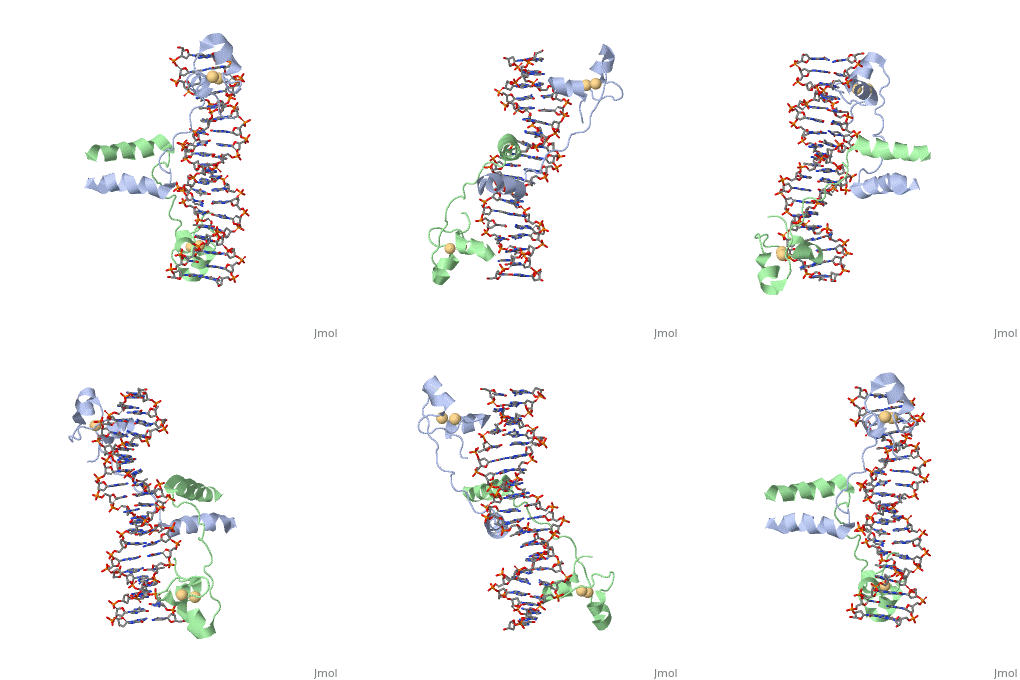
<StructureSection load='1d66' size='340' side='right' caption='Gal4 Transcription factor' scene=''> | <StructureSection load='1d66' size='340' side='right' caption='Gal4 Transcription factor' scene=''> | ||
| - | This is a default text for your page ''''''. Click above on '''edit this page''' to modify. Be careful with the < and > signs. | ||
| - | You may include any references to papers as in: the use of JSmol in Proteopedia <ref>DOI 10.1002/ijch.201300024</ref> or to the article describing Jmol <ref>PMID:21638687</ref> to the rescue. | ||
| - | + | A specific DNA complex of the 65-residue, N-terminal fragment of the yeast transcriptional activator, GAL4, has been analysed at 2.7 A resolution by X-ray crystallography. The protein binds as a dimer to a symmetrical 17-base-pair sequence. A small, Zn(2+)-containing domain recognizes a conserved CCG triplet at each end of the site through direct contacts with the major groove. A short coiled-coil dimerization element imposes 2-fold symmetry. A segment of extended polypeptide chain links the metal-binding module to the dimerization element and specifies the length of the site. The relatively open structure of the complex would allow another protein to bind coordinately with GAL4. | |
| - | == Disease == | ||
| - | == Relevance == | ||
| - | |||
| - | == Structural highlights == | ||
This is a sample scene created with SAT to <scene name="/12/3456/Sample/1">color</scene> by Group, and another to make <scene name="/12/3456/Sample/2">a transparent representation</scene> of the protein. You can make your own scenes on SAT starting from scratch or loading and editing one of these sample scenes. | This is a sample scene created with SAT to <scene name="/12/3456/Sample/1">color</scene> by Group, and another to make <scene name="/12/3456/Sample/2">a transparent representation</scene> of the protein. You can make your own scenes on SAT starting from scratch or loading and editing one of these sample scenes. | ||
Revision as of 13:29, 31 August 2021
| This Sandbox is Reserved from 09/01/2021 through 12/01/2021 for use in Che 462 taught by Ann Taylor at Wabash College, Crawfordsville, IN USA. This reservation includes Sandbox Reserved 1683 through Sandbox Reserved 1689. |
To get started:
More help: Help:Editing |
Zinc Finger
| |||||||||||