This old version of Proteopedia is provided for student assignments while the new version is undergoing repairs. Content and edits done in this old version of Proteopedia after March 1, 2026 will eventually be lost when it is retired in about June of 2026.
Apply for new accounts at the new Proteopedia. Your logins will work in both the old and new versions.
Gluconeogenesis
From Proteopedia
(Difference between revisions)
| Line 1: | Line 1: | ||
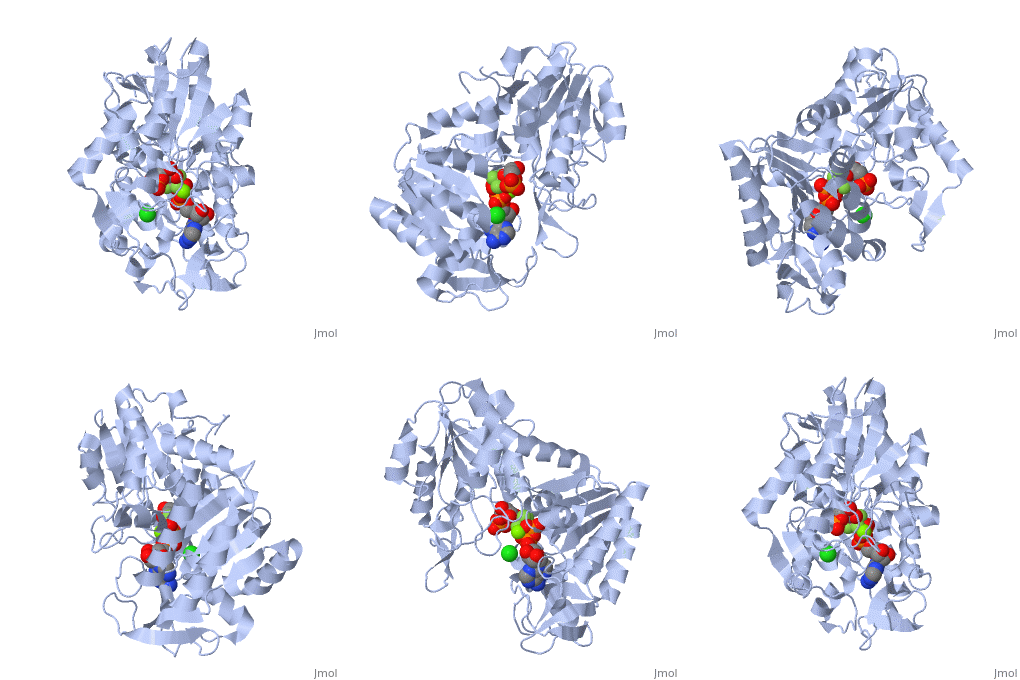
<StructureSection load='2y3i' size='350' side='right' scene='' caption='Human phosphoglycerate kinase complex with phosphoglyceric acid, ADP (stick model) AlF4-, Cl- and Mg+2 ions (green) (PDB code [[2y3i]])'> | <StructureSection load='2y3i' size='350' side='right' scene='' caption='Human phosphoglycerate kinase complex with phosphoglyceric acid, ADP (stick model) AlF4-, Cl- and Mg+2 ions (green) (PDB code [[2y3i]])'> | ||
| + | '''Under development!''' | ||
| + | |||
Gluconeogenesis is a metabolic pathway that results in the generation of glucose from certain non-carbohydrate carbon substrates. [[Phosphoglycerate Kinase|Phosphoglycerate kinase]] is an enzyme that catalyzes the reversible transfer of a phosphate group from 1,3-bisphosphoglycerate (1,3-BPG) to ADP producing 3-phosphoglycerate (3-PG) and ATP : | Gluconeogenesis is a metabolic pathway that results in the generation of glucose from certain non-carbohydrate carbon substrates. [[Phosphoglycerate Kinase|Phosphoglycerate kinase]] is an enzyme that catalyzes the reversible transfer of a phosphate group from 1,3-bisphosphoglycerate (1,3-BPG) to ADP producing 3-phosphoglycerate (3-PG) and ATP : | ||
Revision as of 11:37, 18 September 2022
| |||||||||||