This old version of Proteopedia is provided for student assignments while the new version is undergoing repairs. Content and edits done in this old version of Proteopedia after March 1, 2026 will eventually be lost when it is retired in about June of 2026.
Apply for new accounts at the new Proteopedia. Your logins will work in both the old and new versions.
Sandbox Reserved 1750
From Proteopedia
(Difference between revisions)
| Line 7: | Line 7: | ||
</table> | </table> | ||
== Function == | == Function == | ||
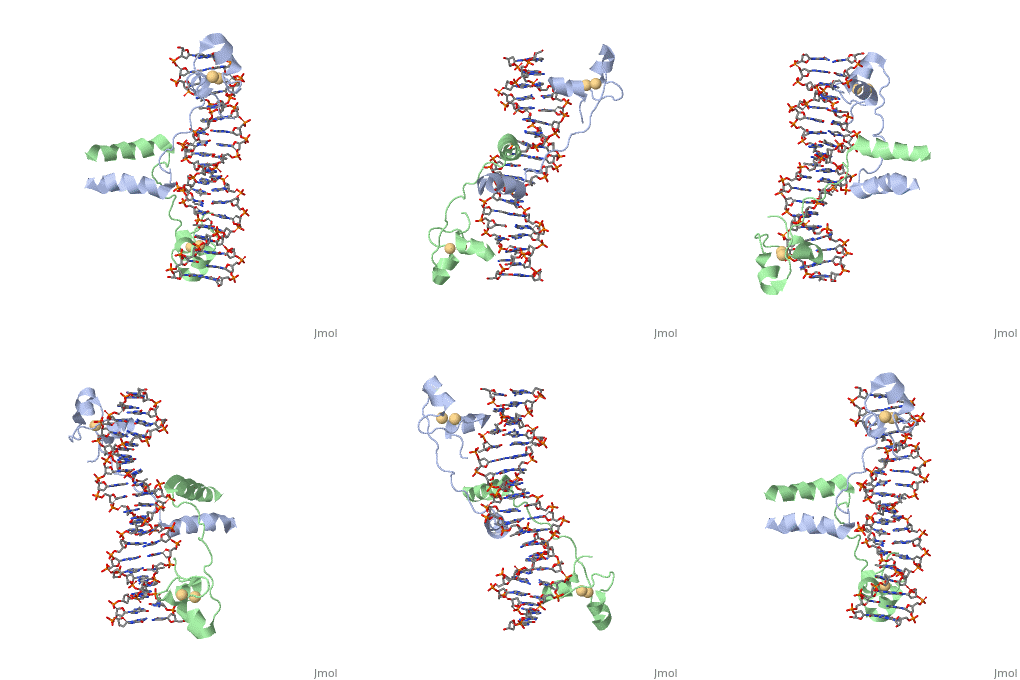
| - | [[https://www.uniprot.org/uniprot/GAL4_YEAST GAL4_YEAST]] This protein is a positive regulator for the gene expression of the galactose-induced genes such as GAL1, GAL2, GAL7, GAL10, and MEL1 which code for the enzymes used to convert galactose to glucose. It recognizes a 17 base pair sequence in (5'-CGGRNNRCYNYNCNCCG-3') the upstream activating sequence (UAS-G) of these genes. This sequence is correctly shown on the structure as (5'-CGGAGGACTGCCCTCCG-3'). <scene name='92/925538/Dna_protein_interaction/ | + | [[https://www.uniprot.org/uniprot/GAL4_YEAST GAL4_YEAST]] This protein is a positive regulator for the gene expression of the galactose-induced genes such as GAL1, GAL2, GAL7, GAL10, and MEL1 which code for the enzymes used to convert galactose to glucose. It recognizes a 17 base pair sequence in (5'-CGGRNNRCYNYNCNCCG-3') the upstream activating sequence (UAS-G) of these genes. This sequence is correctly shown on the structure as (5'-CGGAGGACTGCCCTCCG-3'). <scene name='92/925538/Dna_protein_interaction/3'>The DNA-Protein Interaction</scene> with all of the base pairs within 5 angstroms of the protein highlighted illustrates that the protein interacts with both strands of the UAS. |
== Evolutionary Conservation == | == Evolutionary Conservation == | ||
[[Image:Consurf_key_small.gif|200px|right]] | [[Image:Consurf_key_small.gif|200px|right]] | ||
| Line 20: | Line 20: | ||
<div style="background-color:#fffaf0;"> | <div style="background-color:#fffaf0;"> | ||
== Publication Abstract from PubMed == | == Publication Abstract from PubMed == | ||
| - | A specific DNA complex of the 65-residue, N-terminal fragment of the yeast transcriptional activator, GAL4, has been analysed at 2.7 A resolution by X-ray crystallography. The protein binds as a <scene name='92/925538/Dimer/2'>dimer</scene> to a symmetrical 17-base-pair sequence. There is a compact <scene name='92/925538/Metal_binding_domain/5'>metal binding domain</scene> (residues 8-40), an <scene name='92/925538/Extended_linker/ | + | A specific DNA complex of the 65-residue, N-terminal fragment of the yeast transcriptional activator, GAL4, has been analysed at 2.7 A resolution by X-ray crystallography. The protein binds as a <scene name='92/925538/Dimer/2'>dimer</scene> to a symmetrical 17-base-pair sequence. There is a compact <scene name='92/925538/Metal_binding_domain/5'>metal binding domain</scene> (residues 8-40), an <scene name='92/925538/Extended_linker/4'>extended linker</scene> (41-49), and an <scene name='92/925538/Alpha-helical_dimerization/2'>alpha-helical dimerization element</scene> (50-64). A small, Zn(2+)-containing domain recognizes a conserved CCG triplet at each end of the site through direct contacts with the major groove. The metal binding domain contains <scene name='92/925538/Cysteine_metal_binding/3'>cysteine residues</scene> that coordinate to the metal as shown as cadmium. A short coiled-coil dimerization element imposes 2-fold symmetry. A segment of extended polypeptide chain links the metal-binding module to the dimerization element and specifies the length of the site. The relatively open structure of the complex would allow another protein to bind coordinately with GAL4. |
DNA recognition by GAL4: structure of a protein-DNA complex.,Marmorstein R, Carey M, Ptashne M, Harrison SC Nature. 1992 Apr 2;356(6368):408-14. PMID:1557122<ref>PMID:1557122</ref> | DNA recognition by GAL4: structure of a protein-DNA complex.,Marmorstein R, Carey M, Ptashne M, Harrison SC Nature. 1992 Apr 2;356(6368):408-14. PMID:1557122<ref>PMID:1557122</ref> | ||
Revision as of 21:56, 19 September 2022
DNA RECOGNITION BY GAL4: STRUCTURE OF A PROTEIN/DNA COMPLEX
| |||||||||||