We apologize for Proteopedia being slow to respond. For the past two years, a new implementation of Proteopedia has been being built. Soon, it will replace this 18-year old system. All existing content will be moved to the new system at a date that will be announced here.
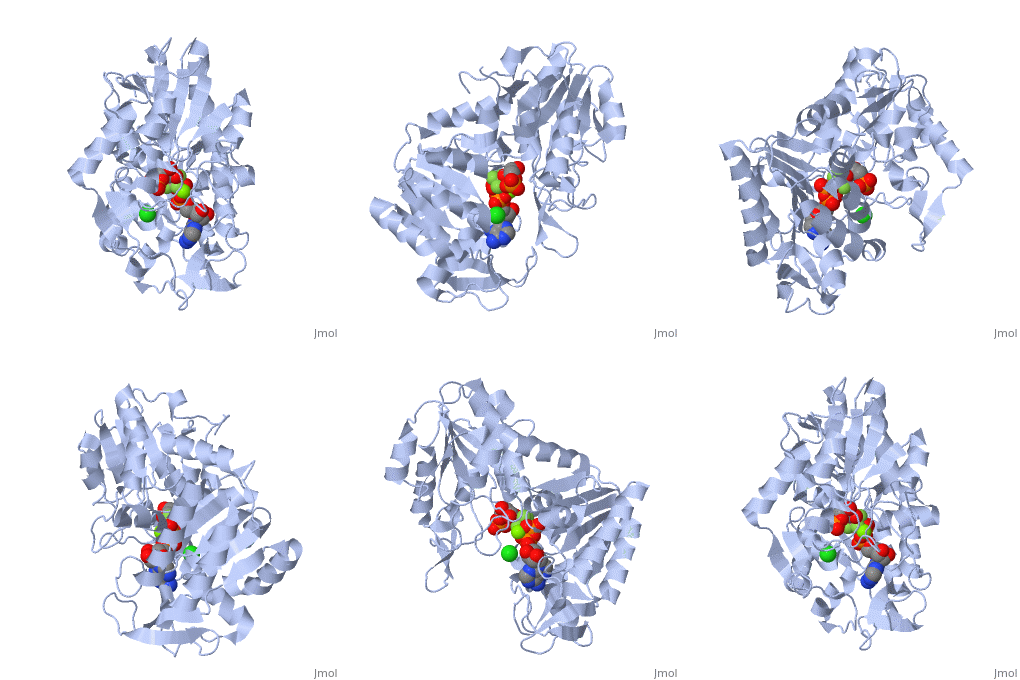
Gluconeogenesis
From Proteopedia
(Difference between revisions)
| Line 33: | Line 33: | ||
Odd-chain fatty acids can be oxidized to yield <scene name='43/430893/Cv/2'>Acetyl-CoA</scene> and <scene name='92/925544/Cv/4'>Propionyl-CoA</scene>, the latter serving as a precursor to <scene name='43/430893/Cv/9'>Succinyl-CoA</scene>, which can be converted to <scene name='39/392339/Cv1/11'>pyruvate</scene> and enter into gluconeogenesis. In contrast, even-chain fatty acids are oxidized to yield only acetyl-CoA, whose entry into gluconeogenesis requires the presence of a [[glyoxylate cycle]] (also known as glyoxylate shunt) to produce four-carbon dicarboxylic acid precursors. | Odd-chain fatty acids can be oxidized to yield <scene name='43/430893/Cv/2'>Acetyl-CoA</scene> and <scene name='92/925544/Cv/4'>Propionyl-CoA</scene>, the latter serving as a precursor to <scene name='43/430893/Cv/9'>Succinyl-CoA</scene>, which can be converted to <scene name='39/392339/Cv1/11'>pyruvate</scene> and enter into gluconeogenesis. In contrast, even-chain fatty acids are oxidized to yield only acetyl-CoA, whose entry into gluconeogenesis requires the presence of a [[glyoxylate cycle]] (also known as glyoxylate shunt) to produce four-carbon dicarboxylic acid precursors. | ||
| + | '''Pathway''' | ||
| + | |||
| + | '''1)''' Gluconeogenesis begins in the mitochondria with the formation of oxaloacetate by the carboxylation of pyruvate. This reaction also requires one molecule of ATP, and is catalyzed by [[pyruvate carboxylase]]. This enzyme is stimulated by high levels of acetyl-CoA (produced in β-oxidation in the liver) and inhibited by high levels of ADP and glucose. | ||
| + | |||
| + | [[Pyruvate carboxylase]]: <scene name='39/392339/Cv1/11'>Pyruvate</scene> => <scene name='43/430893/Cv/3'>Oxaloacetate</scene> | ||
</StructureSection> | </StructureSection> | ||
== References == | == References == | ||
<references/> | <references/> | ||
Revision as of 15:18, 28 November 2022
| |||||||||||
References
- ↑ Dunten P, Belunis C, Crowther R, Hollfelder K, Kammlott U, Levin W, Michel H, Ramsey GB, Swain A, Weber D, Wertheimer SJ. Crystal structure of human cytosolic phosphoenolpyruvate carboxykinase reveals a new GTP-binding site. J Mol Biol. 2002 Feb 15;316(2):257-64. PMID:11851336 doi:http://dx.doi.org/10.1006/jmbi.2001.5364
