Under development!
Gluconeogenesis ([1]) is a metabolic pathway that results in the generation of glucose from certain non-carbohydrate carbon substrates. In humans the main gluconeogenic precursors are lactate, (which is a part of the triglyceride molecule), alanine and glutamine. Other glucogenic amino acids and all Citric Acid Cycle intermediates (through conversion to oxaloacetate) can also function as substrates for gluconeogenesis.
is transported back to the liver where it is converted into by the Cori cycle using the enzyme lactate dehydrogenase. . Pyruvate, the first designated substrate of the gluconeogenic pathway, can then be used to generate glucose.
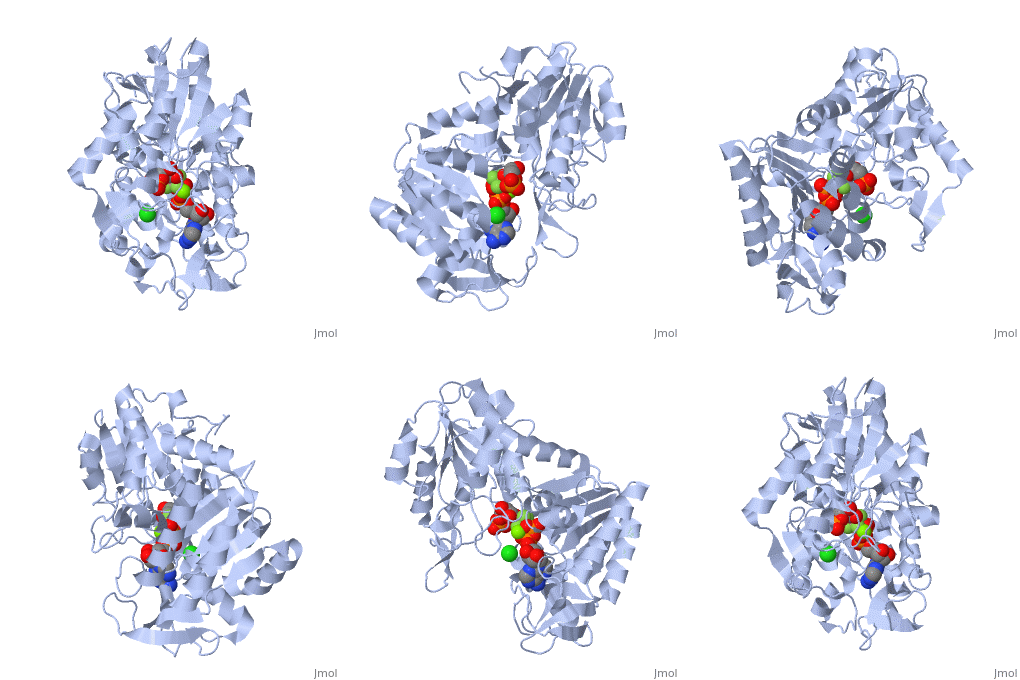
Phosphoglycerate kinase is an enzyme that catalyzes the reversible transfer of a phosphate group from to ADP producing and ATP:
1,3-bisphosphoglycerate + ADP ⇌ glycerate 3-phosphate + ATP
Like all kinases it is a transferase. PGK is a major enzyme used in glycolysis, in the first ATP-generating step of the glycolytic pathway. In gluconeogenesis, the reaction catalyzed by PGK proceeds in the opposite direction, generating ADP and 3-phosphoglycerate (3-PG).
Catabolism of amino acids, Citric Acid Cycle and Gluconeogenesis
1) , cysteine, glycine, serine, tryptophan, threonine =>
2) Tryptophan, threonine, phenylalanine, tyrosine, isoleucine, leucine, lysine =>
3) Arginine, histidine, glutamine, proline => glutamate =>
4) Threonine, methionine, isoleucine, valine => 4C chain (CoA excluded)
5) Tyrosine, phenylalanine, aspartate =>
6) Aspartate, asparagine => =>
[by Phosphoenolpyruvate carboxykinase] (PEP) => ... =>
The location of the enzyme that links these two parts of gluconeogenesis by converting oxaloacetate to PEP – PEP carboxykinase (PEPCK) – is variable by species: it can be found entirely within the mitochondria, entirely within the cytosol, or dispersed evenly between the two, as it is in humans. E. coli GTP-driven PEPCK is located in a pocket at the enzyme surface[1]. Water molecules are shown as red spheres.
Fatty acids
Odd-chain fatty acids can be oxidized to yield and , the latter serving as a precursor to , which can be converted to and enter into gluconeogenesis. In contrast, even-chain fatty acids are oxidized to yield only acetyl-CoA, whose entry into gluconeogenesis requires the presence of a glyoxylate cycle (also known as glyoxylate shunt) to produce four-carbon dicarboxylic acid precursors.
Pathway
1) Gluconeogenesis begins in the mitochondria with the formation of oxaloacetate by the carboxylation of pyruvate. This reaction also requires one molecule of ATP, and is catalyzed by pyruvate carboxylase. This enzyme is stimulated by high levels of acetyl-CoA (produced in β-oxidation in the liver) and inhibited by high levels of ADP and glucose.
Pyruvate carboxylase: =>
2) Oxaloacetate is reduced to using NADH, a step required for its transportation out of the mitochondria.
3) Malate is oxidized to oxaloacetate using NAD+ in the cytosol, where the remaining steps of gluconeogenesis take place.
4) is decarboxylated and then phosphorylated to form using the enzyme PEPCK. A molecule of GTP is hydrolyzed to GDP during this reaction.
The next steps in the reaction are the same as reversed glycolysis. However, fructose 1,6-bisphosphatase converts to , using one water molecule and releasing one phosphate (in glycolysis, phosphofructokinase 1 converts F6P and ATP to F1,6BP and ADP). This is also the rate-limiting step of gluconeogenesis.
is formed from by phosphoglucoisomerase (the reverse of step 2 in glycolysis). Glucose-6-phosphate can be used in other metabolic pathways or dephosphorylated to free glucose.
The final gluconeogenesis, the formation of glucose, occurs in the lumen of the endoplasmic reticulum, where is hydrolyzed by glucose-6-phosphatase to produce and release an inorganic phosphate.