We apologize for Proteopedia being slow to respond. For the past two years, a new implementation of Proteopedia has been being built. Soon, it will replace this 18-year old system. All existing content will be moved to the new system at a date that will be announced here.

Sandbox Home

From Proteopedia

(Difference between revisions)
Jump to: navigation, search
Line 1: Line 1:
 +
<style>
 +
#tableColumnsMainPage td { vertical-align: top !important; }
 +
</style>
<table id="tableColumnsMainPage" style="width:100%; border:2px solid #ddd; border-collapse:collapse; table-layout:fixed;">
<!-- HEADER -->
<!-- HEADER -->

Revision as of 16:01, 30 September 2025

<style>

 #tableColumnsMainPage td { vertical-align: top !important; }

</style>

ISSN 2310-6301
     
       As life is more than 2D, Proteopedia helps to bridge the gap between 3D structure & function of biomacromolecules
     
     
       Proteopedia presents this information in a user-friendly way as a collaborative & free 3D-encyclopedia of proteins & other biomolecules.
     
Selected Research Pages In Journals Education
About this image
BREAKTHROUGH in protein structure prediction!

by Eric Martz
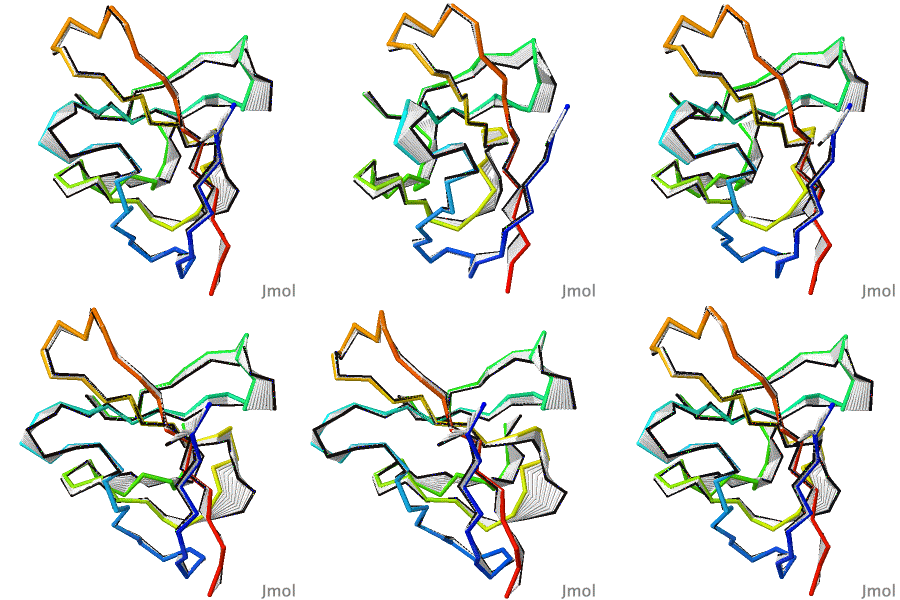
After decades of slow progress by many groups, in 2020, AlphaFold2 proved able to accurately predict the detailed structures of two-thirds of single protein domains from their amino acid sequences. Pictured is AlphaFold2's prediction for the ORF8 protein of SARS-CoV-2 (black), compared with a subsequently published X-ray crystallographic structure (colors). ORF8 contributes to virulence in COVID-19.
>>> Visit this page >>>

About this image
Geobacter pili: surprising function.

Y Gu, V Srikanth, AI Salazar-Morales, R Jain, JP O'Brien, SM Yi, RK Soni, FA Samatey, SE Yalcin, NS Malvankar. Nature 2021 doi: 10.1038/s41586-021-03857-w
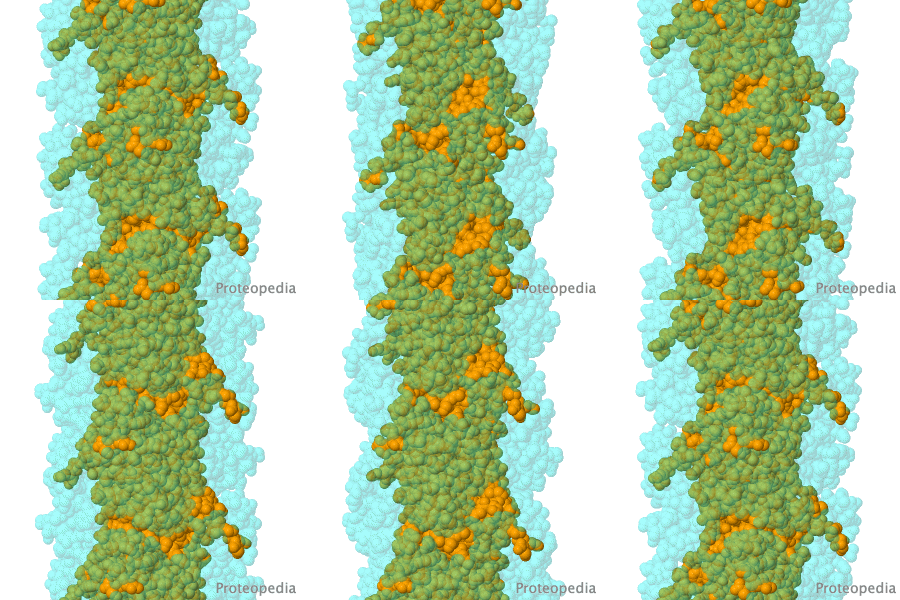
Geobacter pili were long thought to be electrically conductive protein nanowires composed of PilA-N. Nanowires are crucial to the energy metabolism of bacteria flourishing in oxygen-deprived environments. To everyone's surprise, in 2019, the long-studied nanowires were found to be linear polymers of multi-heme cytochromes, not pili. The first cryo-EM structure of pili (2021) reveals a filament made of dimers of PilA-N and PilA-C, shown. Electrical conductivity of pili is much lower than that of cytochrome nanowires. Evidence suggests that PilA-NC filaments are periplasmic pseudopili crucial for exporting cytochrome nanowires onto the cell surface, rather than the pili serving as nanowires themselves.

>>> Visit I3DC Interactive Visualizations >>>

About this image
Make Your Own Electrostatic Potential Maps

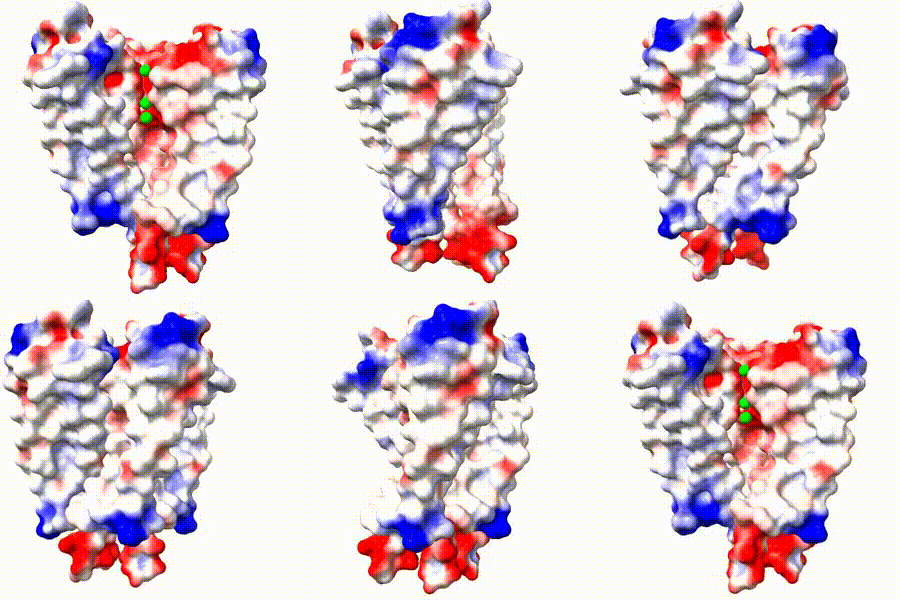
Positive (+) and Negative (-) charges on the surface of a protein molecule play crucial roles in its interactions with other molecules, and hence in its functions. Electrostatic potential maps coloring the surface of a protein molecule are a popular way to visualize the distribution of surface charges. Easy to use free software is available to to create these surface maps. Above is an integral membrane potassium channel protein. One of its 4 identical chains is removed so you can see the Negative (-) protein surface contacting the 3 K+ ions.

>>> See Examples and Get Instructions >>>

About Contact Hot News Table of Contents Structure Index Help
Personal tools