This old version of Proteopedia is provided for student assignments while the new version is undergoing repairs. Content and edits done in this old version of Proteopedia after March 1, 2026 will eventually be lost when it is retired in about June of 2026.
Apply for new accounts at the new Proteopedia. Your logins will work in both the old and new versions.
High school teachers' resources
From Proteopedia
(→Within Proteopedia - added link to Help:Quiz) |
(→Macromolecules for High School Curricula) |
||
| Line 64: | Line 64: | ||
| [http://www.umass.edu/molvis/bme3d/materials/explore.html#LipidBilayers Lipid Bilayers and Channels: Cell Structure] | | [http://www.umass.edu/molvis/bme3d/materials/explore.html#LipidBilayers Lipid Bilayers and Channels: Cell Structure] | ||
| | | | ||
| - | | | + | | [[Gramicidin Channel in Lipid Bilayer]] [[Image:New_yellow1.gif]] |
| | | | ||
|- | |- | ||
Revision as of 19:30, 5 March 2010


Below are listed resources for high school (secondary school) teachers that concern 3D macromolecular structure, both within Proteopedia and outside it. High school teachers typically teach students of ages about 14-18. Some of the resources listed here are also appropriate for younger students (K-12), or older students including adults.
| HighSchool.MolviZ.Org brings you here! |
Macromolecules for High School Curricula
These molecules fit nicely into most secondary school biology curricula.
| Molecule | At BioMolecular Explorer 3D | At Molecule of the Month | At Proteopedia | See Also |
|---|---|---|---|---|
| Antibody | Antibody: Immune System | Antibodies | ||
| Collagen | Collagen: Connective Tissue | Collagen | ||
| DNA | DNA: Genetic Inheritance | DNA | DNA | |
| Hemoglobin | Hemoglobin: Respiration | Hemoglobin | Hemoglobin | |
| HIV Protease | HIV Protease: Infectious Diseases - AIDS Virus | HIV-1 Protease | HIV-1 Protease | |
| Lactase | Lactase: Digestion | (cf. Pepsin, | ||
| Lipid Bilayers | Lipid Bilayers and Channels: Cell Structure | Gramicidin Channel in Lipid Bilayer 
| ||
| Myosin | Myosin: A Molecular Motor | Myosin | ||
| Nucleosomes | Nucleosomes: Chromosome Structure | Nucleosome | Nucleosome |
Within Proteopedia

- About Macromolecular Structure lists articles that explain and define many macromolecular structure concepts, including biological units, hydrogen bonds, ligands, peptide, Protein Data Bank and PDB identification codes, and resolution.
- Importance of 3D macromolecular structure:
- Highest impact structures of all time.
- Structures saving the most lives.
- Molecular Workbench, ready-to-use discovery-based learning activities, at the high school level, with built-in assessment.
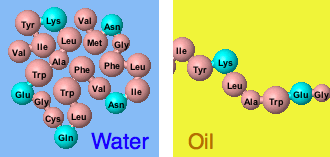  Protein folding simulations in Molecular Workbench. Click image for details. |
- SMART Teams consist of high school teachers and their students, collaborating with scientists to use rapid-prototyping technology to make 3D physical models of macromolecules. Recently, they are also making articles in Proteopedia, for example:
- A Physical Model of the β2-Adrenergic Receptor, from the Madison West High School 2008 SMART Team.
- Teaching Scenes, Tutorials, and Educators' Pages, including
- Lac repressor with morphs of DNA being bent.
- Avian Influenza Neuraminidase, Tamiflu and Relenza
- Teaching Strategies Using Proteopedia
- Quizzes within Proteopedia
Outside Proteopedia
- Biomodel, 3D molecular visualization resources on many topics, also en español and other languages.
- BioMolecular Explorer 3D (bme3d.molviz.org). In addition to the molecules listed above, BME3D includes sections on carbohydrates, protein, lipids, vitamins, and water.

- K-12 Resources at molvisindex.org, the World Index of Molecular Visualization Resources. Includes how to make DNA earrings, and balloon molecules.
- Molecule of the Month. Illustrated introductory articles on over one hundred macromolecules. Interactive 3D visualization is available in the most recent articles.
- MolviZ.Org includes the Top Five Molecular Visualization Resources, an illustrated Atlas of Macromolecules, a tutorial on collagen, a tool for exploring any macromolecule (FirstGlance in Jmol), tools for visualizing evolutionarily conserved patches on the surfaces of protein molecules, Toobers, physical molecular models, and more.
