This old version of Proteopedia is provided for student assignments while the new version is undergoing repairs. Content and edits done in this old version of Proteopedia after March 1, 2026 will eventually be lost when it is retired in about June of 2026.
Apply for new accounts at the new Proteopedia. Your logins will work in both the old and new versions.
Colicin
From Proteopedia
| Line 1: | Line 1: | ||
{{STRUCTURE_2k5x | PDB=2k5x | SCENE= }} | {{STRUCTURE_2k5x | PDB=2k5x | SCENE= }} | ||
| - | + | Colicins are a type of bacteriocin - peptide and protein antibiotics released by bacteria to kill other bacteria of the same species. Bacteriocins are named after their species of origin; colicins are so-called because they are produced by <i>E. Coli</i><ref>PMID: 17347522 </ref>. Because of their narrow killing spectrum which focuses primarily on the species which has made the peptide, bacteriocins are important in microbial biodiversity and the stable co-existence of the bacterial populations. | |
| - | Colicins are a type of bacteriocin - peptide and protein antibiotics released by bacteria to kill other bacteria of the same species. Bacteriocins are named after their species of origin; colicins are so-called because they are produced by <i>E. Coli</i>. Because of their narrow killing spectrum which focuses primarily on the species which has made the peptide, bacteriocins are important in microbial biodiversity and the stable co-existence of the bacterial populations. | + | |
Colicin peptides are plasmid-encoded. The peptide is released by the cell into the area surrounding it, and then parasitises proteins present in the host cell membrane to translocate across into the host cell. Many protein-protein interactions are involved in the cell entry, and the main system is involved in the grouping of colicins into two families: Group A colicins use the Tol system to enter the host cell, and Group B use the Ton system. Once inside the host cell, the cell killing follows 1st order kinetics - ie one molecule is theoretically sufficient to kill the cell. | Colicin peptides are plasmid-encoded. The peptide is released by the cell into the area surrounding it, and then parasitises proteins present in the host cell membrane to translocate across into the host cell. Many protein-protein interactions are involved in the cell entry, and the main system is involved in the grouping of colicins into two families: Group A colicins use the Tol system to enter the host cell, and Group B use the Ton system. Once inside the host cell, the cell killing follows 1st order kinetics - ie one molecule is theoretically sufficient to kill the cell. | ||
| Line 9: | Line 8: | ||
<br>The Receptor binding domain is at the centre of the peptide (R-) | <br>The Receptor binding domain is at the centre of the peptide (R-) | ||
<br>The C terminus contains the Cytotoxic domain (C-). | <br>The C terminus contains the Cytotoxic domain (C-). | ||
| + | <br> | ||
==Synthesis and Production== | ==Synthesis and Production== | ||
| Line 29: | Line 29: | ||
! Colicin !! Group !! OM Receptor !! Translocation Proteins !! Cytotoxic activity | ! Colicin !! Group !! OM Receptor !! Translocation Proteins !! Cytotoxic activity | ||
|- | |- | ||
| - | | | + | | [[Colicin A]] || A || BtuB || OmpF/TolQRAB || Pore-forming |
|- | |- | ||
| - | | | + | | [[Colicin E1]] || A || BtuB || TolC/TolAQ || Pore-forming |
|- | |- | ||
| - | | | + | | [[Colicin E2]] || A || BtuB || OmpF/TolQRAB || DNase |
|- | |- | ||
| - | | | + | | [[Colicin E3]] || A || BtuB || OmpF/TolQRAB || 16s rRNase |
|- | |- | ||
| - | | | + | | [[Colicin E4]] || A || BtuB || OmpF/TolQRAB || 16s rRNase |
|- | |- | ||
| Col E5 || A || BtuB || OmpF/TolQRAB || tRNase | | Col E5 || A || BtuB || OmpF/TolQRAB || tRNase | ||
| Line 88: | Line 88: | ||
|} | |} | ||
| + | |||
| + | |||
| + | ==References== | ||
| + | <references/> | ||
Revision as of 11:50, 4 December 2010
| |||||||||
| 2k5x, 1 NMR models () | |||||||||
|---|---|---|---|---|---|---|---|---|---|
| Gene: | imm, ceiE9 (Escherichia coli), col, cei (Escherichia coli) | ||||||||
| Related: | 1imq, 1fsj, 1emv | ||||||||
| |||||||||
| |||||||||
| Resources: | FirstGlance, OCA, PDBsum, RCSB | ||||||||
| Coordinates: | save as pdb, mmCIF, xml | ||||||||
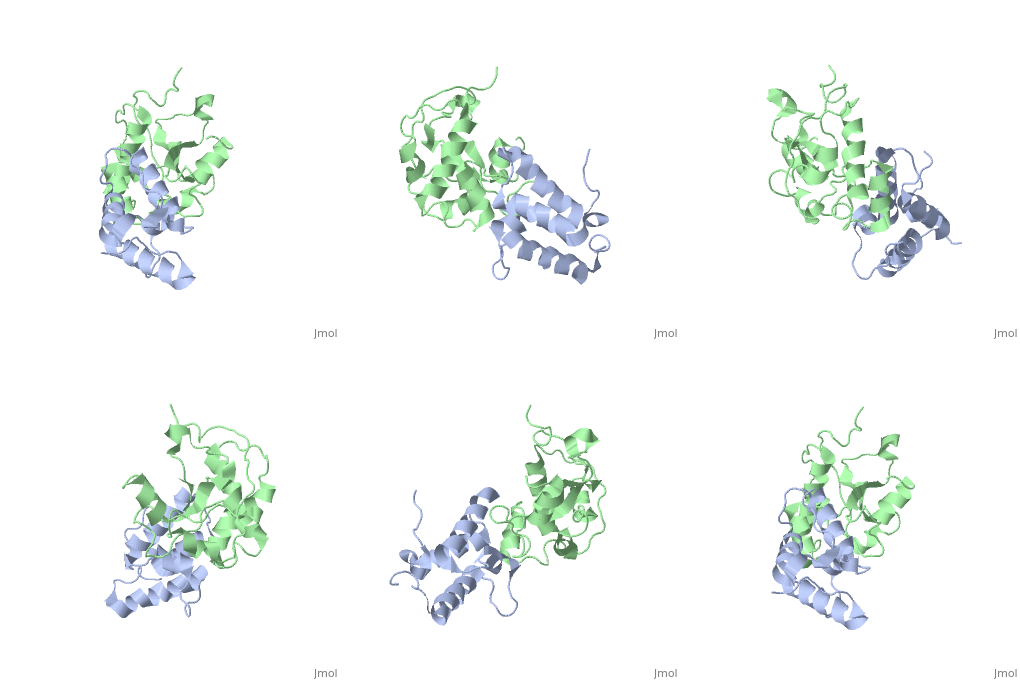

Colicins are a type of bacteriocin - peptide and protein antibiotics released by bacteria to kill other bacteria of the same species. Bacteriocins are named after their species of origin; colicins are so-called because they are produced by E. Coli[1]. Because of their narrow killing spectrum which focuses primarily on the species which has made the peptide, bacteriocins are important in microbial biodiversity and the stable co-existence of the bacterial populations.
Colicin peptides are plasmid-encoded. The peptide is released by the cell into the area surrounding it, and then parasitises proteins present in the host cell membrane to translocate across into the host cell. Many protein-protein interactions are involved in the cell entry, and the main system is involved in the grouping of colicins into two families: Group A colicins use the Tol system to enter the host cell, and Group B use the Ton system. Once inside the host cell, the cell killing follows 1st order kinetics - ie one molecule is theoretically sufficient to kill the cell.
The structure of all colicins, of which over 20 have been identified, follows a 3 domain design:
At the N terminus is the Translocation domain (T-)
The Receptor binding domain is at the centre of the peptide (R-)
The C terminus contains the Cytotoxic domain (C-).
Contents |
Synthesis and Production
Release
Targeting and Receptors
Colicin Uptake
Killing Activities
| Colicin | Group | OM Receptor | Translocation Proteins | Cytotoxic activity |
|---|---|---|---|---|
| Colicin A | A | BtuB | OmpF/TolQRAB | Pore-forming |
| Colicin E1 | A | BtuB | TolC/TolAQ | Pore-forming |
| Colicin E2 | A | BtuB | OmpF/TolQRAB | DNase |
| Colicin E3 | A | BtuB | OmpF/TolQRAB | 16s rRNase |
| Colicin E4 | A | BtuB | OmpF/TolQRAB | 16s rRNase |
| Col E5 | A | BtuB | OmpF/TolQRAB | tRNase |
| Col E6 | A | BtuB | OmpF/TolQRAB | 16s rRNase |
| Col E7 | A | BtuB | OmpF/TolQRAB | DNase |
| Col E8 | A | BtuB | OmpF/TolQRAB | DNase |
| Col E9 | A | BtuB | OmpF/TolQRAB | DNase |
| Col N | A | OmpF | OmpF/TolQRA | Pore-forming |
| Col S4 | A | OmpW | OmpF/TolQRAB | Pore-forming |
| Col K | A | Tsx | OmpF/TolQRAB | Pore-forming |
| Cloacin DF 13 | A | lutA | TolQRA | 16s rRNase |
| Col U | A | ? | OmpAF, TolQRAB | Pore-forming |
| Col 5 | B | Tsx | TolC/TonB, ExbBD | Pore-forming |
| Col 6 | B | Tsx | TolC/TonB, ExbBD | Pore-forming |
| Col 7 | B | Tsx | TolC/TonB, ExbBD | Pore-forming |
| Col 8 | B | Tsx | TolC/TonB, ExbBD | Pore-forming |
| Col 9 | B | Tsx | TolC/TonB, ExbBD | Pore-forming |
| Col 10 | B | Tsx | TolC/TonB, ExbBD | Pore-forming |
| Col-la | B | Cir | Cir/TonB, ExbBD | Pore-forming |
| Col-lb | B | Cir | Cir/TonB, ExbBD | Pore-forming |
| Col B | B | FepA | ?/TonB, ExbBD | Pore-forming |
| Col D | B | FepA | ?/TonB, ExbBD | tRNase |
| Col M | B | FhuA | ?/TonB, ExbBD | Inhibition of PG synthesis |
| Col V | B | Cir? | TonB, ExbB | Disruption of membrane potential |
| Col Js | B | CjrBC | ExbBD, VirB | ? |
| Col Y | ? | ? | ? | Pore-forming |
References
- ↑ Cascales E, Buchanan SK, Duche D, Kleanthous C, Lloubes R, Postle K, Riley M, Slatin S, Cavard D. Colicin biology. Microbiol Mol Biol Rev. 2007 Mar;71(1):158-229. PMID:17347522 doi:10.1128/MMBR.00036-06
Proteopedia Page Contributors and Editors (what is this?)
Michal Harel, Gemma McGoldrick, Alexander Berchansky, Jaime Prilusky
