This old version of Proteopedia is provided for student assignments while the new version is undergoing repairs. Content and edits done in this old version of Proteopedia after March 1, 2026 will eventually be lost when it is retired in about June of 2026.
Apply for new accounts at the new Proteopedia. Your logins will work in both the old and new versions.
Sandbox Reserved 384
From Proteopedia
(Difference between revisions)
| Line 4: | Line 4: | ||
*[[User:LoganBrushart/Sandbox reserved 384]] | *[[User:LoganBrushart/Sandbox reserved 384]] | ||
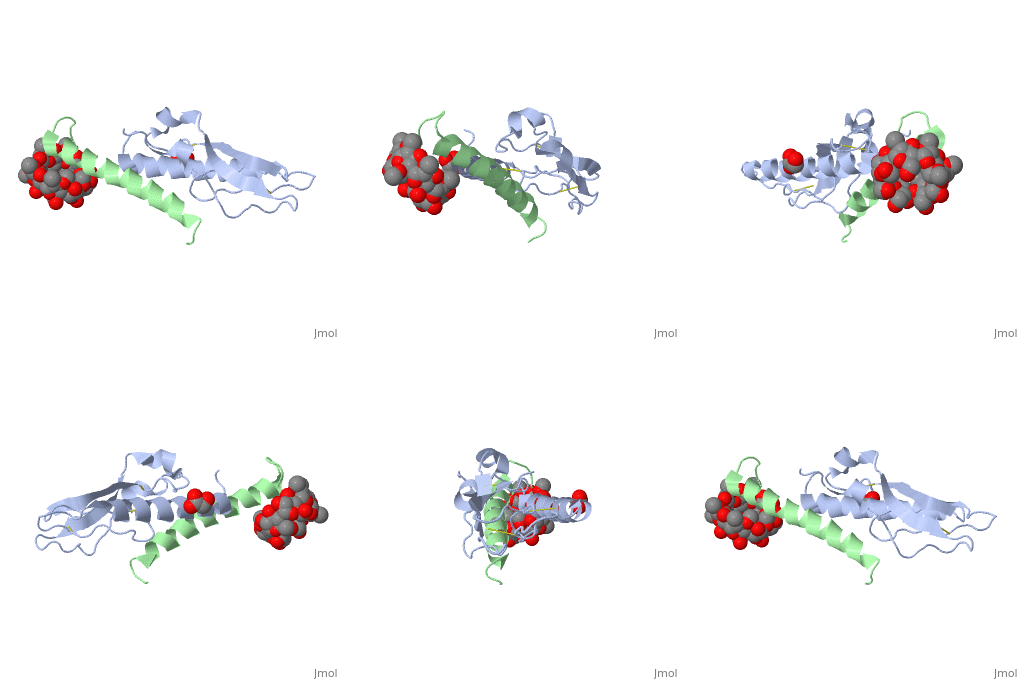
| - | <Structure load='2qkh' size='400' frame='true' align='right' caption='Glucose-dependant insulinotropic polypeptide receptor, [[2qkh]]' scene='' /> | + | <Structure load='2qkh' size='400' frame='true' align='right' caption='Glucose-dependant insulinotropic polypeptide receptor, [[2qkh]]' scene='<scene name='Sandbox_Reserved_384/Standard_scene/1'>TextToBeDisplayed</scene>' /> |
<!-- | <!-- | ||
{{STRUCTURE_2qkh| PDB=2qkh | SIZE=400| SCENE= |right|CAPTION=Glucose-dependent insulinotropic polypeptide receptor, [[2qkh]] }} | {{STRUCTURE_2qkh| PDB=2qkh | SIZE=400| SCENE= |right|CAPTION=Glucose-dependent insulinotropic polypeptide receptor, [[2qkh]] }} | ||
| Line 13: | Line 13: | ||
===Molecular Function=== | ===Molecular Function=== | ||
| - | The purpose of the receptor is to bind Glucose-dependent insulinotropic polypeptide (GIP) in the presence of Glucose. This causes a chain reaction that increases secretion of insulin molecules. GIP binds to GIPR though<scene name='Sandbox_Reserved_384/Hydrophobics/1'>hydrophobic interactions</scene> and causes the release of G protein-coupled receptors which in turn causes an enzymatic cascade resulting in the increased secretion of insulin. This occurs in the pancreatic islet beta-cells. It is likely that the cause of type 2 diabetes is due to the inability of GIP to bind properly to GIPR.<ref>PMID:11334402</ref> | + | The purpose of the receptor is to bind Glucose-dependent insulinotropic polypeptide (GIP) in the presence of Glucose. This causes a chain reaction that increases secretion of insulin molecules. GIP binds to GIPR though <scene name='Sandbox_Reserved_384/Hydrophobics/1'>hydrophobic interactions</scene> and causes the release of G protein-coupled receptors which in turn causes an enzymatic cascade resulting in the increased secretion of insulin. This occurs in the pancreatic islet beta-cells. It is likely that the cause of type 2 diabetes is due to the inability of GIP to bind properly to GIPR.<ref>PMID:11334402</ref> |
===Ongoing Research=== | ===Ongoing Research=== | ||
Revision as of 21:49, 30 November 2011
| This Sandbox is Reserved from September 14, 2021, through May 31, 2022, for use in the class Introduction to Biochemistry taught by User:John Means at the University of Rio Grande, Rio Grande, OH, USA. This reservation includes 5 reserved sandboxes (Sandbox Reserved 1590 through Sandbox Reserved 1594). |
To get started:
More help: Help:Editing. For an example of a student Proteopedia page, please see Photosystem II, Tetanospasmin, or Guanine riboswitch. |
| |||||||||||