Introduction
Two well-known orthologues of the Homo sapiens T protein are present in mice (Brachyury) and Xenopus laevis (Xbra). The homologue of T in mice, Brachyury, was the first T-box crystal structure to be determined.
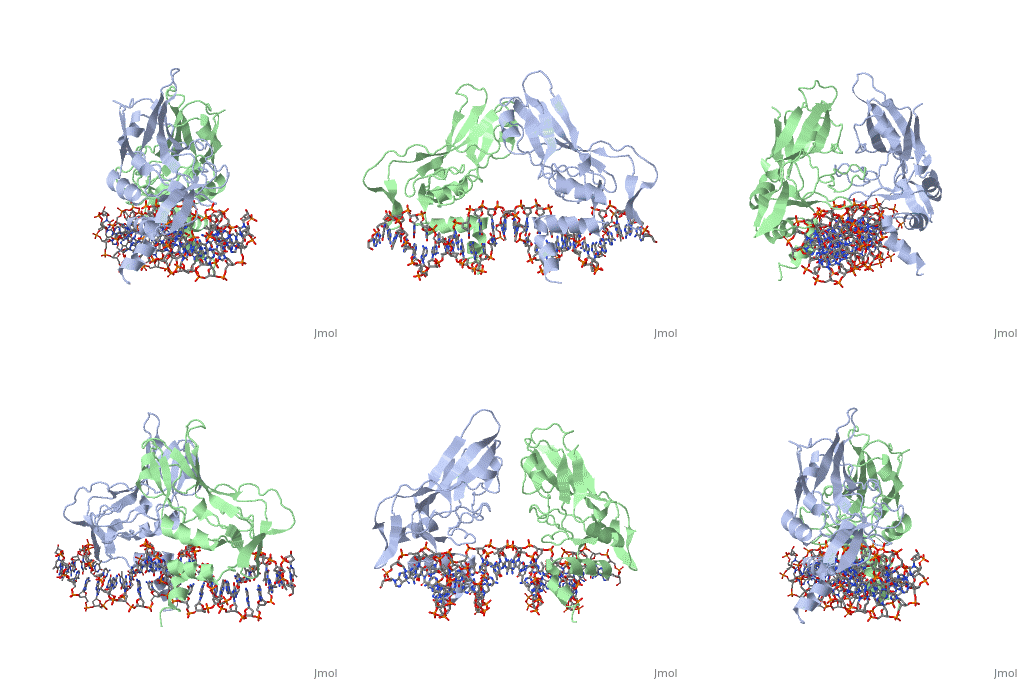
Crystal structure (1xbr)
The T-box region of the Brachyury protein was crystallised with a 24 bp palindromic DNA duplex as determined by in vitro PCR-based binding selection. It crystallised as a dimer; in one monomer residues 39-221 were visible out of a total of 226 residues, and in the other residues 39-222 were visible. Both monomers were bound to the DNA (unlike in the structure of TBX5) and interacted through a poorly conserved region of 250 Å2. The N-terminus of 38 residues and C-terminus of 4 residues were disordered in the crystal structure. Nevertheless, the crystallographic structure agrees with DNA footprinting experiments in terms of which bases are protected by the protein.
The core of the monomer is a seven-stranded β-barrel structure reminiscent of the immunoglobulin fold. Hence the T protein belongs to the superfamily of Ig-domain transcription factors. Strand D of the seven-stranded β-barrel is replaced by helix H2, and the strand-connecting regions also contain α-helices. The C-terminal amino acids are α-helical in structure, unlike TBX3 and TBX5 where they form a 310 helix. The dimer interface is mainly formed by the ends of strand C' of both proteins.
Dimer interface
Residues Pro125, Asp126 and Pro128 from both monomers are bridged by water molecules and the nitrogen of Asn129 forms a hydrogen-bond to Ser127 of the other subunit. To stabilise the structure a hydrophobic patch formed by Pro128, Phe130 and assisted by Met85 and Val173 exists between the two monomers. Some types of T-box proteins have exchanged amino acids for Met85 (Lys, Arg, His), Val173 (Ala) and Phe130 (Thr) which may not undergo dimer formation.
The Brachyury protein is a monomer in solution and thus only dimerises when in contact with DNA. This is supported by the fact that the contact area is only 250 Å2. Antibodies stabilise the dimer on the DNA, however the molecular mechanism of this is unknown: it is possible that the antibodies stabilise the dimer contacts when present on the DNA.
Structural aspects of DNA binding
The loops between the β strands make the important contacts with the DNA. 11 amino acids make polar contacts with the DNA, mainly in the minor groove. Helix H3 and H4 recognise the DNA in the minor groove, where H3 bridges the DNA backbone and is positioned by Tyr196/Asn209 contacts with the phosphates on the edges and hydrophobic contacts between guanine ribose and Ile206 in the middle. H4 points into the minor groove with hydrphobic contacts to base edges/backbone sugars and hydrogen bonds between the Phe211 carbonyl group and N2 of guanine. Note that it can be any amino acid which fills this position (i.e., not conserved), however only guanine is recognised.
It is important to note that H3/H4 is not a helix-turn-helix motif. The angle between the helices is 90° (HTH motifs: 120°) and there are 2 amino acids in the loop (HTH motifs: 4), and it interacts in the minor groove (HTH motifs interact in the major groove). The T-domain is very similar to the NF-κB p50, and superimposing these shows the major groove recognition carried out by arginines in both cases. Arginine recognition of the major groove is also present in other T-box proteins such as TBX5.
Structure of the DNA in the Brachyury-DNA complex
The DNA adopted a B-like conformation with a rise of 3.3 Å, and 10.5 residues per turn (very similar to usual B-form values). The minor groove is enlarged but the DNA remains unbent: the phosphate-phosphate distances are usually 5.7 Å in the B-DNA conformation, but in this case it expands to 10 Å. However, there is no bend unlike in the binding of other transcription factors such as the TATA box binding protein.
Functions and pathways of T protein
The best characterised targets of the Xbra or T protein are the Xenopus embryonic fibroblast growth factor (eFGF, of which the mammalian homologue is FGF-4) and the Brachyury-induced homeobox-containing genes (Bix1, Bix2, Bix3 and Bix4).
Known malfunctional mutations
The Xenopus laevis homologue of Brachyury, Xbra, has a known mutation of Lys149 which destroys DNA-binding activity. This is equivalent to Asn155 and Asn353 of Eomes and VegT respectively.
Additional Resources
For additional information, see: Transcription and RNA Processing