This old version of Proteopedia is provided for student assignments while the new version is undergoing repairs. Content and edits done in this old version of Proteopedia after March 1, 2026 will eventually be lost when it is retired in about June of 2026.
Apply for new accounts at the new Proteopedia. Your logins will work in both the old and new versions.
Scorpion toxin
From Proteopedia
| Line 1: | Line 1: | ||
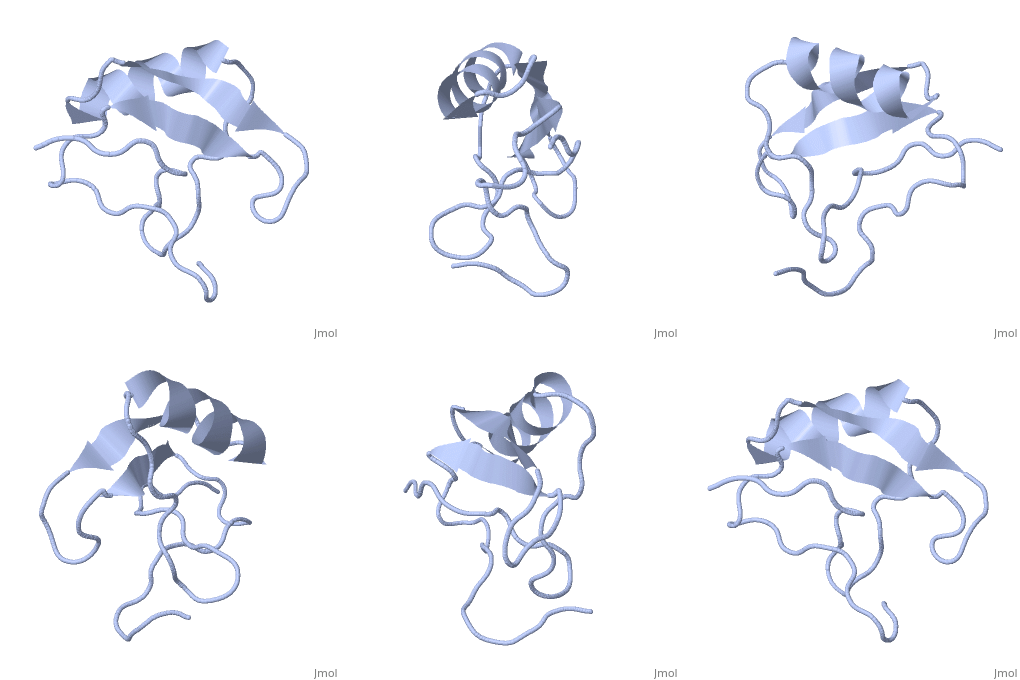
| + | <StructureSection load='1lqh' size="400" color="" frame="true" spin="on" Scene= align="right" caption='Scorpion toxin, [[1lqh]]' > | ||
[[Image:1lqh.png|left|200px|thumb|Scorpion toxin [[1lqh]]]] | [[Image:1lqh.png|left|200px|thumb|Scorpion toxin [[1lqh]]]] | ||
| - | {{STRUCTURE_1lqh| PDB=1lqh | SIZE=400| SCENE= |right|CAPTION=Scorpion toxin [[1lqh]] }} | ||
| - | |||
| - | <font color='red'><b>Under construction!</b></font> <br /> | ||
==Overview== | ==Overview== | ||
Scorpion toxins are 61- to 76-residue long proteins that modulate the gating properties of voltage-gated sodium channels. According to their mode of action and binding properties,scorpion toxins are divided into two major classes, alpha- and beta- toxins. | Scorpion toxins are 61- to 76-residue long proteins that modulate the gating properties of voltage-gated sodium channels. According to their mode of action and binding properties,scorpion toxins are divided into two major classes, alpha- and beta- toxins. | ||
| Line 16: | Line 14: | ||
NMR studies of LqhαIT with a peptide derived from part of neurotoxin receptor site-3 (D4S3-S4) identified residues <scene name='1lqh/Nmr/1'>Lys8, Asn9, Cys12, Val13, Arg18, Trp38, Ala39 and Arg58</scene> of LqhαIT as participating in binding to that extra-cellular part of the sodium channel (3). | NMR studies of LqhαIT with a peptide derived from part of neurotoxin receptor site-3 (D4S3-S4) identified residues <scene name='1lqh/Nmr/1'>Lys8, Asn9, Cys12, Val13, Arg18, Trp38, Ala39 and Arg58</scene> of LqhαIT as participating in binding to that extra-cellular part of the sodium channel (3). | ||
Both methods led to the identification of two regions on the surface of LqhαIT that participate in binding of the toxin to neurotoxin receptor site-3 on sodium channels. | Both methods led to the identification of two regions on the surface of LqhαIT that participate in binding of the toxin to neurotoxin receptor site-3 on sodium channels. | ||
| - | + | </StructureSection> | |
==References== | ==References== | ||
(1) Tugarinov, V., Kustanovich, I., Zilberberg, N., Gurevitz, M. Anglister, J. Solution structures of a highly insecticidal recombinant scorpion alpha-toxin and a mutant with increased activity. Biochemistry 36, 2414-24 (1997). | (1) Tugarinov, V., Kustanovich, I., Zilberberg, N., Gurevitz, M. Anglister, J. Solution structures of a highly insecticidal recombinant scorpion alpha-toxin and a mutant with increased activity. Biochemistry 36, 2414-24 (1997). | ||
Revision as of 12:46, 11 July 2012
| |||||||||||
References
(1) Tugarinov, V., Kustanovich, I., Zilberberg, N., Gurevitz, M. Anglister, J. Solution structures of a highly insecticidal recombinant scorpion alpha-toxin and a mutant with increased activity. Biochemistry 36, 2414-24 (1997). PMID: 9054546
(2) Karbat, I., Frolow, F., Froy, O., Gilles, N., Cohen, L., Turkov, M., Gordon, D. Gurevitz, M. Molecular basis of the high insecticidal potency of scorpion alpha-toxins. J. Biol. Chem. 279, 31679-86 (2004). PMID: 15133045
(3) Schnur, E., Turkov, M., Kahn, R., Gordon, D., Gurevitz, M., Anglister, J. NMR Analysis of interaction of Lqh(alpha)IT scorpion toxin with a peptide corresponding to the D4/S3-S4 loop of insect para voltage-gated sodium channel. Biochemistry 47(3), 911-21 (2008).
PMID: 18154318
Created with the participation of Eran Hodis, Einat Schnur, Jaime Prilusky

