This old version of Proteopedia is provided for student assignments while the new version is undergoing repairs. Content and edits done in this old version of Proteopedia after March 1, 2026 will eventually be lost when it is retired in about June of 2026.
Apply for new accounts at the new Proteopedia. Your logins will work in both the old and new versions.
1l1i
From Proteopedia
(New page: 200px<br /><applet load="1l1i" size="450" color="white" frame="true" align="right" spinBox="true" caption="1l1i" /> '''Solution Structure of the Tenebrio molitor A...) |
|||
| Line 1: | Line 1: | ||
| - | [[Image:1l1i.jpg|left|200px]]<br /><applet load="1l1i" size=" | + | [[Image:1l1i.jpg|left|200px]]<br /><applet load="1l1i" size="350" color="white" frame="true" align="right" spinBox="true" |
caption="1l1i" /> | caption="1l1i" /> | ||
'''Solution Structure of the Tenebrio molitor Antifreeze Protein'''<br /> | '''Solution Structure of the Tenebrio molitor Antifreeze Protein'''<br /> | ||
==Overview== | ==Overview== | ||
| - | Antifreeze proteins (AFPs) protect many types of organisms from damage | + | Antifreeze proteins (AFPs) protect many types of organisms from damage caused by freezing. They do this by binding to the ice surface, which causes inhibition of ice crystal growth. However, the molecular mechanism of ice binding leading to growth inhibition is not well understood. In this paper, we present the solution structure and backbone NMR relaxation data of the antifreeze protein from the yellow mealworm beetle Tenebrio molitor (TmAFP) to study the dynamics in the context of structure. The full (15)N relaxation analysis was completed at two magnetic field strengths, 500 and 600 MHz, as well as at two temperatures, 30 and 5 degrees C, to measure the dynamic changes that occur in the protein backbone at different temperatures. TmAFP is a small, highly disulfide-bonded, right-handed parallel beta-helix consisting of seven tandemly repeated 12-amino acid loops. The backbone relaxation data displays a periodic pattern, which reflects both the 12-amino acid structural repeat and the highly anisotropic nature of the protein. Analysis of the (15)N relaxation parameters shows that TmAFP is a well-defined, rigid structure, and the extracted parameters show that there is similar restricted internal mobility throughout the protein backbone at both temperatures studied. We conclude that the hydrophobic, rigid binding site may reduce the entropic penalty for the binding of the protein to ice. The beta-helical fold of the protein provides this rigidity, as it does not appear to be a consequence of cooling toward a physiologically relevant temperature. |
==About this Structure== | ==About this Structure== | ||
| - | 1L1I is a [http://en.wikipedia.org/wiki/Single_protein Single protein] structure of sequence from [http://en.wikipedia.org/wiki/Tenebrio_molitor Tenebrio molitor]. Full crystallographic information is available from [http:// | + | 1L1I is a [http://en.wikipedia.org/wiki/Single_protein Single protein] structure of sequence from [http://en.wikipedia.org/wiki/Tenebrio_molitor Tenebrio molitor]. Full crystallographic information is available from [http://oca.weizmann.ac.il/oca-bin/ocashort?id=1L1I OCA]. |
==Reference== | ==Reference== | ||
| Line 13: | Line 13: | ||
[[Category: Single protein]] | [[Category: Single protein]] | ||
[[Category: Tenebrio molitor]] | [[Category: Tenebrio molitor]] | ||
| - | [[Category: Daley, M | + | [[Category: Daley, M E.]] |
| - | [[Category: Davies, P | + | [[Category: Davies, P L.]] |
[[Category: Jia, Z.]] | [[Category: Jia, Z.]] | ||
[[Category: Spyracopoulos, L.]] | [[Category: Spyracopoulos, L.]] | ||
| - | [[Category: Sykes, B | + | [[Category: Sykes, B D.]] |
[[Category: beta-helix]] | [[Category: beta-helix]] | ||
| - | ''Page seeded by [http:// | + | ''Page seeded by [http://oca.weizmann.ac.il/oca OCA ] on Thu Feb 21 13:40:17 2008'' |
Revision as of 11:40, 21 February 2008
|
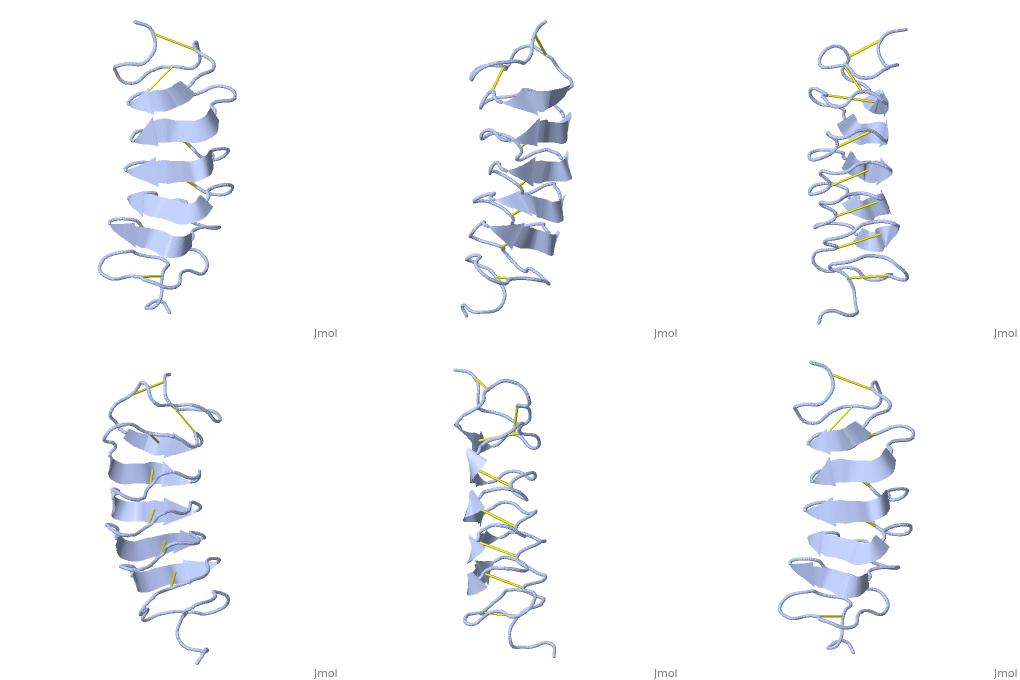
Solution Structure of the Tenebrio molitor Antifreeze Protein
Overview
Antifreeze proteins (AFPs) protect many types of organisms from damage caused by freezing. They do this by binding to the ice surface, which causes inhibition of ice crystal growth. However, the molecular mechanism of ice binding leading to growth inhibition is not well understood. In this paper, we present the solution structure and backbone NMR relaxation data of the antifreeze protein from the yellow mealworm beetle Tenebrio molitor (TmAFP) to study the dynamics in the context of structure. The full (15)N relaxation analysis was completed at two magnetic field strengths, 500 and 600 MHz, as well as at two temperatures, 30 and 5 degrees C, to measure the dynamic changes that occur in the protein backbone at different temperatures. TmAFP is a small, highly disulfide-bonded, right-handed parallel beta-helix consisting of seven tandemly repeated 12-amino acid loops. The backbone relaxation data displays a periodic pattern, which reflects both the 12-amino acid structural repeat and the highly anisotropic nature of the protein. Analysis of the (15)N relaxation parameters shows that TmAFP is a well-defined, rigid structure, and the extracted parameters show that there is similar restricted internal mobility throughout the protein backbone at both temperatures studied. We conclude that the hydrophobic, rigid binding site may reduce the entropic penalty for the binding of the protein to ice. The beta-helical fold of the protein provides this rigidity, as it does not appear to be a consequence of cooling toward a physiologically relevant temperature.
About this Structure
1L1I is a Single protein structure of sequence from Tenebrio molitor. Full crystallographic information is available from OCA.
Reference
Structure and dynamics of a beta-helical antifreeze protein., Daley ME, Spyracopoulos L, Jia Z, Davies PL, Sykes BD, Biochemistry. 2002 Apr 30;41(17):5515-25. PMID:11969412
Page seeded by OCA on Thu Feb 21 13:40:17 2008


