This old version of Proteopedia is provided for student assignments while the new version is undergoing repairs. Content and edits done in this old version of Proteopedia after March 1, 2026 will eventually be lost when it is retired in about June of 2026.
Apply for new accounts at the new Proteopedia. Your logins will work in both the old and new versions.
Josie N. Harmon/Sandbox Tutorial
From Proteopedia
| Line 1: | Line 1: | ||
== Xanthine Oxidase Biochemistry Tutorial == | == Xanthine Oxidase Biochemistry Tutorial == | ||
| - | The human diet introduces a large assortment of various new molecules into the body. These molecules are often degraded and used by the body to be later utilized as a source of metabolic energy. In other cirmcumstances the molecules can be broken down into components to be used by the body to build necessary proteins and nucleic acids. Lastly, any molecules that are remaining following the previous processes can be degraded for elimination. Xanthine oxidoreductase is considered to be the final stop for extra purine nucleotides, such as adenosine triphosphate (ATP)[[Image: | + | The human diet introduces a large assortment of various new molecules into the body. These molecules are often degraded and used by the body to be later utilized as a source of metabolic energy. In other cirmcumstances the molecules can be broken down into components to be used by the body to build necessary proteins and nucleic acids. Lastly, any molecules that are remaining following the previous processes can be degraded for elimination. Xanthine oxidoreductase is considered to be the final stop for extra purine nucleotides, such as adenosine triphosphate (ATP)[[Image:ATP.png]]and guanosine triphosphate (GTP)[[Image:GTP.png]], in our cells. Inside the cells the enzyme takes on a role of purine degredation, where it is involved in the extrememly inportant catabolism of purines through a series of steps to yield uric acid which is ultimately excreted from the body. |
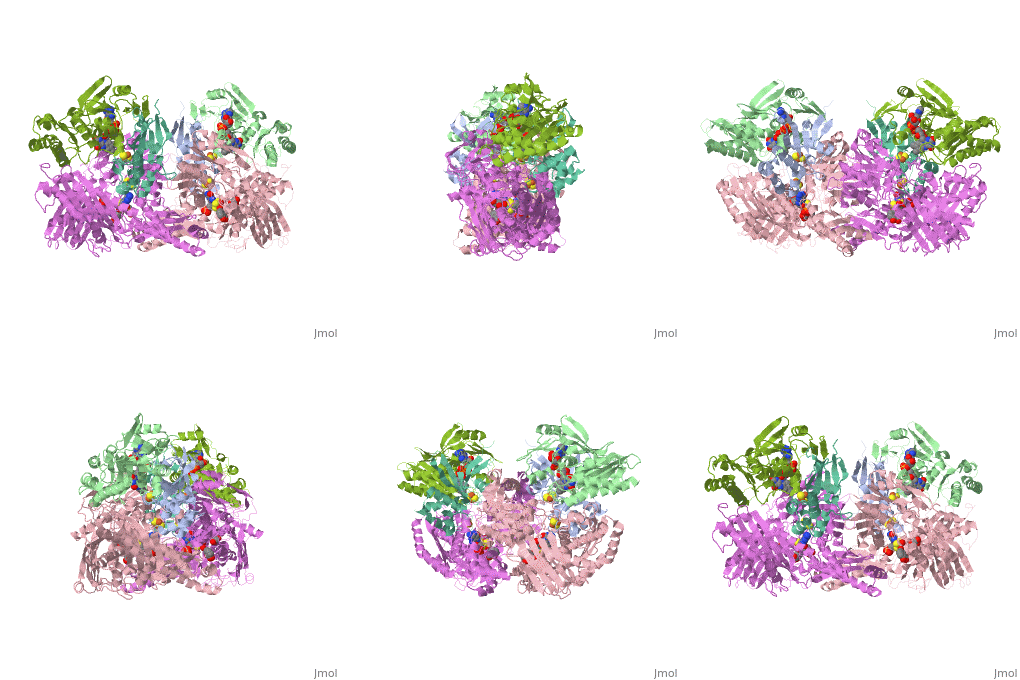
<StructureSection load='1fiq' size='350' side='right' caption='Crystal Structure of Xanthine Oxidase from Bovine Milk (PDB entry [[1fiq]])' scene=''> | <StructureSection load='1fiq' size='350' side='right' caption='Crystal Structure of Xanthine Oxidase from Bovine Milk (PDB entry [[1fiq]])' scene=''> | ||
Revision as of 18:44, 7 November 2012
Xanthine Oxidase Biochemistry Tutorial
The human diet introduces a large assortment of various new molecules into the body. These molecules are often degraded and used by the body to be later utilized as a source of metabolic energy. In other cirmcumstances the molecules can be broken down into components to be used by the body to build necessary proteins and nucleic acids. Lastly, any molecules that are remaining following the previous processes can be degraded for elimination. Xanthine oxidoreductase is considered to be the final stop for extra purine nucleotides, such as adenosine triphosphate (ATP)Image:ATP.pngand guanosine triphosphate (GTP)Image:GTP.png, in our cells. Inside the cells the enzyme takes on a role of purine degredation, where it is involved in the extrememly inportant catabolism of purines through a series of steps to yield uric acid which is ultimately excreted from the body.
| |||||||||||