This old version of Proteopedia is provided for student assignments while the new version is undergoing repairs. Content and edits done in this old version of Proteopedia after March 1, 2026 will eventually be lost when it is retired in about June of 2026.
Apply for new accounts at the new Proteopedia. Your logins will work in both the old and new versions.
JMS/sandbox7
From Proteopedia
(Difference between revisions)
| Line 1: | Line 1: | ||
== Your Heading Here (maybe something like 'Structure') == | == Your Heading Here (maybe something like 'Structure') == | ||
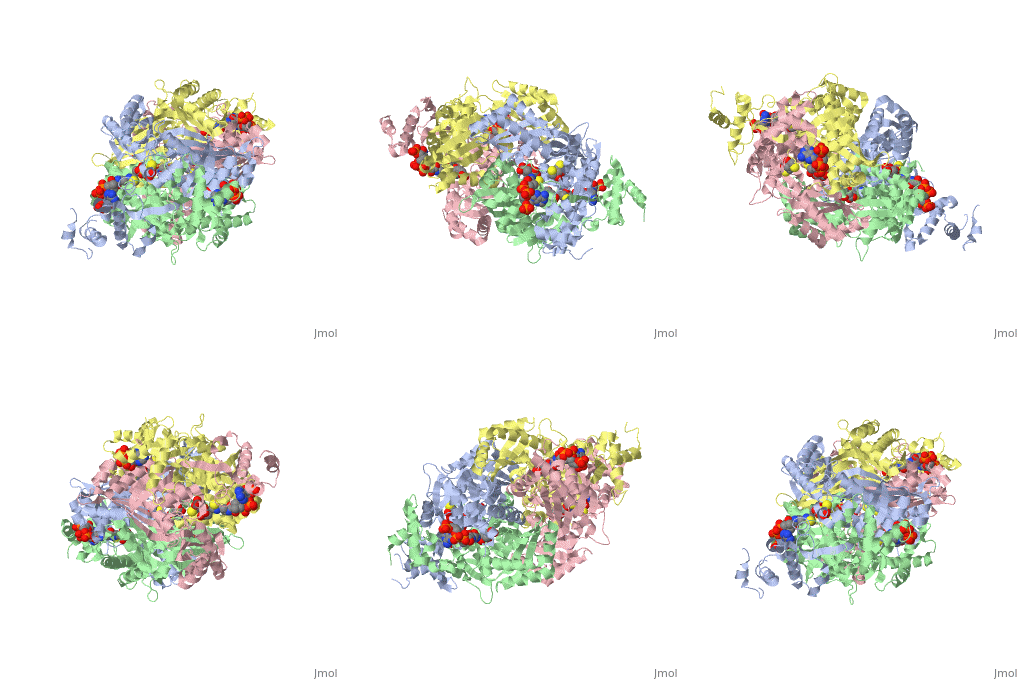
<StructureSection load='1dq8' size='350' side='right' caption='Structure of HMG-CoA reductase (PDB entry [[1dq8]])' scene=''> | <StructureSection load='1dq8' size='350' side='right' caption='Structure of HMG-CoA reductase (PDB entry [[1dq8]])' scene=''> | ||
| - | Anything in this section will appear adjacent to the 3D structure and will be scrollable. | ||
| - | |||
== Where there is no man, be a bacteria == | == Where there is no man, be a bacteria == | ||
Where no man or plant could survive, bacteria have been eking out a living, and some even thriving. From the Dead Sea which has 10 times the concentration of salt in salt sea water to the hot springs heated by the molten center of the earth, that pour forth through vents deep under the sea - in all these hostile environments, life has found footing. To make the question stronger, realize that many things can go wrong, cells could burst or shrivel, DNA can become undone and tattered, protein can unfold into a jumbled mass of amino acids, and membranes made of fat molecules can rip and melt. Environment stress usually achieves all or many of these deadly process to organisms - yet some bacteria survive. To study how the extremophiles (extreme-loving bacteria) survive involves explaining how each of the above processes that should kill the bacteria, in fact do not occur. To understand all of these is a tall order, but to start, in this Proteopedia article, we'll tackle the protein survival under extreme stress problem. | Where no man or plant could survive, bacteria have been eking out a living, and some even thriving. From the Dead Sea which has 10 times the concentration of salt in salt sea water to the hot springs heated by the molten center of the earth, that pour forth through vents deep under the sea - in all these hostile environments, life has found footing. To make the question stronger, realize that many things can go wrong, cells could burst or shrivel, DNA can become undone and tattered, protein can unfold into a jumbled mass of amino acids, and membranes made of fat molecules can rip and melt. Environment stress usually achieves all or many of these deadly process to organisms - yet some bacteria survive. To study how the extremophiles (extreme-loving bacteria) survive involves explaining how each of the above processes that should kill the bacteria, in fact do not occur. To understand all of these is a tall order, but to start, in this Proteopedia article, we'll tackle the protein survival under extreme stress problem. | ||
| - | |||
== Extremophiles talk in thermodynamics terms == | == Extremophiles talk in thermodynamics terms == | ||
| Line 13: | Line 10: | ||
∆G = ∆H - T∆S. | ∆G = ∆H - T∆S. | ||
Where ∆G is negative the movement to products in the reaction is spontaneous. This means, for the case of going from unfolded protein to folded protein as the product, a negative ∆G wold correspond to a stable protein structure. The other three terms: ∆H, T, and ∆S correspond to the change in enthalpy, the temperature (in Kalvins), and the change in entropy. Where the product is more stable than the reactants, ∆H will be negative, and there the produce is more ordered than the reactant, ∆S will be positive. It can be seen from the equation that ∆G becomes more negative for a more negative ∆H or for a less negative ∆S. | Where ∆G is negative the movement to products in the reaction is spontaneous. This means, for the case of going from unfolded protein to folded protein as the product, a negative ∆G wold correspond to a stable protein structure. The other three terms: ∆H, T, and ∆S correspond to the change in enthalpy, the temperature (in Kalvins), and the change in entropy. Where the product is more stable than the reactants, ∆H will be negative, and there the produce is more ordered than the reactant, ∆S will be positive. It can be seen from the equation that ∆G becomes more negative for a more negative ∆H or for a less negative ∆S. | ||
| - | |||
== At the the Weizmann Institute, scientists discover enzymes in the Dead Sea == | == At the the Weizmann Institute, scientists discover enzymes in the Dead Sea == | ||
| Line 19: | Line 15: | ||
∆G=∆H-T∆S. | ∆G=∆H-T∆S. | ||
In the next example, however, I specify the thermodynamic terms which a structural adaptation personifies. For that, we turn to a thermophilic enzyme, also solved by Weizmann Institute lab - Porfessor Yigal Burstein and his team of scientists. | In the next example, however, I specify the thermodynamic terms which a structural adaptation personifies. For that, we turn to a thermophilic enzyme, also solved by Weizmann Institute lab - Porfessor Yigal Burstein and his team of scientists. | ||
| - | |||
== Thermophilic enzymes adapt by changing their Enthalpic and Entropic properties == | == Thermophilic enzymes adapt by changing their Enthalpic and Entropic properties == | ||
| Line 25: | Line 20: | ||
∆G=∆H - ∆S | ∆G=∆H - ∆S | ||
| - | + | == Extreme Radiation presents a unique challenge to bacteria == | |
| - | == Extreme Radiation presents a unique challenge to bacteria | + | |
These two environmental stresses, Salt and Heat, are but two among many. We turn our attention next to radiation resistance. Deinococcus radiodurans which can withstand thousands more fold radiation and unsurprisingly the most famous extremophiles. Let us now consider their special radiation-resistant proteins. | These two environmental stresses, Salt and Heat, are but two among many. We turn our attention next to radiation resistance. Deinococcus radiodurans which can withstand thousands more fold radiation and unsurprisingly the most famous extremophiles. Let us now consider their special radiation-resistant proteins. | ||
</StructureSection> | </StructureSection> | ||
Revision as of 11:59, 6 December 2012
Your Heading Here (maybe something like 'Structure')
| |||||||||||