This old version of Proteopedia is provided for student assignments while the new version is undergoing repairs. Content and edits done in this old version of Proteopedia after March 1, 2026 will eventually be lost when it is retired in about June of 2026.
Apply for new accounts at the new Proteopedia. Your logins will work in both the old and new versions.
1xbn
From Proteopedia
(New page: 200px<br /><applet load="1xbn" size="450" color="white" frame="true" align="right" spinBox="true" caption="1xbn, resolution 2.50Å" /> '''Crystal structure of...) |
|||
| Line 1: | Line 1: | ||
| - | [[Image:1xbn.gif|left|200px]]<br /><applet load="1xbn" size=" | + | [[Image:1xbn.gif|left|200px]]<br /><applet load="1xbn" size="350" color="white" frame="true" align="right" spinBox="true" |
caption="1xbn, resolution 2.50Å" /> | caption="1xbn, resolution 2.50Å" /> | ||
'''Crystal structure of a bacterial nitric oxide sensor: an ortholog of mammalian soluble guanylate cyclase heme domain'''<br /> | '''Crystal structure of a bacterial nitric oxide sensor: an ortholog of mammalian soluble guanylate cyclase heme domain'''<br /> | ||
==Overview== | ==Overview== | ||
| - | Nitric oxide (NO) is extremely toxic to Clostridium botulinum, but its | + | Nitric oxide (NO) is extremely toxic to Clostridium botulinum, but its molecular targets are unknown. Here, we identify a heme protein sensor (SONO) that displays femtomolar affinity for NO. The crystal structure of the SONO heme domain reveals a previously undescribed fold and a strategically placed tyrosine residue that modulates heme-nitrosyl coordination. Furthermore, the domain architecture of a SONO ortholog cloned from Chlamydomonas reinhardtii indicates that NO signaling through cyclic guanosine monophosphate arose before the origin of multicellular eukaryotes. Our findings have broad implications for understanding bacterial responses to NO, as well as for the activation of mammalian NO-sensitive guanylyl cyclase. |
==About this Structure== | ==About this Structure== | ||
| - | 1XBN is a [http://en.wikipedia.org/wiki/Single_protein Single protein] structure of sequence from [http://en.wikipedia.org/wiki/Thermoanaerobacter_tengcongensis Thermoanaerobacter tengcongensis] with OXY and HEM as [http://en.wikipedia.org/wiki/ligands ligands]. Full crystallographic information is available from [http:// | + | 1XBN is a [http://en.wikipedia.org/wiki/Single_protein Single protein] structure of sequence from [http://en.wikipedia.org/wiki/Thermoanaerobacter_tengcongensis Thermoanaerobacter tengcongensis] with <scene name='pdbligand=OXY:'>OXY</scene> and <scene name='pdbligand=HEM:'>HEM</scene> as [http://en.wikipedia.org/wiki/ligands ligands]. Full crystallographic information is available from [http://oca.weizmann.ac.il/oca-bin/ocashort?id=1XBN OCA]. |
==Reference== | ==Reference== | ||
| Line 14: | Line 14: | ||
[[Category: Thermoanaerobacter tengcongensis]] | [[Category: Thermoanaerobacter tengcongensis]] | ||
[[Category: Nioche, P.]] | [[Category: Nioche, P.]] | ||
| - | [[Category: Raman, C | + | [[Category: Raman, C S.]] |
[[Category: HEM]] | [[Category: HEM]] | ||
[[Category: OXY]] | [[Category: OXY]] | ||
| Line 22: | Line 22: | ||
[[Category: soluble guanylyl cyclase]] | [[Category: soluble guanylyl cyclase]] | ||
| - | ''Page seeded by [http:// | + | ''Page seeded by [http://oca.weizmann.ac.il/oca OCA ] on Thu Feb 21 15:53:03 2008'' |
Revision as of 13:53, 21 February 2008
|
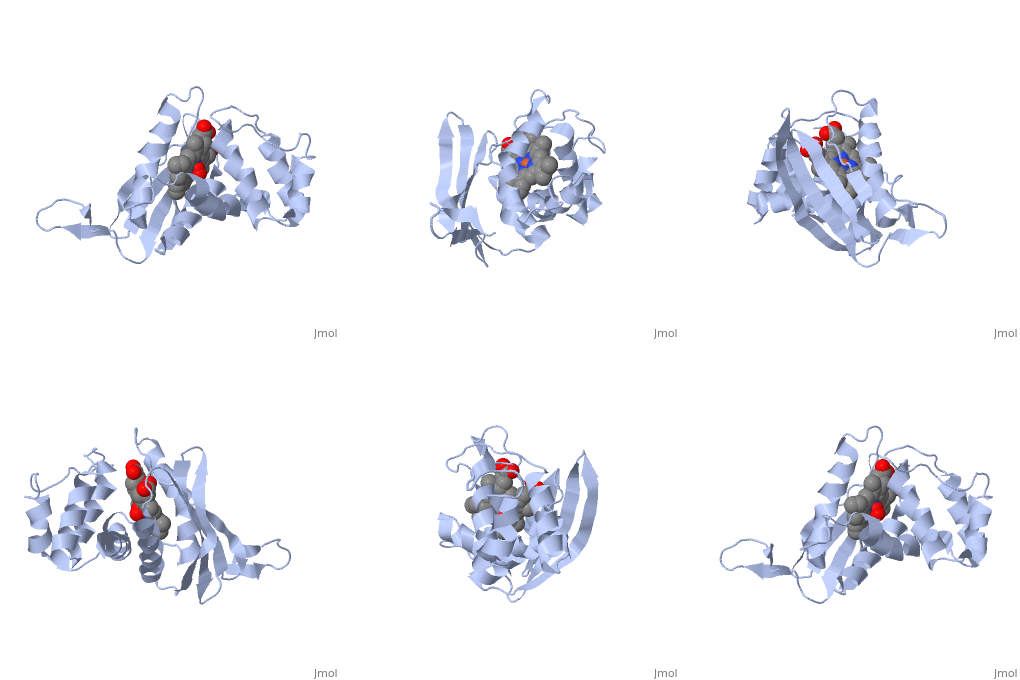
Crystal structure of a bacterial nitric oxide sensor: an ortholog of mammalian soluble guanylate cyclase heme domain
Overview
Nitric oxide (NO) is extremely toxic to Clostridium botulinum, but its molecular targets are unknown. Here, we identify a heme protein sensor (SONO) that displays femtomolar affinity for NO. The crystal structure of the SONO heme domain reveals a previously undescribed fold and a strategically placed tyrosine residue that modulates heme-nitrosyl coordination. Furthermore, the domain architecture of a SONO ortholog cloned from Chlamydomonas reinhardtii indicates that NO signaling through cyclic guanosine monophosphate arose before the origin of multicellular eukaryotes. Our findings have broad implications for understanding bacterial responses to NO, as well as for the activation of mammalian NO-sensitive guanylyl cyclase.
About this Structure
1XBN is a Single protein structure of sequence from Thermoanaerobacter tengcongensis with and as ligands. Full crystallographic information is available from OCA.
Reference
Femtomolar sensitivity of a NO sensor from Clostridium botulinum., Nioche P, Berka V, Vipond J, Minton N, Tsai AL, Raman CS, Science. 2004 Nov 26;306(5701):1550-3. Epub 2004 Oct 7. PMID:15472039
Page seeded by OCA on Thu Feb 21 15:53:03 2008


