This old version of Proteopedia is provided for student assignments while the new version is undergoing repairs. Content and edits done in this old version of Proteopedia after March 1, 2026 will eventually be lost when it is retired in about June of 2026.
Apply for new accounts at the new Proteopedia. Your logins will work in both the old and new versions.
1g5m
From Proteopedia
| Line 1: | Line 1: | ||
| - | [[Image:1g5m.png|left|200px]] | ||
| - | |||
{{STRUCTURE_1g5m| PDB=1g5m | SCENE= }} | {{STRUCTURE_1g5m| PDB=1g5m | SCENE= }} | ||
| - | |||
===HUMAN BCL-2, ISOFORM 1=== | ===HUMAN BCL-2, ISOFORM 1=== | ||
| + | {{ABSTRACT_PUBMED_11248023}} | ||
| - | + | ==Disease== | |
| + | [[http://www.uniprot.org/uniprot/BCL2_HUMAN BCL2_HUMAN]] Note=A chromosomal aberration involving BCL2 has been found in chronic lymphatic leukemia. Translocation t(14;18)(q32;q21) with immunoglobulin gene regions. BCL2 mutations found in non-Hodgkin lymphomas carrying the chromosomal translocation could be attributed to the Ig somatic hypermutation mechanism resulting in nucleotide transitions. | ||
| + | |||
| + | ==Function== | ||
| + | [[http://www.uniprot.org/uniprot/BCL2_HUMAN BCL2_HUMAN]] Suppresses apoptosis in a variety of cell systems including factor-dependent lymphohematopoietic and neural cells. Regulates cell death by controlling the mitochondrial membrane permeability. Appears to function in a feedback loop system with caspases. Inhibits caspase activity either by preventing the release of cytochrome c from the mitochondria and/or by binding to the apoptosis-activating factor (APAF-1).<ref>PMID:18570871</ref> | ||
==About this Structure== | ==About this Structure== | ||
| Line 15: | Line 17: | ||
==Reference== | ==Reference== | ||
| - | <ref group="xtra">PMID:011248023</ref><references group="xtra"/> | + | <ref group="xtra">PMID:011248023</ref><references group="xtra"/><references/> |
[[Category: Homo sapiens]] | [[Category: Homo sapiens]] | ||
[[Category: Fesik, S W.]] | [[Category: Fesik, S W.]] | ||
Revision as of 05:14, 25 March 2013

Contents |
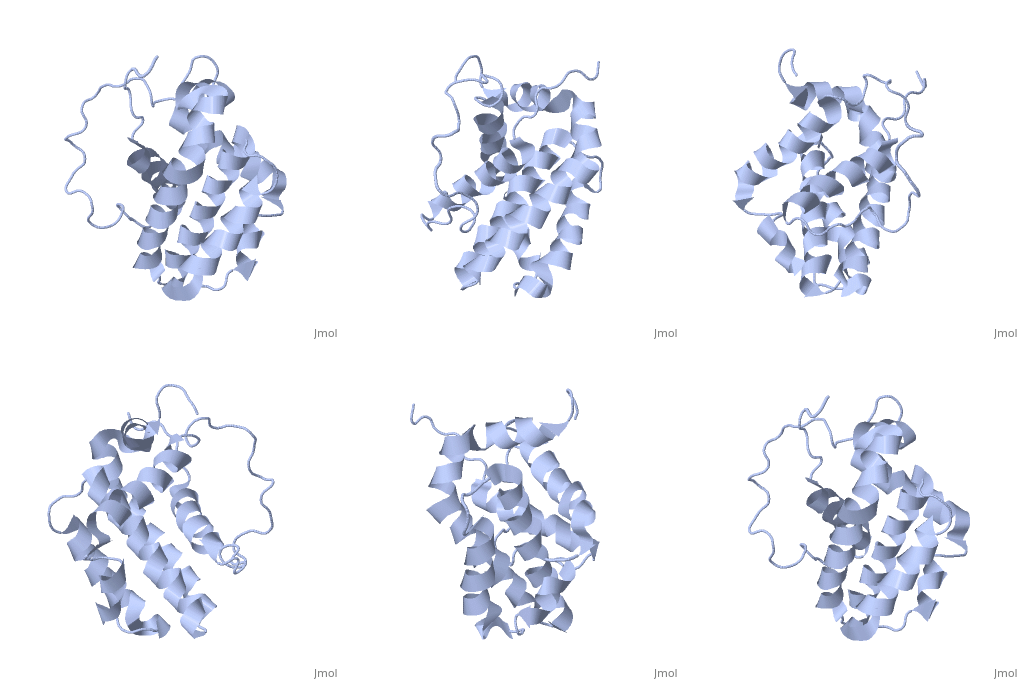
HUMAN BCL-2, ISOFORM 1
Template:ABSTRACT PUBMED 11248023
Disease
[BCL2_HUMAN] Note=A chromosomal aberration involving BCL2 has been found in chronic lymphatic leukemia. Translocation t(14;18)(q32;q21) with immunoglobulin gene regions. BCL2 mutations found in non-Hodgkin lymphomas carrying the chromosomal translocation could be attributed to the Ig somatic hypermutation mechanism resulting in nucleotide transitions.
Function
[BCL2_HUMAN] Suppresses apoptosis in a variety of cell systems including factor-dependent lymphohematopoietic and neural cells. Regulates cell death by controlling the mitochondrial membrane permeability. Appears to function in a feedback loop system with caspases. Inhibits caspase activity either by preventing the release of cytochrome c from the mitochondria and/or by binding to the apoptosis-activating factor (APAF-1).[1]
About this Structure
1g5m is a 1 chain structure with sequence from Homo sapiens. Full experimental information is available from OCA.
See Also
Reference
- Petros AM, Medek A, Nettesheim DG, Kim DH, Yoon HS, Swift K, Matayoshi ED, Oltersdorf T, Fesik SW. Solution structure of the antiapoptotic protein bcl-2. Proc Natl Acad Sci U S A. 2001 Mar 13;98(6):3012-7. Epub 2001 Feb 27. PMID:11248023 doi:10.1073/pnas.041619798
- ↑ Wei Y, Pattingre S, Sinha S, Bassik M, Levine B. JNK1-mediated phosphorylation of Bcl-2 regulates starvation-induced autophagy. Mol Cell. 2008 Jun 20;30(6):678-88. doi: 10.1016/j.molcel.2008.06.001. PMID:18570871 doi:10.1016/j.molcel.2008.06.001
