This old version of Proteopedia is provided for student assignments while the new version is undergoing repairs. Content and edits done in this old version of Proteopedia after March 1, 2026 will eventually be lost when it is retired in about June of 2026.
Apply for new accounts at the new Proteopedia. Your logins will work in both the old and new versions.
Single stranded binding protein
From Proteopedia
| Line 13: | Line 13: | ||
<StructureSection load='2vw9' size='400' side='right' frame='true' caption='Structure of Single Stranded DNA-Binding Protein from Helicobacter Pylori bound to ssDNA (PDB entry [[2vw9]])' scene=''> | <StructureSection load='2vw9' size='400' side='right' frame='true' caption='Structure of Single Stranded DNA-Binding Protein from Helicobacter Pylori bound to ssDNA (PDB entry [[2vw9]])' scene=''> | ||
| - | SSB consists is a homotetramer that has a DNA binding domain which binds to a single strand of DNA. The tetramers consist of α-helices, β-sheets, and random coils. Each subunit contains an <scene name='56/566528/Alpha_helices/3'>α-helix</scene> and several <scene name='56/566528/Beta_sheets/1'>β-sheets</scene>. The secondary structure also includes a NH2 terminus, which consists of multiple positively charged amino acids. The DNA-binding domain lies within 115 amino acid residues from this terminus. The COOH terminus includes many acidic amino acids. | + | SSB consists is a homotetramer that has a DNA binding domain which binds to a single strand of DNA. The tetramers consist of α-helices, β-sheets, and random coils. Each subunit contains an <scene name='56/566528/Alpha_helices/3'>α-helix</scene> and several <scene name='56/566528/Beta_sheets/1'>β-sheets</scene>. The secondary structure also includes a NH2 terminus, which consists of multiple positively charged amino acids. The DNA-binding domain lies within 115 amino acid residues from this terminus <ref>PMID: 2087220</ref>. The COOH terminus includes many acidic amino acids. |
==Binding Interactions in the Active Site== | ==Binding Interactions in the Active Site== | ||
Revision as of 02:22, 2 November 2013
Contents |
Sandbox Single Stranded DNA-Binding Protein (SSB)
Introduction
Single-stranded DNA-binding protein, or SSB, binds to single-stranded regions of DNA in order to prevent premature annealing, to protect the single-stranded DNA from being digested by nucleases, and to remove secondary structure from the DNA to allow other enzymes to function effectively upon it. Single-stranded DNA is produced during all aspects of DNA metabolism: replication, recombination and repair. As well as stabilizing this single-stranded DNA, SSB proteins bind to and modulate the function of numerous proteins involved in all of these processes.
| |||||||||||
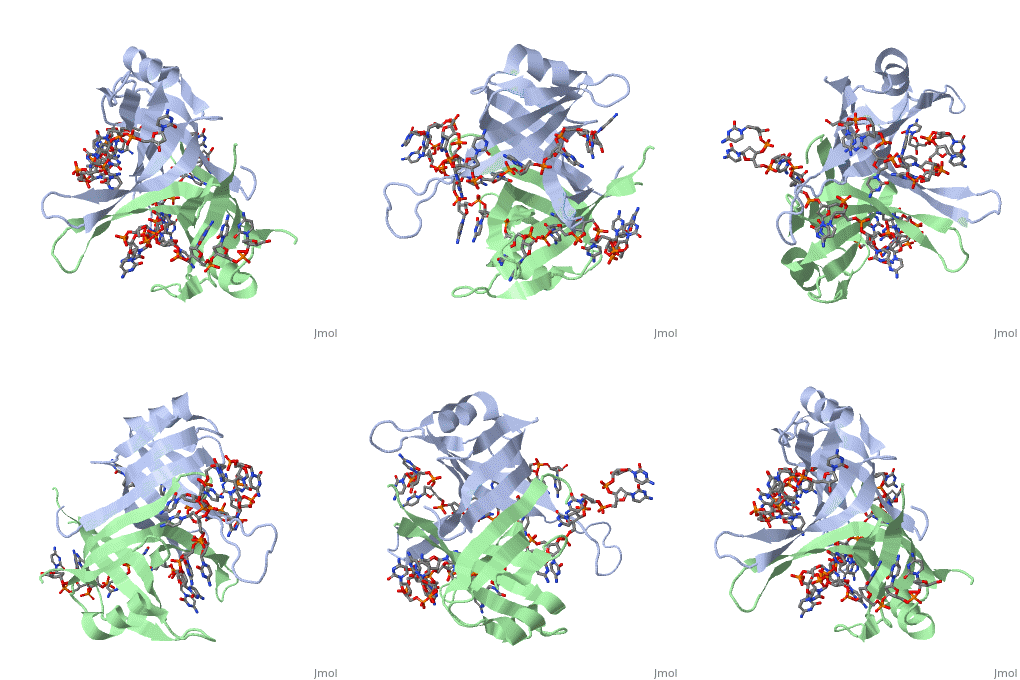
Structure
| |||||||||||
Binding Interactions between DNA and SSB of E. coli
| |||||||||||
See Also
References
- ↑ Meyer RR, Laine PS. The single-stranded DNA-binding protein of Escherichia coli. Microbiol Rev. 1990 Dec;54(4):342-80. PMID:2087220
- ↑ Meyer RR, Laine PS. The single-stranded DNA-binding protein of Escherichia coli. Microbiol Rev. 1990 Dec;54(4):342-80. PMID:2087220
- ↑ Meyer RR, Laine PS. The single-stranded DNA-binding protein of Escherichia coli. Microbiol Rev. 1990 Dec;54(4):342-80. PMID:2087220
- ↑ Meyer RR, Laine PS. The single-stranded DNA-binding protein of Escherichia coli. Microbiol Rev. 1990 Dec;54(4):342-80. PMID:2087220
Proteopedia Page Contributors and Editors (what is this?)
Refayat Ahsen, Rachel Craig, Michal Harel, Alexander Berchansky
