This old version of Proteopedia is provided for student assignments while the new version is undergoing repairs. Content and edits done in this old version of Proteopedia after March 1, 2026 will eventually be lost when it is retired in about June of 2026.
Apply for new accounts at the new Proteopedia. Your logins will work in both the old and new versions.
Erythropoietin
From Proteopedia
(Difference between revisions)
| Line 24: | Line 24: | ||
''' | ''' | ||
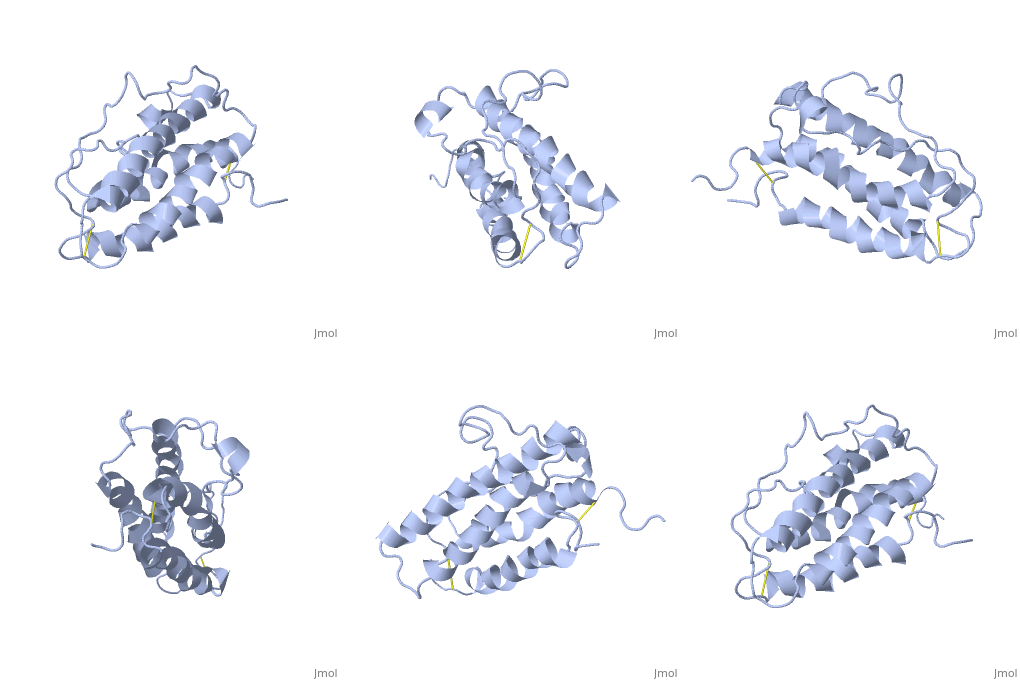
| - | The EPO receptor of the blood marrow is part of the hematipoietic cytokine family. This receptor has a single transmembrane domain, that forms a homodimer complex until it is activated by the binding of EPO.This receptor is 484 amino acids long and weigh 52.6 kDa (3). Once the homodimer is formed after the binding, autophosphorlation of the Jak2 kinases, which activates other cellular processes (1). This transmembrane receptor has two extracellular domains. This receptor has two disulfide bonds that are formed from 4 cystine residues, Cys67 and Cys83 and Cys28 and Cys38 (1). The intracellular domain of this receptor does not possess any enzymatic activity like other receptors. When EPO comes in contact with the extracellular domains form a ligand bond. The extracellular sinding site 1 and Binding site 2 are composed of D1 and D2 (1). When EPO binds, all loops on D1 and D2 of binding site one form a bind with EPO. However loop 4 of D1 on binding site 2 does not participate in the binding of EPO (6). After the biniding of EPO, 8 tyrosine residues are phosphoralated which activates the Jak2 kinase (1). This kinase helps regulate the transcription of different genes and expression of other proteins. | + | The <scene name='12/128258/Eporeceptor/3'>EPO receptor</scene> of the blood marrow is part of the hematipoietic cytokine family. This receptor has a single transmembrane domain, that forms a homodimer complex until it is activated by the binding of EPO.This receptor is 484 amino acids long and weigh 52.6 kDa (3). Once the homodimer is formed after the binding, autophosphorlation of the Jak2 kinases, which activates other cellular processes (1). This transmembrane receptor has two extracellular domains. This receptor has two disulfide bonds that are formed from 4 cystine residues, Cys67 and Cys83 and Cys28 and Cys38 (1). The intracellular domain of this receptor does not possess any enzymatic activity like other receptors. When EPO comes in contact with the extracellular domains form a ligand bond. The extracellular sinding site 1 and Binding site 2 are composed of D1 and D2 (1). When EPO binds, all loops on D1 and D2 of binding site one form a bind with EPO. However loop 4 of D1 on binding site 2 does not participate in the binding of EPO (6). After the biniding of EPO, 8 tyrosine residues are phosphoralated which activates the Jak2 kinase (1). This kinase helps regulate the transcription of different genes and expression of other proteins. |
Revision as of 18:33, 24 April 2014
Erythropoietin Structure, Function, and History
| |||||||||||