We apologize for Proteopedia being slow to respond. For the past two years, a new implementation of Proteopedia has been being built. Soon, it will replace this 18-year old system. All existing content will be moved to the new system at a date that will be announced here.
From Proteopedia
(Difference between revisions)
proteopedia linkproteopedia link
|
|
| Line 12: |
Line 12: |
| | | | |
| | | | |
| - | <StructureSection load='2VY1_assembly.pdb' size='300' side= 'right' caption='LEAFY dimer binding to the AP1 promoter' scene=' '><Structure load='2VY1_assembly.pdb'' size='350' frame='true' align='right' caption='Insert caption here' scene='Insert optional scene name here' /> | + | <StructureSection load='2VY1_assembly.pdb' size='400' side= 'right' caption='LEAFY dimer binding to the AP1 promoter' scene=' '><Structure load='2VY1_assembly.pdb'' size='400' frame='true' align='middle' caption='LEAFY dimer binding to the AG promoter' /> |
| | == Structural Basis of LEAFY binding == | | == Structural Basis of LEAFY binding == |
| | === General information about the structure === | | === General information about the structure === |
Revision as of 09:08, 16 May 2014
| This Sandbox is Reserved from 01/04/2014, through 30/06/2014 for use in the course "510042. Protein structure, function and folding" taught by Prof Adrian Goldman, Tommi Kajander, Taru Meri, Konstantin Kogan and Juho Kellosalo at the University of Helsinki. This reservation includes Sandbox Reserved 923 through Sandbox Reserved 947.
|
To get started:
- Click the edit this page tab at the top. Save the page after each step, then edit it again.
- Click the 3D button (when editing, above the wikitext box) to insert Jmol.
- show the Scene authoring tools, create a molecular scene, and save it. Copy the green link into the page.
- Add a description of your scene. Use the buttons above the wikitext box for bold, italics, links, headlines, etc.
More help: Help:Editing
|
The DNA binding domain of LEAFY: from flower development to evolution
Introduction
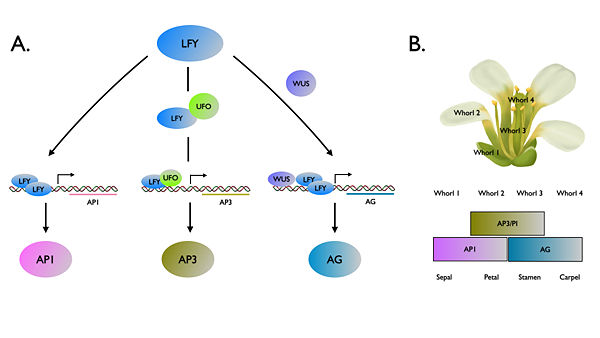
Schematic presentation LEAFY regulatory roles in controlling floral organ identity (A) and the ABC model in
Arabidopsis thaliana (B).
FLORICAULA/LEAFY (FLO/LFY) genes encode a plant specific transcription factor family that controlling floral fate of reproductive phase. [1] In the plant model system Arabidopsis thaliana , ‘’LFY’’ also acts upstream of floral homeotic genes to modulate organ identity. [2] LFY activates the organ identity genes by binding to promoter regions of floral organ identity genes. LFY can directly bind to the promoter to APELATA1 (AP1), while co-regulators UNUSUAL FLORAL ORGANS (UFO) (ref 3) and WUSCHEL (WUS) (ref 4) are required for increment of binding affinity to promoter regions of APELATA3 (AP3) and AGAMOUS (AG), respectively. The exact mechanism how LFY binds to these promoters has yet to be well elucidated until the first structure report about LFY-pAP1 and LFY-pAG (ref 5). Among land plants, FLO/LFY homologs share a highly conserved DNA binding region that a hypothesis claimed substitution in this domain might result in the functional divergence (ref 6). Recently, a new study (ref 7) provided new insights of structural basis of LEAFY evolution by changing DNA binding activity.
|
Structural Basis of LEAFY binding
General information about the structure
The LFY gene encodes a 424 amino acids protein that containing two domains. The N-terminal domain of LFY has been proved mediating homodimerization (ref) and it is also thought to be responsible for transcriptional activation (ref). The C-terminal consensus is highly conserved among land species and functioning as DNA-binding domain. Two DNA-protein binding structure for LEAFY were first published by Hame et al. 2008 (ref). These two structures include a recombinant C-terminal domain of LEAFY expressed by Escherichia coli strain RosettaBlue (DE3) and a short nucleotide structure from AP1 or AG promoter region. Final models of LFY-pAP1 and LFY-pAG were solved at 2.1 Å and 2.3 Å by X-ray diffraction and deposits as PDB entry 2VY1/2VY2.
DNA recognition is conducted by a HTH-like motif
DNA binding required cooperative dimerization
LEAFY Evolution
<SectionEnd>
Reference
- ↑ Detlef Weigel, John Alvarez, David R. Smyth, Martin F. Yanofsky, Elliot M. Meyerowitz, LEAFY controls floral meristem identity in Arabidopsis. Cell 69 :843-859, http://dx.doi.org/10.1016/0092-8674(92)90295-N.
- ↑ Irish, V. F. (2010), The flowering of Arabidopsis flower development. The Plant Journal, 61: 1014–1028. http://doi:10.1111/j.1365-313X.2009.04065.x
|

