We apologize for Proteopedia being slow to respond. For the past two years, a new implementation of Proteopedia has been being built. Soon, it will replace this 18-year old system. All existing content will be moved to the new system at a date that will be announced here.
3et3
From Proteopedia
(Difference between revisions)
| Line 1: | Line 1: | ||
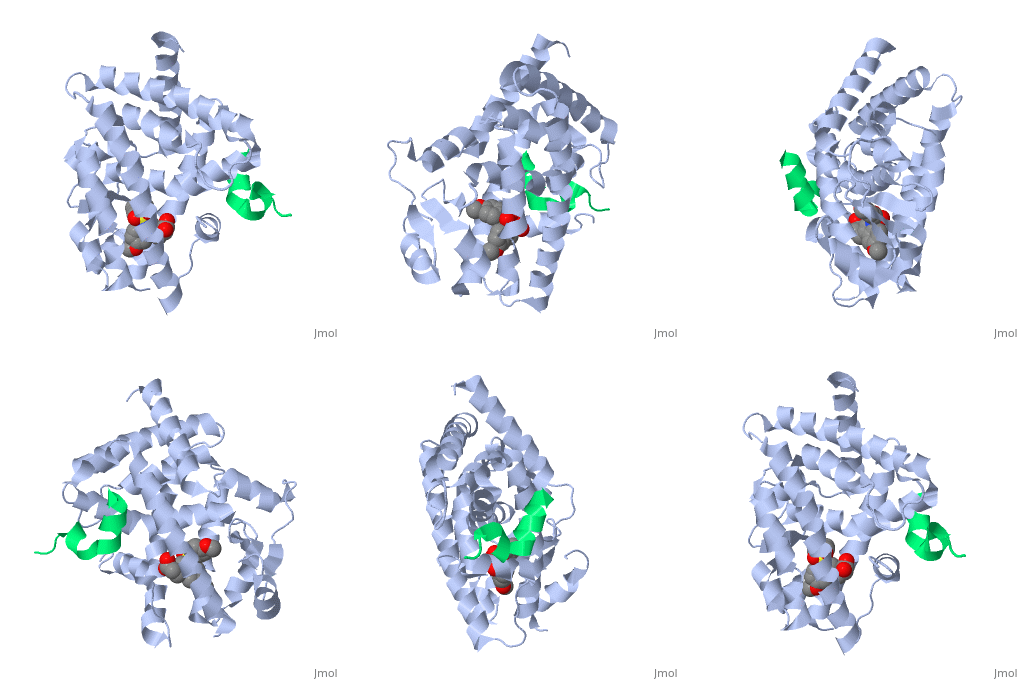
| - | + | ==Structure of PPARgamma with 3-[5-Methoxy-1-(4-methoxy-benzenesulfonyl)-1H-indol-3-yl]-propionic acid== | |
| - | + | <StructureSection load='3et3' size='340' side='right' caption='[[3et3]], [[Resolution|resolution]] 1.95Å' scene=''> | |
| - | { | + | == Structural highlights == |
| + | <table><tr><td colspan='2'>[[3et3]] is a 2 chain structure with sequence from [http://en.wikipedia.org/wiki/Homo_sapiens Homo sapiens]. Full crystallographic information is available from [http://oca.weizmann.ac.il/oca-bin/ocashort?id=3ET3 OCA]. For a <b>guided tour on the structure components</b> use [http://oca.weizmann.ac.il/oca-docs/fgij/fg.htm?mol=3ET3 FirstGlance]. <br> | ||
| + | </td></tr><tr id='ligand'><td class="sblockLbl"><b>[[Ligand|Ligands:]]</b></td><td class="sblockDat"><scene name='pdbligand=ET1:3-{5-METHOXY-1-[(4-METHOXYPHENYL)SULFONYL]-1H-INDOL-3-YL}PROPANOIC+ACID'>ET1</scene></td></tr> | ||
| + | <tr id='related'><td class="sblockLbl"><b>[[Related_structure|Related:]]</b></td><td class="sblockDat">[[3et0|3et0]], [[3et1|3et1]], [[3et2|3et2]]</td></tr> | ||
| + | <tr id='gene'><td class="sblockLbl"><b>[[Gene|Gene:]]</b></td><td class="sblockDat">PPARG, NR1C3 ([http://www.ncbi.nlm.nih.gov/Taxonomy/Browser/wwwtax.cgi?mode=Info&srchmode=5&id=9606 Homo sapiens]), NCOA1, SRC1 ([http://www.ncbi.nlm.nih.gov/Taxonomy/Browser/wwwtax.cgi?mode=Info&srchmode=5&id=9606 Homo sapiens])</td></tr> | ||
| + | <tr id='activity'><td class="sblockLbl"><b>Activity:</b></td><td class="sblockDat"><span class='plainlinks'>[http://en.wikipedia.org/wiki/Histone_acetyltransferase Histone acetyltransferase], with EC number [http://www.brenda-enzymes.info/php/result_flat.php4?ecno=2.3.1.48 2.3.1.48] </span></td></tr> | ||
| + | <tr id='resources'><td class="sblockLbl"><b>Resources:</b></td><td class="sblockDat"><span class='plainlinks'>[http://oca.weizmann.ac.il/oca-docs/fgij/fg.htm?mol=3et3 FirstGlance], [http://oca.weizmann.ac.il/oca-bin/ocaids?id=3et3 OCA], [http://www.rcsb.org/pdb/explore.do?structureId=3et3 RCSB], [http://www.ebi.ac.uk/pdbsum/3et3 PDBsum]</span></td></tr> | ||
| + | </table> | ||
| + | == Disease == | ||
| + | [[http://www.uniprot.org/uniprot/PPARG_HUMAN PPARG_HUMAN]] Note=Defects in PPARG can lead to type 2 insulin-resistant diabetes and hyptertension. PPARG mutations may be associated with colon cancer. Defects in PPARG may be associated with susceptibility to obesity (OBESITY) [MIM:[http://omim.org/entry/601665 601665]]. It is a condition characterized by an increase of body weight beyond the limitation of skeletal and physical requirements, as the result of excessive accumulation of body fat.<ref>PMID:9753710</ref> Defects in PPARG are the cause of familial partial lipodystrophy type 3 (FPLD3) [MIM:[http://omim.org/entry/604367 604367]]. Familial partial lipodystrophies (FPLD) are a heterogeneous group of genetic disorders characterized by marked loss of subcutaneous (sc) fat from the extremities. Affected individuals show an increased preponderance of insulin resistance, diabetes mellitus and dyslipidemia.<ref>PMID:12453919</ref> <ref>PMID:11788685</ref> Genetic variations in PPARG can be associated with susceptibility to glioma type 1 (GLM1) [MIM:[http://omim.org/entry/137800 137800]]. Gliomas are central nervous system neoplasms derived from glial cells and comprise astrocytomas, glioblastoma multiforme, oligodendrogliomas, and ependymomas. Note=Polymorphic PPARG alleles have been found to be significantly over-represented among a cohort of American patients with sporadic glioblastoma multiforme suggesting a possible contribution to disease susceptibility. [[http://www.uniprot.org/uniprot/NCOA1_HUMAN NCOA1_HUMAN]] Note=A chromosomal aberration involving NCOA1 is a cause of rhabdomyosarcoma. Translocation t(2;2)(q35;p23) with PAX3 generates the NCOA1-PAX3 oncogene consisting of the N-terminus part of PAX3 and the C-terminus part of NCOA1. The fusion protein acts as a transcriptional activator. Rhabdomyosarcoma is the most common soft tissue carcinoma in childhood, representing 5-8% of all malignancies in children. | ||
| + | == Function == | ||
| + | [[http://www.uniprot.org/uniprot/PPARG_HUMAN PPARG_HUMAN]] Receptor that binds peroxisome proliferators such as hypolipidemic drugs and fatty acids. Once activated by a ligand, the receptor binds to a promoter element in the gene for acyl-CoA oxidase and activates its transcription. It therefore controls the peroxisomal beta-oxidation pathway of fatty acids. Key regulator of adipocyte differentiation and glucose homeostasis. Acts as a critical regulator of gut homeostasis by suppressing NF-kappa-B-mediated proinflammatory responses.<ref>PMID:9065481</ref> <ref>PMID:16150867</ref> <ref>PMID:20829347</ref> [[http://www.uniprot.org/uniprot/NCOA1_HUMAN NCOA1_HUMAN]] Nuclear receptor coactivator that directly binds nuclear receptors and stimulates the transcriptional activities in a hormone-dependent fashion. Involved in the coactivation of different nuclear receptors, such as for steroids (PGR, GR and ER), retinoids (RXRs), thyroid hormone (TRs) and prostanoids (PPARs). Also involved in coactivation mediated by STAT3, STAT5A, STAT5B and STAT6 transcription factors. Displays histone acetyltransferase activity toward H3 and H4; the relevance of such activity remains however unclear. Plays a central role in creating multisubunit coactivator complexes that act via remodeling of chromatin, and possibly acts by participating in both chromatin remodeling and recruitment of general transcription factors. Required with NCOA2 to control energy balance between white and brown adipose tissues. Required for mediating steroid hormone response. Isoform 2 has a higher thyroid hormone-dependent transactivation activity than isoform 1 and isoform 3.<ref>PMID:9427757</ref> <ref>PMID:7481822</ref> <ref>PMID:9223431</ref> <ref>PMID:9296499</ref> <ref>PMID:9223281</ref> <ref>PMID:10449719</ref> <ref>PMID:12954634</ref> | ||
| + | == Evolutionary Conservation == | ||
| + | [[Image:Consurf_key_small.gif|200px|right]] | ||
| + | Check<jmol> | ||
| + | <jmolCheckbox> | ||
| + | <scriptWhenChecked>select protein; define ~consurf_to_do selected; consurf_initial_scene = true; script "/wiki/ConSurf/et/3et3_consurf.spt"</scriptWhenChecked> | ||
| + | <scriptWhenUnchecked>script /wiki/extensions/Proteopedia/spt/initialview01.spt</scriptWhenUnchecked> | ||
| + | <text>to colour the structure by Evolutionary Conservation</text> | ||
| + | </jmolCheckbox> | ||
| + | </jmol>, as determined by [http://consurfdb.tau.ac.il/ ConSurfDB]. You may read the [[Conservation%2C_Evolutionary|explanation]] of the method and the full data available from [http://bental.tau.ac.il/new_ConSurfDB/chain_selection.php?pdb_ID=2ata ConSurf]. | ||
| + | <div style="clear:both"></div> | ||
| + | <div style="background-color:#fffaf0;"> | ||
| + | == Publication Abstract from PubMed == | ||
| + | In a search for more effective anti-diabetic treatment, we used a process coupling low-affinity biochemical screening with high-throughput co-crystallography in the design of a series of compounds that selectively modulate the activities of all three peroxisome proliferator-activated receptors (PPARs), PPARalpha, PPARgamma, and PPARdelta. Transcriptional transactivation assays were used to select compounds from this chemical series with a bias toward partial agonism toward PPARgamma, to circumvent the clinically observed side effects of full PPARgamma agonists. Co-crystallographic characterization of the lead molecule, indeglitazar, in complex with each of the 3 PPARs revealed the structural basis for its PPAR pan-activity and its partial agonistic response toward PPARgamma. Compared with full PPARgamma-agonists, indeglitazar is less potent in promoting adipocyte differentiation and only partially effective in stimulating adiponectin gene expression. Evaluation of the compound in vivo confirmed the reduced adiponectin response in animal models of obesity and diabetes while revealing strong beneficial effects on glucose, triglycerides, cholesterol, body weight, and other metabolic parameters. Indeglitazar has now progressed to Phase II clinical evaluations for Type 2 diabetes mellitus (T2DM). | ||
| - | + | Scaffold-based discovery of indeglitazar, a PPAR pan-active anti-diabetic agent.,Artis DR, Lin JJ, Zhang C, Wang W, Mehra U, Perreault M, Erbe D, Krupka HI, England BP, Arnold J, Plotnikov AN, Marimuthu A, Nguyen H, Will S, Signaevsky M, Kral J, Cantwell J, Settachatgull C, Yan DS, Fong D, Oh A, Shi S, Womack P, Powell B, Habets G, West BL, Zhang KY, Milburn MV, Vlasuk GP, Hirth KP, Nolop K, Bollag G, Ibrahim PN, Tobin JF Proc Natl Acad Sci U S A. 2009 Jan 6;106(1):262-7. Epub 2008 Dec 30. PMID:19116277<ref>PMID:19116277</ref> | |
| - | + | ||
| - | + | From MEDLINE®/PubMed®, a database of the U.S. National Library of Medicine.<br> | |
| - | + | </div> | |
| - | + | ||
| - | + | ||
| - | + | ||
==See Also== | ==See Also== | ||
| - | *[[PPAR-gamma|PPAR-gamma]] | ||
*[[Peroxisome Proliferator-Activated Receptors|Peroxisome Proliferator-Activated Receptors]] | *[[Peroxisome Proliferator-Activated Receptors|Peroxisome Proliferator-Activated Receptors]] | ||
| - | + | == References == | |
| - | == | + | <references/> |
| - | + | __TOC__ | |
| + | </StructureSection> | ||
[[Category: Histone acetyltransferase]] | [[Category: Histone acetyltransferase]] | ||
[[Category: Homo sapiens]] | [[Category: Homo sapiens]] | ||
| - | [[Category: Wang, W | + | [[Category: Wang, W]] |
| - | [[Category: Zhang, K Y.J | + | [[Category: Zhang, K Y.J]] |
[[Category: Activator]] | [[Category: Activator]] | ||
[[Category: Acyltransferase]] | [[Category: Acyltransferase]] | ||
Revision as of 13:27, 18 December 2014
Structure of PPARgamma with 3-[5-Methoxy-1-(4-methoxy-benzenesulfonyl)-1H-indol-3-yl]-propionic acid
| |||||||||||

Categories: Histone acetyltransferase | Homo sapiens | Wang, W | Zhang, K Y.J | Activator | Acyltransferase | Adiponectin | Diabetes | Diabetes mellitus | Disease mutation | Dna-binding | Drug discovery | Fragment-based drug discovery | Metabolic disease | Metal-binding | Nucleus | Obesity | Phosphoprotein | Ppar | Pparg | Ppargamma | Proto-oncogene | Receptor | Scaffold-based drug discovery | Transcription | Transcription regulation | Transferase | Zinc-finger
