This old version of Proteopedia is provided for student assignments while the new version is undergoing repairs. Content and edits done in this old version of Proteopedia after March 1, 2026 will eventually be lost when it is retired in about June of 2026.
Apply for new accounts at the new Proteopedia. Your logins will work in both the old and new versions.
SCF-KIT
From Proteopedia
(Difference between revisions)
| Line 1: | Line 1: | ||
<StructureSection load='2E9W' size='340' side='right' caption='Caption for this structure' scene='> | <StructureSection load='2E9W' size='340' side='right' caption='Caption for this structure' scene='> | ||
== Introduction == | == Introduction == | ||
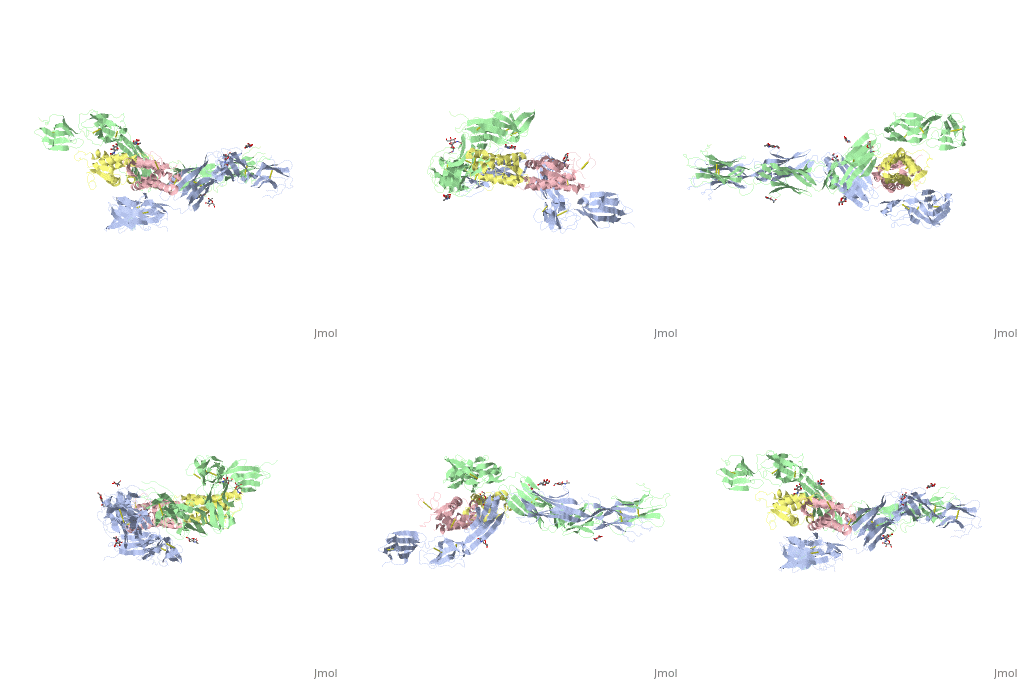
| - | '''Stem cell factor (SCF)''' is a cytokine that mediates its diverse cellular responses by binding to and activating the [https://en.wikipedia.org/wiki/Receptor_tyrosine_kinase receptor tyrosine kinase (RTK)]. [https://en.wikipedia.org/wiki/CD117 KIT] (also known as | + | '''Stem cell factor (SCF)''' is a cytokine that mediates its diverse cellular responses by binding to and activating the [https://en.wikipedia.org/wiki/Receptor_tyrosine_kinase receptor tyrosine kinase (RTK)]. [https://en.wikipedia.org/wiki/CD117 KIT] (also known as [https://en.wikipedia.org/wiki/Stem_cell_factor SCF]receptor), functions as a noncovalent homodimer, and both membrane-anchored and soluble forms of SCF have been described. |
KIT was initially discovered as an oncogene in a feline retrovirus. | KIT was initially discovered as an oncogene in a feline retrovirus. | ||
SCF and KIT are required for a normal development of hematopoietic cells, melanocytes and others. In humans, loss-of-function mutations in KIT cause the [https://en.wikipedia.org/wiki/Piebald piebald] trait. A variety of gain-of-function mutations in KIT were found in different types of human cancers such as gastro-intestinal-stromal tumors, acute myeloid leukemia, and mast cell leukemia. | SCF and KIT are required for a normal development of hematopoietic cells, melanocytes and others. In humans, loss-of-function mutations in KIT cause the [https://en.wikipedia.org/wiki/Piebald piebald] trait. A variety of gain-of-function mutations in KIT were found in different types of human cancers such as gastro-intestinal-stromal tumors, acute myeloid leukemia, and mast cell leukemia. | ||
Revision as of 19:41, 16 August 2015
| |||||||||||