This old version of Proteopedia is provided for student assignments while the new version is undergoing repairs. Content and edits done in this old version of Proteopedia after March 1, 2026 will eventually be lost when it is retired in about June of 2026.
Apply for new accounts at the new Proteopedia. Your logins will work in both the old and new versions.
Quinone reductase
From Proteopedia
(Difference between revisions)
| Line 11: | Line 11: | ||
{{Clear}} | {{Clear}} | ||
| - | The crystal structure of human NQO1 in complex with dicoumarol was determined at 2.75 Å resolution ([[2f1o]]). NQO1 is a <scene name='2f1o/Com_view/6'>physiological homodimer</scene> composed of two interlocked monomers. <scene name='2f1o/Com_view/7'>Two catalytic sites</scene> are formed and are present at the dimer interface (<font color='red'><b>FAD is colored red</b></font> and <font color='blue'><b>dicoumarol is colored blue</b></font>). Therefore, each from these two <scene name='2f1o/Active_site/3'>dicoumarol-hNQO1 binding sites</scene> is formed by both monomers. <span style="color:cyan;background-color:black;font-weight:bold;">Dicoumarol is colored cyan</span>, <span style="color:orange;background-color:black;font-weight:bold;">FAD in orange</span>, nitrogens and oxygens are shown in [http://en.wikipedia.org/wiki/CPK_coloring CPK colors]. NQO1 <font color='blueviolet'><b>chain A is colored blueviolet</b></font> and < | + | The crystal structure of human NQO1 in complex with dicoumarol was determined at 2.75 Å resolution ([[2f1o]]). NQO1 is a <scene name='2f1o/Com_view/6'>physiological homodimer</scene> composed of two interlocked monomers. <scene name='2f1o/Com_view/7'>Two catalytic sites</scene> are formed and are present at the dimer interface (<font color='red'><b>FAD is colored red</b></font> and <font color='blue'><b>dicoumarol is colored blue</b></font>). Therefore, each from these two <scene name='2f1o/Active_site/3'>dicoumarol-hNQO1 binding sites</scene> is formed by both monomers. <span style="color:cyan;background-color:black;font-weight:bold;">Dicoumarol is colored cyan</span>, <span style="color:orange;background-color:black;font-weight:bold;">FAD in orange</span>, nitrogens and oxygens are shown in [http://en.wikipedia.org/wiki/CPK_coloring CPK colors]. NQO1 <font color='blueviolet'><b>chain A is colored blueviolet</b></font> and <span style="color:lime;background-color:black;font-weight:bold;">chain C in green</span>. NQO1 residues, participating in ligand interactions, are shown as stick representation and are labeled (A and C refer to the NQO1 chains). H-bonds are shown by dashed lines with their distances. |
{{Clear}} | {{Clear}} | ||
Revision as of 10:35, 9 September 2015
| |||||||||||
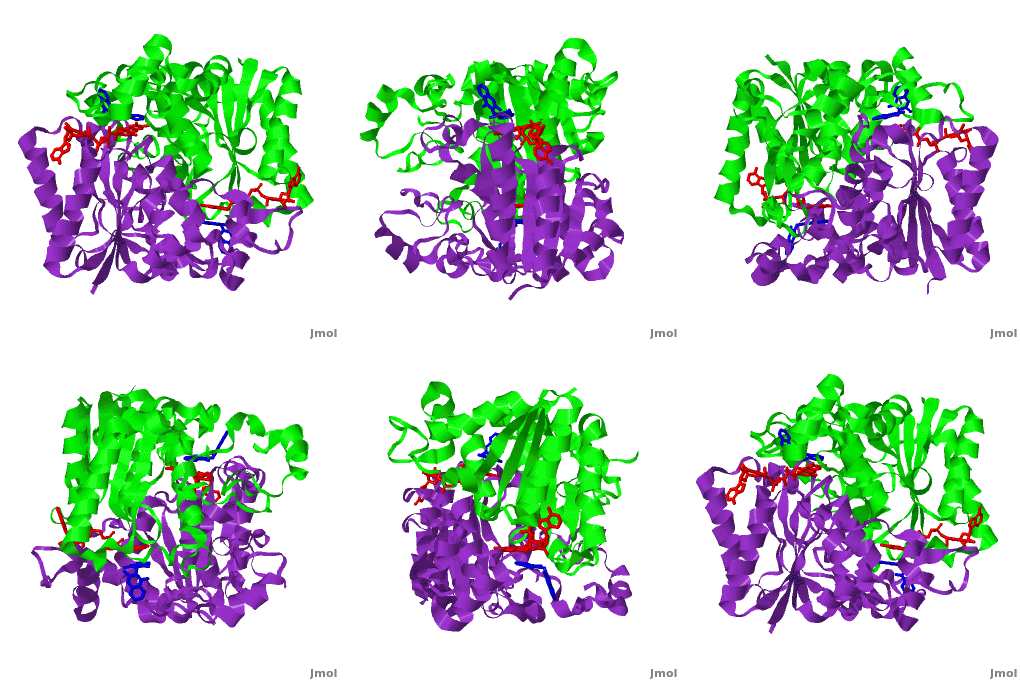
3D Structures of Quinone reductase
Updated on 09-September-2015
References
- Faig M, Bianchet MA, Talalay P, Chen S, Winski S, Ross D, Amzel LM. Structures of recombinant human and mouse NAD(P)H:quinone oxidoreductases: species comparison and structural changes with substrate binding and release. Proc Natl Acad Sci U S A. 2000 Mar 28;97(7):3177-82. PMID:10706635 doi:http://dx.doi.org/10.1073/pnas.050585797
- Asher G, Dym O, Tsvetkov P, Adler J, Shaul Y. The crystal structure of NAD(P)H quinone oxidoreductase 1 in complex with its potent inhibitor dicoumarol. Biochemistry. 2006 May 23;45(20):6372-8. PMID:16700548 doi:10.1021/bi0600087
