This old version of Proteopedia is provided for student assignments while the new version is undergoing repairs. Content and edits done in this old version of Proteopedia after March 1, 2026 will eventually be lost when it is retired in about June of 2026.
Apply for new accounts at the new Proteopedia. Your logins will work in both the old and new versions.
User:Jessica Gauldin/Sandbox1
From Proteopedia
| Line 9: | Line 9: | ||
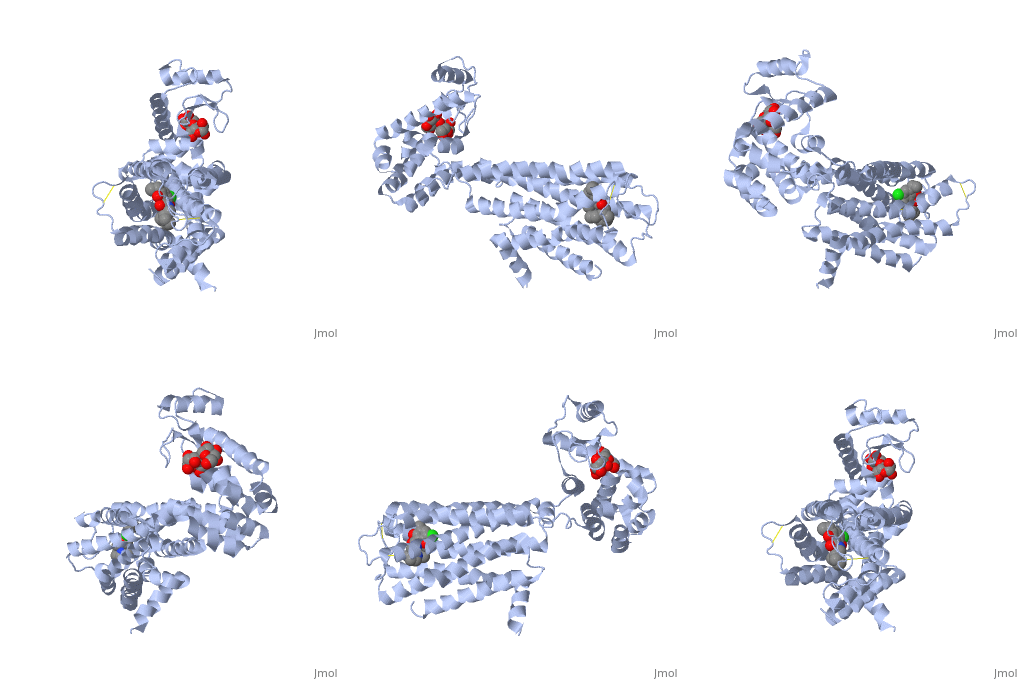
Proteins are a long chain of various amino acid sequences. Inside the binding pocket, the residues that are used to bind dopamine to the receptor are Asp-114, Ser-193, Ser-197, Phe-110, Met-117, Cys-118, Phe-164, Phe-189, Val-190, Trp-386, Phe-390, and Hist-394. Dopamine binds to the top of the receptor structure. The pocket formed by these residues is hydrophobic and the residues are consistent among human dopamine receptors (Kalani et al., 2004). In the dopamine receptor, both the N-terminus (amino end of the polypeptide chain) and the C-terminus (carboxyl-group end of the polypeptide chain) are located on the extracellular portions of the cell membrane. Furthermore, all dopamine receptors contain two cysteine amino acids on their extracellular portions whose disulfide bridge helps stabilize this protein (Missale et al., 1998). | Proteins are a long chain of various amino acid sequences. Inside the binding pocket, the residues that are used to bind dopamine to the receptor are Asp-114, Ser-193, Ser-197, Phe-110, Met-117, Cys-118, Phe-164, Phe-189, Val-190, Trp-386, Phe-390, and Hist-394. Dopamine binds to the top of the receptor structure. The pocket formed by these residues is hydrophobic and the residues are consistent among human dopamine receptors (Kalani et al., 2004). In the dopamine receptor, both the N-terminus (amino end of the polypeptide chain) and the C-terminus (carboxyl-group end of the polypeptide chain) are located on the extracellular portions of the cell membrane. Furthermore, all dopamine receptors contain two cysteine amino acids on their extracellular portions whose disulfide bridge helps stabilize this protein (Missale et al., 1998). | ||
| + | |||
| + | == Function == | ||
== Ligands == | == Ligands == | ||
Revision as of 22:01, 16 November 2015
Dopamine Receptor
| |||||||||||
References
- ↑ Hanson, R. M., Prilusky, J., Renjian, Z., Nakane, T. and Sussman, J. L. (2013), JSmol and the Next-Generation Web-Based Representation of 3D Molecular Structure as Applied to Proteopedia. Isr. J. Chem., 53:207-216. doi:http://dx.doi.org/10.1002/ijch.201300024
- ↑ Herraez A. Biomolecules in the computer: Jmol to the rescue. Biochem Mol Biol Educ. 2006 Jul;34(4):255-61. doi: 10.1002/bmb.2006.494034042644. PMID:21638687 doi:10.1002/bmb.2006.494034042644
3. Beaulieu, Jean-Martin, and Gainetdinov, Raul R. "The Physiology, Signaling, and Pharmacology of Dopamine Receptors." Pharmacological Reviews 63.1 (2011): 182-217.
4. Brisch, Ralf, Arthur Saniotis, Rainer Wolf, Hendrik Bielau, Hans-Gert Bernstein, Johann Steiner, Bernhard Bogerts, Katharina Braun, Zbigniew Jankowski, Jaliya Kumaratilake, Maciej Henneberg, and Tomasz Gos. "The Role of Dopamine in Schizophrenia from a Neurobiological and Evolutionary Perspective: Old Fashioned, but Still in Vogue." Frontiers in Psychiatry. Frontiers Media S.A., 19 May 2014. Web. 16 Nov. 2015.
5. "Dopamine." Dopamine. PubChem, 24 Oct. 2015. Web. 27 Oct. 2015.
6. Kalani, M., Vaidehi, N., Hall, S., Trabanino, R., Freddolino, P., Kalani, M., Floriano, W., Kam, V., Goddard, W.(2004). The predicted 3D structure of the human D2 dopamine receptor and the binding site and binding affinities for agonists and antagonists. Proceedings of the National Academy of Sciences, 101(11), 3815-3820. doi:10.1073/pnas.0400100101
7. Kim, Jong-Hoon, and Johnathan Auerbach. "Dopamine Neurons Derived from Embryonic Stem Cells Function in an Animal Model of Parkinson's Disease." Nature.com. Nature Publishing Group, 4 July 2002. Web. 16 Nov. 2015.
8. Missale, C., Nash, S., Robinson, S., Jaber, M., & Caron, M. (1998). Dopamine Receptors: From Structure to Function. Physiological Reviews, 78(1), 189-225. 16 Nov 2015.
9. "Treatment Statistics." DrugFacts:. NIH, Mar. 2011. Web. 16 Nov. 2015.
