This old version of Proteopedia is provided for student assignments while the new version is undergoing repairs. Content and edits done in this old version of Proteopedia after March 1, 2026 will eventually be lost when it is retired in about June of 2026.
Apply for new accounts at the new Proteopedia. Your logins will work in both the old and new versions.
Sandbox Reserved 1122
From Proteopedia
(Difference between revisions)
| Line 12: | Line 12: | ||
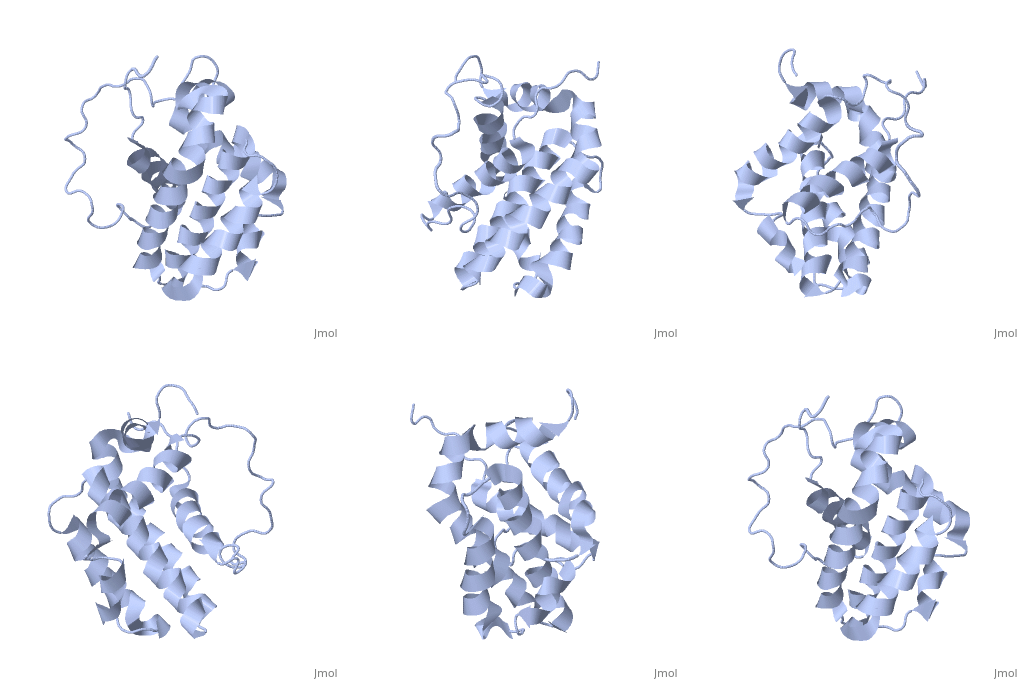
transmembrane domain (218-239) (due to its poor behavior in solution, it has been replaced by a segment of Bcl-xl in the presented 3D structure). It organizes as eight alpha-helices: from 11 to 25 (1) , from 93 to 107 (2), from 109 to 118 (3), from 126 to 137 (4), from 144-163 (5), from 169 to 184 (6), from 186 to 191 (7) and from 194 to 202(8). Helices 5 and 6 are mostly hydrophobic and they are surrounded by four other helices characterized by their amphipathic properties. There are also 3 turns (32-34, 123-125, 138-140). The <scene name='71/719863/Bcl2helix/1'>3rd alpha-helix</scene> is a 3(10) helix, whereas BCL-XL 3rd helix is a normal alpha-helix. | transmembrane domain (218-239) (due to its poor behavior in solution, it has been replaced by a segment of Bcl-xl in the presented 3D structure). It organizes as eight alpha-helices: from 11 to 25 (1) , from 93 to 107 (2), from 109 to 118 (3), from 126 to 137 (4), from 144-163 (5), from 169 to 184 (6), from 186 to 191 (7) and from 194 to 202(8). Helices 5 and 6 are mostly hydrophobic and they are surrounded by four other helices characterized by their amphipathic properties. There are also 3 turns (32-34, 123-125, 138-140). The <scene name='71/719863/Bcl2helix/1'>3rd alpha-helix</scene> is a 3(10) helix, whereas BCL-XL 3rd helix is a normal alpha-helix. | ||
| + | The transmembrane domain of Bcl-2 is made of 21 aminoacids and is located at the carboxy-terminal tail of the protein. It allows the docking of Bcl-2 in the mitochondrial outer membrane where the protein interacts with other effectors. | ||
Bcl-2 contains a hydrophobic groove on its surface that allows dimerization with other members of the Bcl-2 family. This region needs to be highly conserved to keep the ability of interacting with proapoptotic protein of the family, in fact, it has been shown that a mutation in this structure leads to the silencing of the dimerization thus may inhibit the activity of Bcl-2. | Bcl-2 contains a hydrophobic groove on its surface that allows dimerization with other members of the Bcl-2 family. This region needs to be highly conserved to keep the ability of interacting with proapoptotic protein of the family, in fact, it has been shown that a mutation in this structure leads to the silencing of the dimerization thus may inhibit the activity of Bcl-2. | ||
The isoform 1 and 2 differs from two amino acid in the hydrophobic groove but this difference doesn’t induce any change in the conformation of this protein. | The isoform 1 and 2 differs from two amino acid in the hydrophobic groove but this difference doesn’t induce any change in the conformation of this protein. | ||
Revision as of 17:13, 28 January 2016
| This Sandbox is Reserved from 15/12/2015, through 15/06/2016 for use in the course "Structural Biology" taught by Bruno Kieffer at the University of Strasbourg, ESBS. This reservation includes Sandbox Reserved 1120 through Sandbox Reserved 1159. |
To get started:
More help: Help:Editing |
HUMAN BCL-2, ISOFORM1
| |||||||||||
References
- ↑ Hanson, R. M., Prilusky, J., Renjian, Z., Nakane, T. and Sussman, J. L. (2013), JSmol and the Next-Generation Web-Based Representation of 3D Molecular Structure as Applied to Proteopedia. Isr. J. Chem., 53:207-216. doi:http://dx.doi.org/10.1002/ijch.201300024
- ↑ Herraez A. Biomolecules in the computer: Jmol to the rescue. Biochem Mol Biol Educ. 2006 Jul;34(4):255-61. doi: 10.1002/bmb.2006.494034042644. PMID:21638687 doi:10.1002/bmb.2006.494034042644
- ↑ Solution structure of the antiapoptotic protein bcl-2
- ↑ Alpha-Helical Destabilization of the Bcl-2-BH4-Domain Peptide Abolishes Its Ability to Inhibit the IP3 Receptor
- ↑ BH1 and BH2 domains of Bcl-2 are required for inhibition of apoptosis and heterodimerization with Bax
- ↑ Control of mitochondrial apoptosis by the Bcl-2 family
- ↑ Differential Targeting of Prosurvival Bcl-2 Proteins by Their BH3-Only Ligands Allows Complementary Apoptotic Function
- ↑ Distinct BH3 domains either sensitize or activate mitochondrial apoptosis, serving as prototype cancer therapeutics
- ↑ The Release of Cytochrome c from Mitochondria: A Primary Site for Bcl-2 Regulation of Apoptosis
- ↑ Prevention of Apoptosis by Bcl-2: Release of Cytochrome c from Mitochondria Blocked
- ↑ Bcl-2 and Bcl-XL Regulate Proinflammatory Caspase-1 Activation by Interaction with NALP1
