This old version of Proteopedia is provided for student assignments while the new version is undergoing repairs. Content and edits done in this old version of Proteopedia after March 1, 2026 will eventually be lost when it is retired in about June of 2026.
Apply for new accounts at the new Proteopedia. Your logins will work in both the old and new versions.
Nitrite reductase
From Proteopedia
(Difference between revisions)
| Line 1: | Line 1: | ||
<StructureSection load='Cca.pdb' size='450' side='right' scene='Journal:JBIC:16/Cv/2' caption='Heme-containing nitrite reductase with heme and Ca+2 ions (PDB code [[3ubr]])'> | <StructureSection load='Cca.pdb' size='450' side='right' scene='Journal:JBIC:16/Cv/2' caption='Heme-containing nitrite reductase with heme and Ca+2 ions (PDB code [[3ubr]])'> | ||
| - | '''Nitrite reductase''' (NIR) catalyzes the reduction of NO<sub>2</sub> to NO. There are 2 classes of NIR: (1) A heme-containing cytochrome Cd type NIR. This enzyme contains 4 heme groups. Its d-type heme group binds NO<sub>2</sub>. (2) A copper-containing NIR which produces NO<sub>2</sub>. Under anaerobic conditions bacteria rely on the reduction of nitrogen oxide species to obtain energy. NIR is part of the nitrogen cycle used for this purpose. | + | '''Nitrite reductase''' (NIR) catalyzes the reduction of NO<sub>2</sub> to NO. There are 2 classes of NIR: (1) A '''heme-containing cytochrome Cd type NIR'''. This enzyme contains 4 heme groups. Its d-type heme group binds NO<sub>2</sub>. (2) A '''copper-containing NIR''' which produces NO<sub>2</sub>. Under anaerobic conditions bacteria rely on the reduction of nitrogen oxide species to obtain energy. NIR is part of the nitrogen cycle used for this purpose. |
Cytochrome c nitrite reductase (ccNIR) is a central enzyme of the nitrogen cycle. It binds nitrite, and reduces it by transferring 6 electrons to form ammonia. This ammonia can then be utilized to synthesize nitrogen containing molecules such as amino acids or nucleic acids. However, ccNiR’s primary role is to help extract energy from the reduction; ammonia is simply a potentially useful byproduct. In general, heterotrophic organisms feed on electron-rich substances such as sugars or fatty acids. During the metabolism of these substances large numbers of electrons are produced. Many organisms use oxygen as the final acceptor of these electrons, in which case water is formed. However, some organisms can use alternative electron acceptors such as nitrite, which is where ccNiR comes in. | Cytochrome c nitrite reductase (ccNIR) is a central enzyme of the nitrogen cycle. It binds nitrite, and reduces it by transferring 6 electrons to form ammonia. This ammonia can then be utilized to synthesize nitrogen containing molecules such as amino acids or nucleic acids. However, ccNiR’s primary role is to help extract energy from the reduction; ammonia is simply a potentially useful byproduct. In general, heterotrophic organisms feed on electron-rich substances such as sugars or fatty acids. During the metabolism of these substances large numbers of electrons are produced. Many organisms use oxygen as the final acceptor of these electrons, in which case water is formed. However, some organisms can use alternative electron acceptors such as nitrite, which is where ccNiR comes in. | ||
Revision as of 09:42, 15 May 2016
| |||||||||||
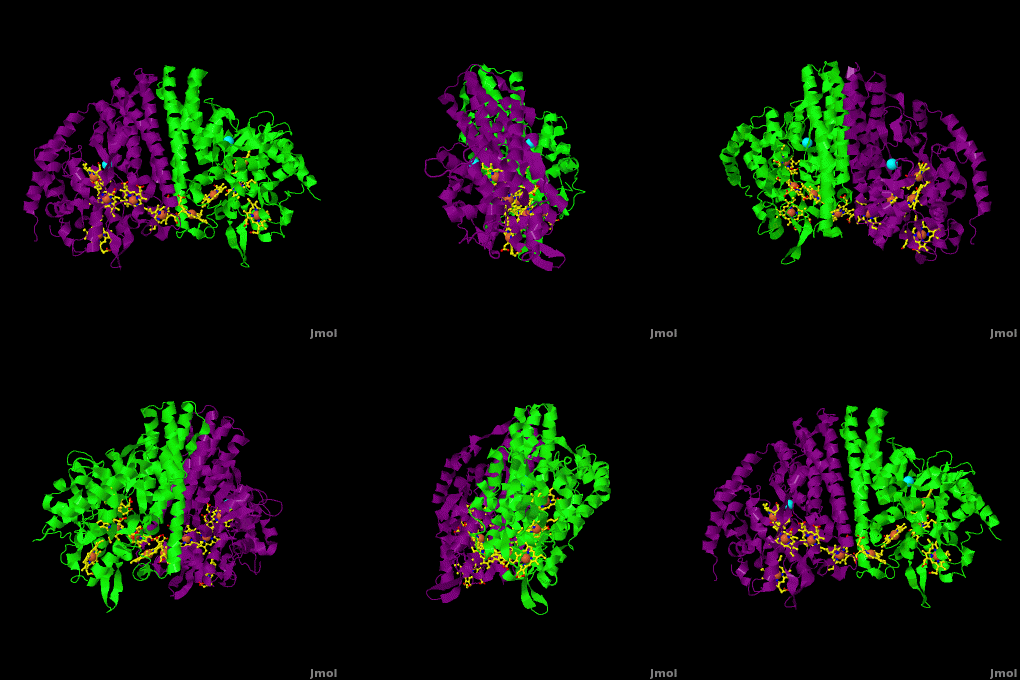

3D structures of nitric reductase
Updated on 15-May-2016
References
- ↑ 1.0 1.1 1.2 Youngblut M, Judd ET, Srajer V, Sayyed B, Goelzer T, Elliott SJ, Schmidt M, Pacheco AA. Laue crystal structure of Shewanella oneidensis cytochrome c nitrite reductase from a high-yield expression system. J Biol Inorg Chem. 2012 Mar 2. PMID:22382353 doi:10.1007/s00775-012-0885-0
