This old version of Proteopedia is provided for student assignments while the new version is undergoing repairs. Content and edits done in this old version of Proteopedia after March 1, 2026 will eventually be lost when it is retired in about June of 2026.
Apply for new accounts at the new Proteopedia. Your logins will work in both the old and new versions.
Sequestosome
From Proteopedia
(Difference between revisions)
| Line 2: | Line 2: | ||
== Function == | == Function == | ||
| + | '''Sequestosome''' (SQS) or '''p62''', is required for the formation and autophagic degredation of polyubiquitin-containg bodies. SQS may regulate signaling cascades through ubiquitination<ref>PMID:15340068</ref>. | ||
| - | + | == Structural highlights == | |
SQS is a multi-domain protein. SQS domain structure includes: <br /> | SQS is a multi-domain protein. SQS domain structure includes: <br /> | ||
PB1 domain which contains Phox and Berm1<br /> | PB1 domain which contains Phox and Berm1<br /> | ||
| Line 12: | Line 13: | ||
LIR – interaction region<br /> | LIR – interaction region<br /> | ||
UBA – ubiquitin association domain. | UBA – ubiquitin association domain. | ||
| - | |||
| - | == Disease == | ||
== Relevance == | == Relevance == | ||
| - | + | SQS is associated with fibrillary tangles in Alzheimer disease<ref>PMID:22138392</ref>. | |
| - | + | ||
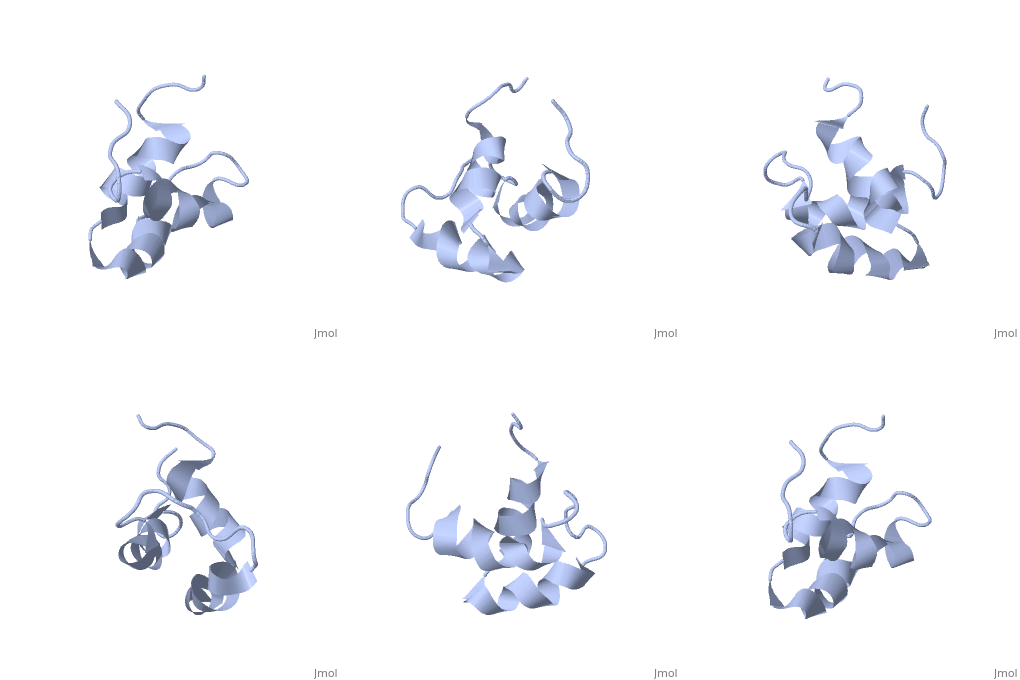
==3D structures of sequestosome== | ==3D structures of sequestosome== | ||
Revision as of 06:46, 25 August 2016
| |||||||||||
References
- ↑ Seibenhener ML, Babu JR, Geetha T, Wong HC, Krishna NR, Wooten MW. Sequestosome 1/p62 is a polyubiquitin chain binding protein involved in ubiquitin proteasome degradation. Mol Cell Biol. 2004 Sep;24(18):8055-68. PMID:15340068 doi:10.1128/MCB.24.18.8055-8068.2004
- ↑ Salminen A, Kaarniranta K, Haapasalo A, Hiltunen M, Soininen H, Alafuzoff I. Emerging role of p62/sequestosome-1 in the pathogenesis of Alzheimer's disease. Prog Neurobiol. 2012 Jan;96(1):87-95. doi: 10.1016/j.pneurobio.2011.11.005. Epub , 2011 Nov 22. PMID:22138392 doi:http://dx.doi.org/10.1016/j.pneurobio.2011.11.005
