This old version of Proteopedia is provided for student assignments while the new version is undergoing repairs. Content and edits done in this old version of Proteopedia after March 1, 2026 will eventually be lost when it is retired in about June of 2026.
Apply for new accounts at the new Proteopedia. Your logins will work in both the old and new versions.
Sandbox 45673
From Proteopedia
(Difference between revisions)
| Line 31: | Line 31: | ||
'''Prostate Cancer''' | '''Prostate Cancer''' | ||
| - | Prostate cancer is an androgen dependant adenocarcinoma. The FDA has not approved finasteride as a treatment for prostate cancer. A warning was added, 5α-reductase inhibitors concerning an increased risk of high-grade prostate cancer, as the treatment of BPH lowers PSA (prostate-specific antigen), which could mask that prostate cancer is present. | + | Prostate cancer is an androgen dependant adenocarcinoma. The FDA has not approved finasteride as a treatment for prostate cancer. A warning was added, 5α-reductase inhibitors concerning an increased risk of high-grade prostate cancer, as the treatment of BPH lowers PSA (prostate-specific antigen), which could mask that prostate cancer is present <ref name=""> Wilt, T.J., MacDonald, R., Hagerty, K., Schellhammer, P., Kramer, B.S. (2008). Five-alpha-reductase Inhibitors for prostate cancer prevention. Cochrane Database Syst Rev (2): CD007091. doi:10.1002/14651858.CD007091. </ref>. |
'''Androgenetic Alopecia (AGA)''' | '''Androgenetic Alopecia (AGA)''' | ||
Revision as of 13:00, 6 December 2016
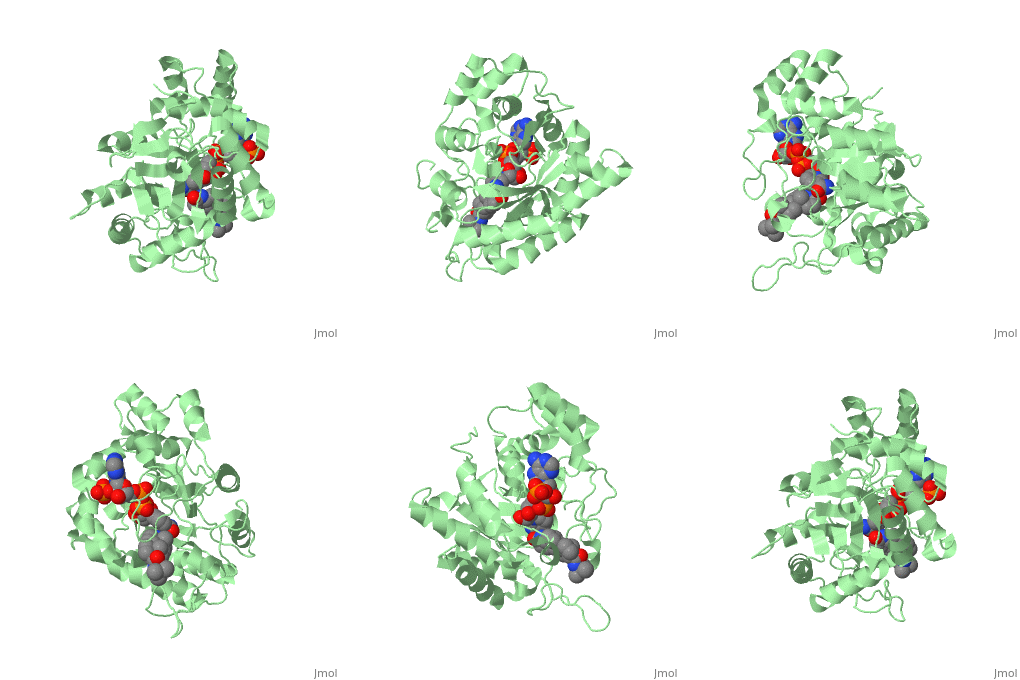
N-(1,1-dimethylethyl)-3-oxo-(5α,17β)-4-azaandrost-1-ene-17-carboxamide (Finasteride)
| |||||||||||


References
- ↑ 1.0 1.1 I.K. Morton; Judith M. Hall (6 December 2012). Concise Dictionary of Pharmacological Agents: Properties and Synonyms. Springer Science & Business Media. pp. 121, 246. ISBN 978-94-011-4439-1
- ↑ 2.0 2.1 Yamana K, Labrie F, Luu-The V (January 2010). Human type 3 5α-reductase is expressed in peripheral tissues at higher levels than types 1 and 2 and its activity is potently inhibited by finasteride and dutasteride. Hormone Molecular Biology and Clinical Investigation. 2 (3). doi:10.1515/hmbci.2010.035
- ↑ Varothai, S; Bergfeld, WF (Jul 2014). "Androgenetic alopecia: an evidence-based treatment update.". American journal of clinical dermatology. 15 (3): 217–30. doi:10.1007/s40257-014-0077-5. PMID 24848508
- ↑ 4.0 4.1 4.2 4.3 Lednicer D (2011). Steroid Chemistry at a Glance. Hoboken: Wiley. ISBN 978-0-470-66084-3
- ↑ 5.0 5.1 Burkhard Fugmann; Susanne Lang-Fugmann; Wolfgang Steglich (28 May 2014). RÖMPP Encyclopedia Natural Products, 1st Edition, 2000. Thieme. pp. 1918–. ISBN 978-3-13-179551-9
- ↑ Schieck, Cynthia L.(1998, August) "Finasteride (Propecia ®)". http://www.chm.bris.ac.uk/motm/finasteride/Finasteride%20(Propecia)%20-%20Feature%20Molecule.htm
- ↑ 7.0 7.1 Bull, Herbert G.*Garcia-Calvo,Margarita Andersson,Stefan†, Baginsky, Walter F.,Chan,H. Karen,Ellsworth,‡ Dina E., Miller,§ Randall R., Stearns,Ralph A.,Bakshi,Raman K.,Rasmusson, Gary H.,Tolman,Richard L., Myers,Robert W.,Kozarich,John W.,Harris,Georgianna S. (1995, August 6) Mechanism-Based Inhibition of Human Steroid 5R-Reductase by Finasteride: Enzyme-Catalyzed Formation of NADP-Dihydrofinasteride, a Potent Bisubstrate Analog Inhibitor. http://pubs.acs.org/doi/pdf/10.1021/ja953069t
- ↑ Tacklind, J., Fink, H.A., MacDonald, R., Rutks, I., Wilt, T.J. (2010). Finasteride for benign prostatic hyperplasia. Cochrane database of systematic reviews 2010, Issue 10. Art. No.: CD006015. DOI: 10.1002/14651858.CD006015.pub3.
- ↑ Dragan, I., Misso, M. (2012). Lycopene for the prevention and treatment of benign prostatic hyperplasia and prostate cancer: A systematic review. Maturitas, 72 (4), 269
- ↑ 10.0 10.1 Robaire, B., Henderson, N.A. (2006). Actions of 5alpha-reductase inhibitors on the epididymis. Molecular and Cellular Endocrinology. 250 (1-2): 190–5. doi:10.1016/j.mce.2005.12.044
- ↑ Olsen, E. A., Hordinsky, M., & Whiting, D., et al. (2006, December).
- ↑ Leyden, James et al.(June 1999)."Finasteride in the treatment of men with frontal male pattern hair loss." Journal of the American Academy of Dermatology. Volume 40 , Issue 6 , 930 - 937
