This old version of Proteopedia is provided for student assignments while the new version is undergoing repairs. Content and edits done in this old version of Proteopedia after March 1, 2026 will eventually be lost when it is retired in about June of 2026.
Apply for new accounts at the new Proteopedia. Your logins will work in both the old and new versions.
GP1 of Lassa Virus
From Proteopedia
(Difference between revisions)
| Line 5: | Line 5: | ||
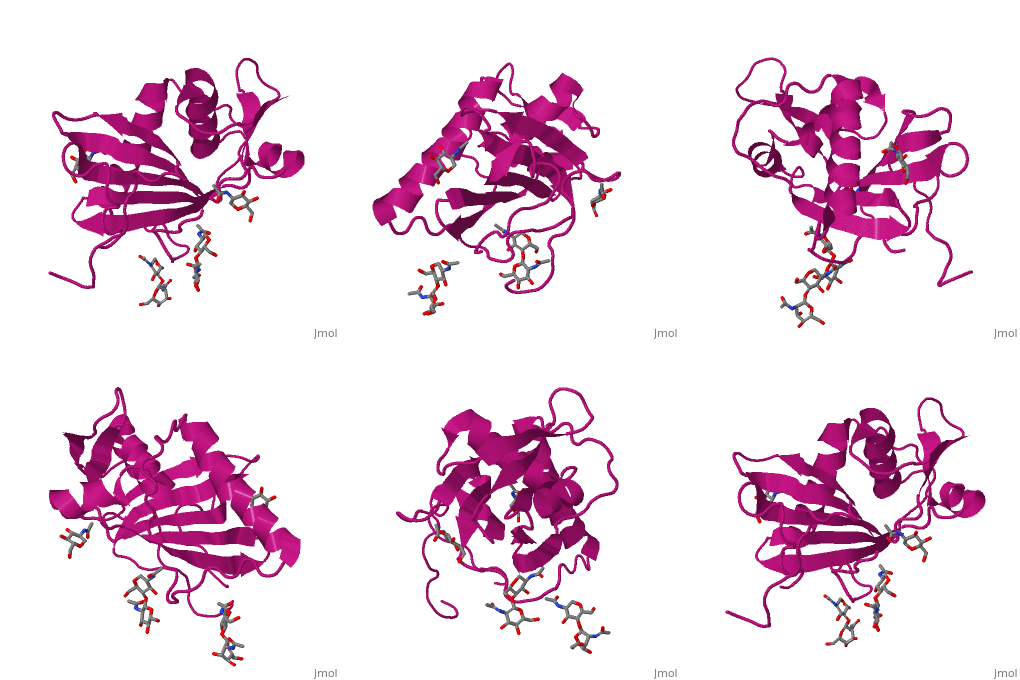
'''GP1''' (Glycoprotein 1) is the receptor binding domain of LASV that mediates receptor recognition. Research thus far indicates that GP1 from LASV may undergo irreversible conformational changes that could serve as an immunological decoy mechanism. | '''GP1''' (Glycoprotein 1) is the receptor binding domain of LASV that mediates receptor recognition. Research thus far indicates that GP1 from LASV may undergo irreversible conformational changes that could serve as an immunological decoy mechanism. | ||
==Structural Highlights== | ==Structural Highlights== | ||
| - | GP1 of LASV is a 4 chain structure with <scene name=' | + | GP1 of LASV is a 4 chain structure with <scene name='76/761695/Nag/1'>NAG</scene> ligands attached to each chain. The overall architecture of GP1 features a central β-sheet and two distinct halves: a glycosylated half containing the receptor-binding site that is made mostly by the central β-sheet and surrounding loops and a half that contains mostly helices and most likely faces the trimer axis<ref name="MolMechforLAMP1">DOI 10.1128/JVI.00651-15</ref>. The method used to determine this structure was [https://en.wikipedia.org/wiki/X-ray_crystallography X-ray diffraction] |
=== Histidine Triad=== | === Histidine Triad=== | ||
Attached to this structure is a unique <scene name='76/761695/Histriad/5'>triad of histidines</scene> that is highly conserved among Old World arenaviruses. Located on the β-sheet face of GP1, the histidine triad is a structural element that directly interacts with [[LAMP1]] (Lysosome-associated membrane glycoprotein) and helps stabilize a LAMP1-"compatible" conformation by providing a molecular mechanism for the pH-dependent receptor switching<ref name="MolMechforLAMP1" />. The histidine triad is critical in forming a binding site for LAMP1 (insert scene). | Attached to this structure is a unique <scene name='76/761695/Histriad/5'>triad of histidines</scene> that is highly conserved among Old World arenaviruses. Located on the β-sheet face of GP1, the histidine triad is a structural element that directly interacts with [[LAMP1]] (Lysosome-associated membrane glycoprotein) and helps stabilize a LAMP1-"compatible" conformation by providing a molecular mechanism for the pH-dependent receptor switching<ref name="MolMechforLAMP1" />. The histidine triad is critical in forming a binding site for LAMP1 (insert scene). | ||
Revision as of 12:01, 27 June 2017
| |||||||||||
References
- ↑ 1.0 1.1 Cohen-Dvashi H, Cohen N, Israeli H, Diskin R. Molecular mechanism for LAMP1 recognition by Lassa Virus. J Virol. 2015 May 13. pii: JVI.00651-15. PMID:25972533 doi:http://dx.doi.org/10.1128/JVI.00651-15
Categories: Cohen, N | Cohen-Dvashi, H | Diskin, R | Israeli, H | Arenavirus | Glycoprotein | Lassa | LASV | Receptor binding | Viral protein | 4zjf | GP1
