This old version of Proteopedia is provided for student assignments while the new version is undergoing repairs. Content and edits done in this old version of Proteopedia after March 1, 2026 will eventually be lost when it is retired in about June of 2026.
Apply for new accounts at the new Proteopedia. Your logins will work in both the old and new versions.
PCSK9
From Proteopedia
| Line 1: | Line 1: | ||
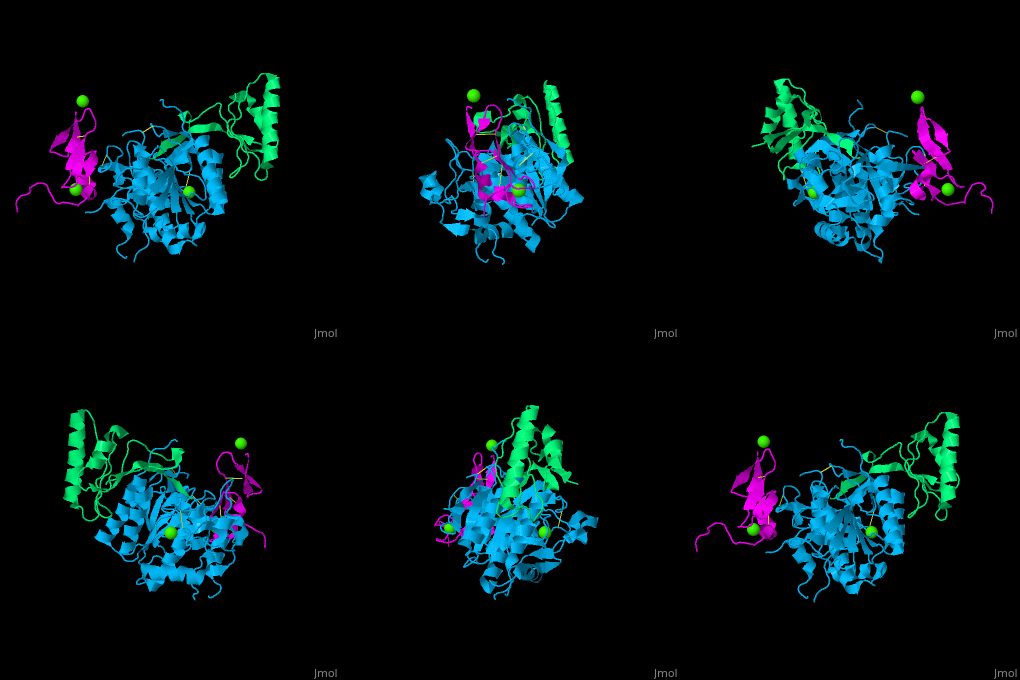
| - | <StructureSection load='2w2m' size=' | + | <StructureSection load='2w2m' size='400' side='right' caption='Structure of human PCSK9 catalytic domain (grey) and prodomain (green) complex with LDL receptor EGF-A domain (magenta) and Ca+2 ion (PDB entry [[2w2m]])' scene='55/553967/Cv/1' pspeed='8'> |
== Function == | == Function == | ||
'''PCSK9''' or '''Proprotein Convertase Subtilisin/Kexin type 9''' is a proteinase which is part of the cholesterol synthesis<ref>PMID:17502100</ref>. PCSK9 undergoes autocatalysis producing an active enzyme from its precursor. PCSK9 binds to EGF-A domain of the LDL receptor (LDLR) inducing its degradation. | '''PCSK9''' or '''Proprotein Convertase Subtilisin/Kexin type 9''' is a proteinase which is part of the cholesterol synthesis<ref>PMID:17502100</ref>. PCSK9 undergoes autocatalysis producing an active enzyme from its precursor. PCSK9 binds to EGF-A domain of the LDL receptor (LDLR) inducing its degradation. | ||
| Line 6: | Line 6: | ||
Low levels of LDL receptor are a cause of hypercholesterolemia since LDLR removes LDL cholesterol from the blood. Thus PCSK9 is an important drug target as its level affects the amount of cholesterol in blood<ref>PMID:23317404</ref>. Inhibition of PCSK9 results in increased pathogen lipid clearance, decreased inflammatory response and improved septic shock outcome<ref>PMID:25320235</ref>. | Low levels of LDL receptor are a cause of hypercholesterolemia since LDLR removes LDL cholesterol from the blood. Thus PCSK9 is an important drug target as its level affects the amount of cholesterol in blood<ref>PMID:23317404</ref>. Inhibition of PCSK9 results in increased pathogen lipid clearance, decreased inflammatory response and improved septic shock outcome<ref>PMID:25320235</ref>. | ||
| + | == Structural highlights == | ||
| + | </StructureSection> | ||
==3D structures of PCSK9== | ==3D structures of PCSK9== | ||
Revision as of 13:15, 24 August 2017
| |||||||||||
3D structures of PCSK9
Updated on 24-August-2017
2p4e, 2pmw, 2qtw – hPCSK9 – human
3bps, 2w2m, 3gcx – hPCSK9 + LDLR EGF-A
2w2n, 3gcw – hPCSK9 + LDLR EGF-A (mutant)
2w2o, 2w2p, 2w2q – hPCSK9 (mutant) + LDLR EGF-A
3h42 – hPCSK9 (mutant) + antibody
2xtj, 3sqo, 4k8r – hPCSK9 + antibody
3m0c – hPCSK9 (mutant) + LDLR
3p5b, 3p5c – hPCSK9 + LDLR variant
References
- ↑ Piper DE, Jackson S, Liu Q, Romanow WG, Shetterly S, Thibault ST, Shan B, Walker NP. The crystal structure of PCSK9: a regulator of plasma LDL-cholesterol. Structure. 2007 May;15(5):545-52. PMID:17502100 doi:http://dx.doi.org/10.1016/j.str.2007.04.004
- ↑ Seidah NG. Proprotein convertase subtilisin kexin 9 (PCSK9) inhibitors in the treatment of hypercholesterolemia and other pathologies. Curr Pharm Des. 2013;19(17):3161-72. PMID:23317404
- ↑ Walley KR, Thain KR, Russell JA, Reilly MP, Meyer NJ, Ferguson JF, Christie JD, Nakada TA, Fjell CD, Thair SA, Cirstea MS, Boyd JH. PCSK9 is a critical regulator of the innate immune response and septic shock outcome. Sci Transl Med. 2014 Oct 15;6(258):258ra143. doi: 10.1126/scitranslmed.3008782. PMID:25320235 doi:http://dx.doi.org/10.1126/scitranslmed.3008782
