We apologize for Proteopedia being slow to respond. For the past two years, a new implementation of Proteopedia has been being built. Soon, it will replace this 18-year old system. All existing content will be moved to the new system at a date that will be announced here.
Plasminogen activator
From Proteopedia
(Difference between revisions)
| Line 1: | Line 1: | ||
| - | <StructureSection load=' | + | <StructureSection load='' size='400' side='right' caption='Human tissue plasminogen activator light chain catalytic domain (sky blue and green), heavy chain catalytic domain fragment (yellow and pink) complex with benzamidine, [[1a5h]]' scene='47/476004/Cv/1' pspeed='8' > |
== Function == | == Function == | ||
'''Plasminogen activator''' (PLA) is a serine protease which converts plasminogen to plasmin. TPA structure contains heavy and light chains (HC, LC). PLA is inhibited by PLA inhibitor 1 and 2. | '''Plasminogen activator''' (PLA) is a serine protease which converts plasminogen to plasmin. TPA structure contains heavy and light chains (HC, LC). PLA is inhibited by PLA inhibitor 1 and 2. | ||
Revision as of 19:58, 3 September 2017
| |||||||||||
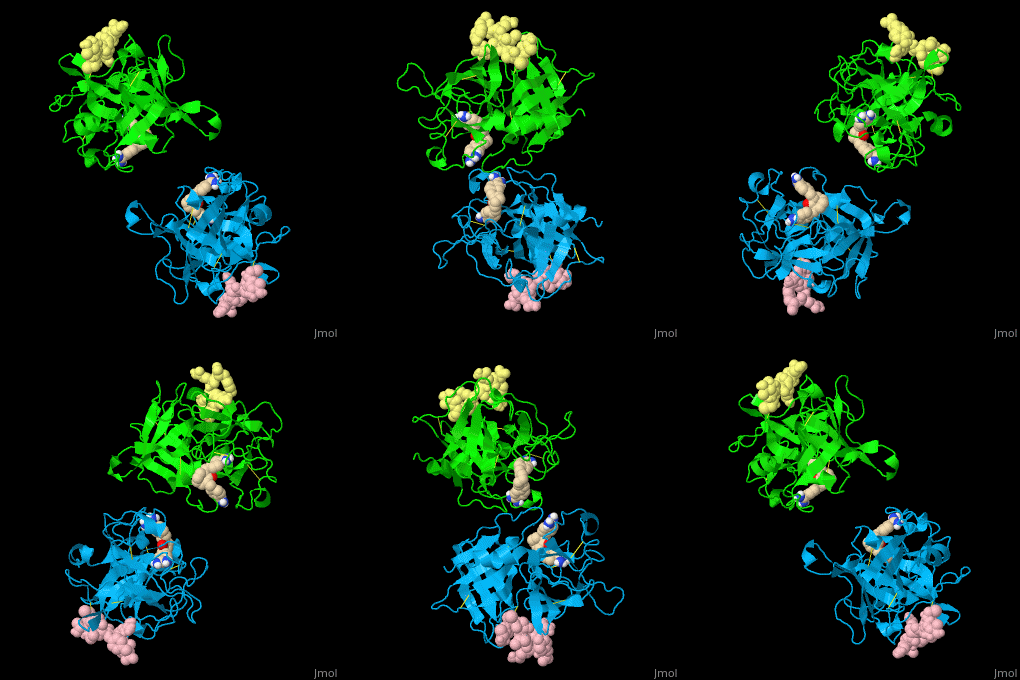
3D structures of plasminogen activator
Updated on 03-September-2017
References
- ↑ Sodeinde OA, Sample AK, Brubaker RR, Goguen JD. Plasminogen activator/coagulase gene of Yersinia pestis is responsible for degradation of plasmid-encoded outer membrane proteins. Infect Immun. 1988 Oct;56(10):2749-52. PMID:2843471
- ↑ . Tissue plasminogen activator for acute ischemic stroke. The National Institute of Neurological Disorders and Stroke rt-PA Stroke Study Group. N Engl J Med. 1995 Dec 14;333(24):1581-7. PMID:7477192 doi:http://dx.doi.org/10.1056/NEJM199512143332401
