This old version of Proteopedia is provided for student assignments while the new version is undergoing repairs. Content and edits done in this old version of Proteopedia after March 1, 2026 will eventually be lost when it is retired in about June of 2026.
Apply for new accounts at the new Proteopedia. Your logins will work in both the old and new versions.
Polygalacturonase
From Proteopedia
(Difference between revisions)
| Line 1: | Line 1: | ||
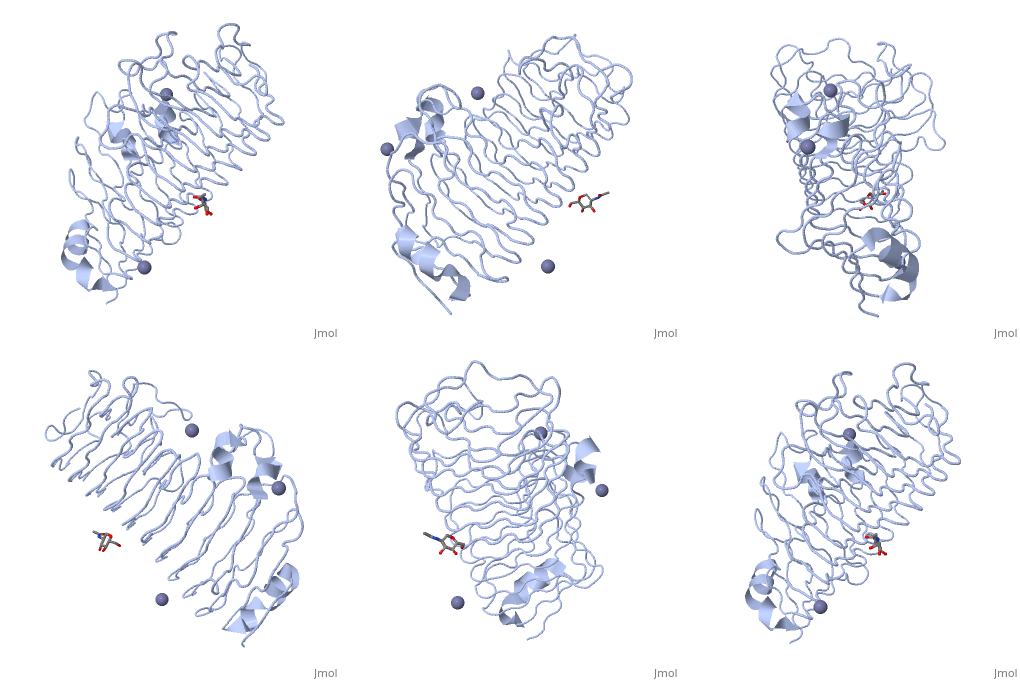
| - | <Structure load='1czf' size='350' side='right' caption='Glycosylated structure of | + | <Structure load='1czf' size='350' side='right' caption='Glycosylated structure of endo-polygalacturonase II complex with Zn+2 ion (grey) (PDB code [[1czf]])' scene=''> |
| - | + | ||
'''Polygalacturonases''' (PGs) catalyze the enzymatic depolymerization of pectates – polysaccharides that comprise the plant cell wall. Polymer disassembly of substrates by ''exo-'' and ''endo-'' PGs is carried out via a hydrolytic mechanism. Degradation of pectates in plant cell walls contributes to ripening of fruits, such as tomatoes and melons <ref>DOI: 10.1104/pp.117.2.337</ref>. Microbial PGs have been identified to be a part of defense mechanisms because of their role in pathogen attack <ref>DOI: 10.1074/jbc.273.38.24660</ref>. | '''Polygalacturonases''' (PGs) catalyze the enzymatic depolymerization of pectates – polysaccharides that comprise the plant cell wall. Polymer disassembly of substrates by ''exo-'' and ''endo-'' PGs is carried out via a hydrolytic mechanism. Degradation of pectates in plant cell walls contributes to ripening of fruits, such as tomatoes and melons <ref>DOI: 10.1104/pp.117.2.337</ref>. Microbial PGs have been identified to be a part of defense mechanisms because of their role in pathogen attack <ref>DOI: 10.1074/jbc.273.38.24660</ref>. | ||
Revision as of 19:09, 7 January 2018
| |||||||||||

Proteopedia Page Contributors and Editors (what is this?)
Joel L. Sussman, Krishna Amin, Michal Harel, Marilyn Yoder, OCA, Jaime Prilusky
