This old version of Proteopedia is provided for student assignments while the new version is undergoing repairs. Content and edits done in this old version of Proteopedia after March 1, 2026 will eventually be lost when it is retired in about June of 2026.
Apply for new accounts at the new Proteopedia. Your logins will work in both the old and new versions.
Sandbox Reserved 1387
From Proteopedia
(Difference between revisions)
| Line 6: | Line 6: | ||
== Function == | == Function == | ||
The main function of this protein is glucose transmembrane transport. It is one of fourteen facilitative sugar transporters. <ref>https://www.ebi.ac.uk/pdbe/entry/pdb/5c65</ref> | The main function of this protein is glucose transmembrane transport. It is one of fourteen facilitative sugar transporters. <ref>https://www.ebi.ac.uk/pdbe/entry/pdb/5c65</ref> | ||
| - | GLUT3 is categorized as a Class I transporter due to its protein sequence and structural similarity to other glucose transporters grouped in Class I. GLUT3 displays the highest affinity for glucose of all of the Class I glucose transporters and has a transport capacity five times greater than that of GLUT1 and GLUT4<ref>DOI 10.1152/ajpendo.90388.2008</ref>. | + | GLUT3 is categorized as a Class I transporter due to its protein sequence and structural similarity to other glucose transporters grouped in Class I. GLUT3 displays the highest affinity for glucose of all of the Class I glucose transporters and has a transport capacity five times greater than that of GLUT1 and GLUT4<ref>DOI 10.1152/ajpendo.90388.2008</ref>. |
| + | |||
| + | GLUT3 is found predominantly in brain tissue, almost always expressed by neurons. The location of GLUT3 has led to it sometimes being called the "neuronal glucose transporter". | ||
| + | |||
| + | Its main function is to act in the transmembrane region to create channels for glucose to move across the cell membrane. | ||
== Disease == | == Disease == | ||
| Line 13: | Line 17: | ||
== Structural highlights == | == Structural highlights == | ||
| - | GLUT3 has 481 amino acids, which compose 28 alpha helices. | + | GLUT3 has 481 amino acids, which compose 28 alpha helices. It weighs approximately 52,520 Daltons which is equivalent to 8.72115e-20 grams<ref>https://www.ebi.ac.uk/pdbe/entry/pdb/5c65</ref>. |
Its <scene name='77/777707/Hydrophobic_binding_sites/2'>Hydrophobic Binding Sites</scene> are Leucine, Alanine, Phenylalanine, Isoleucine. | Its <scene name='77/777707/Hydrophobic_binding_sites/2'>Hydrophobic Binding Sites</scene> are Leucine, Alanine, Phenylalanine, Isoleucine. | ||
Revision as of 03:02, 27 February 2018
| This Sandbox is Reserved from January through July 31, 2018 for use in the course HLSC322: Principles of Genetics and Genomics taught by Genevieve Houston-Ludlam at the University of Maryland, College Park, USA. This reservation includes Sandbox Reserved 1311 through Sandbox Reserved 1430. |
To get started:
More help: Help:Editing |
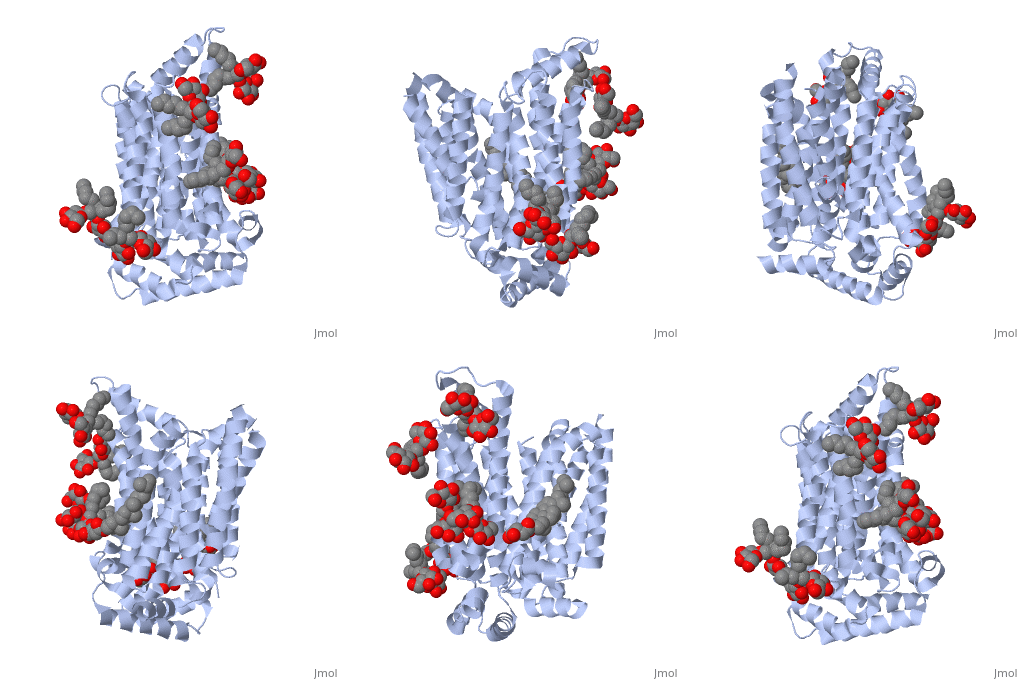
Homo sapien Glucose Transporter GLUT3 / SLC2A3
| |||||||||||
References
- ↑ Hanson, R. M., Prilusky, J., Renjian, Z., Nakane, T. and Sussman, J. L. (2013), JSmol and the Next-Generation Web-Based Representation of 3D Molecular Structure as Applied to Proteopedia. Isr. J. Chem., 53:207-216. doi:http://dx.doi.org/10.1002/ijch.201300024
- ↑ Herraez A. Biomolecules in the computer: Jmol to the rescue. Biochem Mol Biol Educ. 2006 Jul;34(4):255-61. doi: 10.1002/bmb.2006.494034042644. PMID:21638687 doi:10.1002/bmb.2006.494034042644
- ↑ https://www.ebi.ac.uk/pdbe/entry/pdb/5c65
- ↑ Simpson IA, Dwyer D, Malide D, Moley KH, Travis A, Vannucci SJ. The facilitative glucose transporter GLUT3: 20 years of distinction. Am J Physiol Endocrinol Metab. 2008 Aug;295(2):E242-53. doi:, 10.1152/ajpendo.90388.2008. Epub 2008 Jun 24. PMID:18577699 doi:http://dx.doi.org/10.1152/ajpendo.90388.2008
- ↑ https://www.ebi.ac.uk/pdbe/entry/pdb/5c65
