We apologize for Proteopedia being slow to respond. For the past two years, a new implementation of Proteopedia has been being built. Soon, it will replace this 18-year old system. All existing content will be moved to the new system at a date that will be announced here.

User:Jaime.Prilusky/Test/Sortable

From Proteopedia

(Difference between revisions)
Jump to: navigation, search
Line 1: Line 1:
-
<table style="width:100%;border:2px solid #ddd;border-collapse: collapse;table-layout: fixed; ">
+
<table id="tableColumnsMainPage" style="width:100%;border:2px solid #ddd;border-collapse: collapse;table-layout: fixed; ">
<tr><td colspan='4' style="background:#F5F5FC;border:1px solid #ddd;">
<span style="font-size:2.0em; border:none; margin:0; padding:0.3em; color:#000; font-weight: bold;">Welcome to Proteopedia</span><br>

Revision as of 07:23, 18 October 2018

Welcome to Proteopedia
ISSN 2310-6301 The free, collaborative 3D-encyclopedia of proteins & other molecules

Journals Art on Science Selected Pages Education
About this image
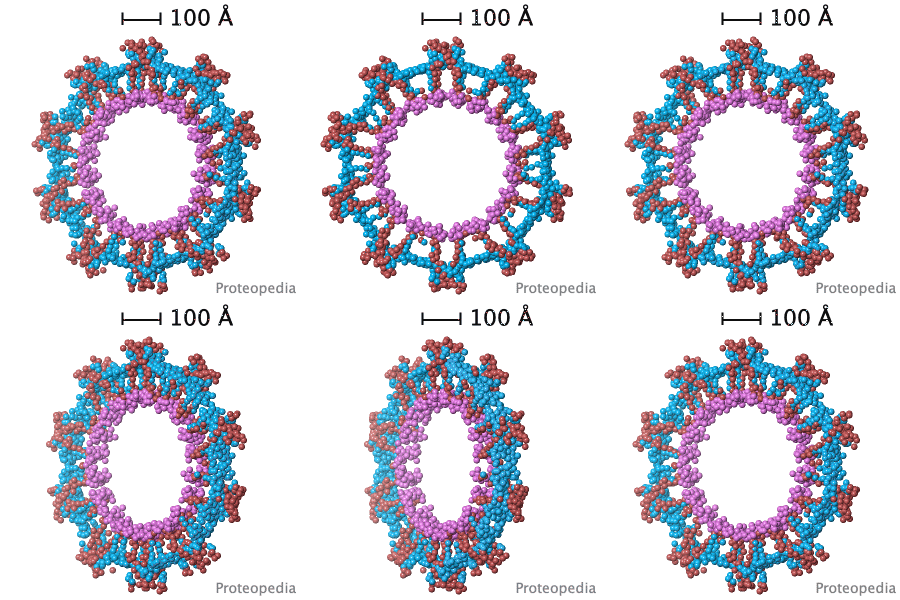
Geobacter pili: surprising function.

Y Gu, V Srikanth, AI Salazar-Morales, R Jain, JP O'Brien, SM Yi, RK Soni, FA Samatey, SE Yalcin, NS Malvankar. Nature 2021 doi: 10.1038/s41586-021-03857-w
Geobacter pili were long thought to be electrically conductive protein nanowires composed of PilA-N. Nanowires are crucial to the energy metabolism of bacteria flourishing in oxygen-deprived environments. To everyone's surprise, in 2019, the long-studied nanowires were found to be linear polymers of multi-heme cytochromes, not pili. The first cryo-EM structure of pili (2021) reveals a filament made of dimers of PilA-N and PilA-C, shown. Electrical conductivity of pili is much lower than that of cytochrome nanowires. Evidence suggests that PilA-NC filaments are periplasmic pseudopili crucial for exporting cytochrome nanowires onto the cell surface, rather than the pili serving as nanowires themselves.

>>> Visit I3DC Interactive Visualizations >>>

About this image
Molecular Sculpture

by Eric Martz
A historical review on sculptures and physical models of macromolecules.

>>> Visit this page >>>

About this image
The ribosome

by Wayne Decatur
The 2009 Nobel Prize in Chemistry was awarded for studies of the ribosome. The ribosome is the machine in your cells that accurately and efficiently decodes the genetic information stored in your genome and synthesizes the corresponding polypeptide chain one amino acid at a time in the process of translation. These structures are considered landmarks for the fact they showed clearly the major contributions to decoding and peptide bond synthesis come from RNA and not protein, as well as for the sheer size of the structures determined.

>>> Visit this page >>>

About this image
Tutorial: The Ramachandran principle, phi (φ) and psi (ψ) angles in proteins

by Eric Martz
The Ramachandran Principle says that alpha helices, beta strands, and turns are the most likely conformations for a polypeptide chain to adopt, because most other conformations are impossible due to steric collisions between atoms. Check Show Clashes to see where non-bonded atoms are overlapping, and thus in physically impossible positions.

>>> Visit this tutorial >>>

Proteopedia Page Contributors and Editors (what is this?)

Jaime Prilusky

Personal tools