This old version of Proteopedia is provided for student assignments while the new version is undergoing repairs. Content and edits done in this old version of Proteopedia after March 1, 2026 will eventually be lost when it is retired in about June of 2026.
Apply for new accounts at the new Proteopedia. Your logins will work in both the old and new versions.
Lisinopril-Angiotensin Converting Enzyme
From Proteopedia
(Difference between revisions)
| Line 1: | Line 1: | ||
| - | + | =Effect of Lisinopril on ACE= | |
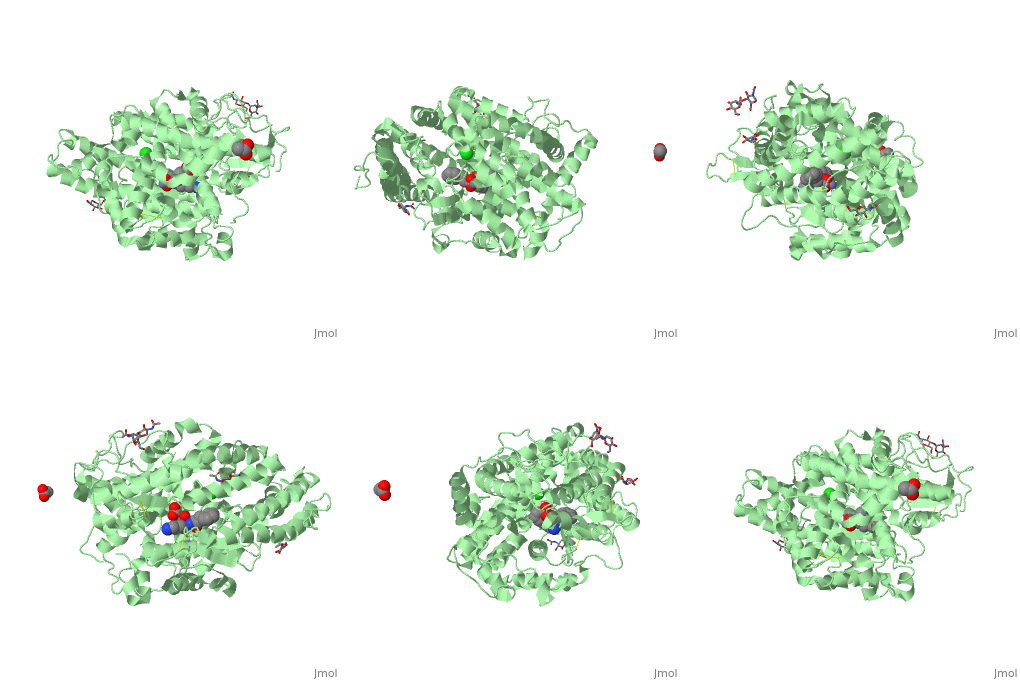
<StructureSection load='2c6n' Caption for this structure'Structure of human somatic angiontensin-I converting enzyme N domain with lisinopril | <StructureSection load='2c6n' Caption for this structure'Structure of human somatic angiontensin-I converting enzyme N domain with lisinopril | ||
='> | ='> | ||
| Line 9: | Line 9: | ||
The angiotensin converting enzyme (ACE) is an enzyme that is found renin angiotensin system which is often known as RAS. RAS is a hormone system that regulates blood pressure and fluid as well as electrolyte balance. It is a zinc and chloride dependent metallopeptidase that is membrane bound. The job of the enzyme is to catalyze the conversion of angiotensin I to the physiologically active peptide angiotensin II. It does this cleaving C-terminal (His-Leu) dipeptide on the angiotensin I. It also inactivates the hormone bradykinin (vasodepressor) by removing two C-terminal dipeptides. | The angiotensin converting enzyme (ACE) is an enzyme that is found renin angiotensin system which is often known as RAS. RAS is a hormone system that regulates blood pressure and fluid as well as electrolyte balance. It is a zinc and chloride dependent metallopeptidase that is membrane bound. The job of the enzyme is to catalyze the conversion of angiotensin I to the physiologically active peptide angiotensin II. It does this cleaving C-terminal (His-Leu) dipeptide on the angiotensin I. It also inactivates the hormone bradykinin (vasodepressor) by removing two C-terminal dipeptides. | ||
| - | =Structure of Lisinopril= | + | ==Structure of Lisinopril== |
Lisinopril (S)-1-[(N^2-carboxyl-3-phenylpropyl]-L-lysyl-L-proline diyhdrate) is a drug that is used to inhibit ACE and to treat hypertension, congestive heart failure and improve survival after a heart attack. Its molecular formula is C21 H31 N3 O5. | Lisinopril (S)-1-[(N^2-carboxyl-3-phenylpropyl]-L-lysyl-L-proline diyhdrate) is a drug that is used to inhibit ACE and to treat hypertension, congestive heart failure and improve survival after a heart attack. Its molecular formula is C21 H31 N3 O5. | ||
Revision as of 23:33, 5 May 2019
Effect of Lisinopril on ACE
| |||||||||||
References
- ↑ Riordan, James F. “Angiotensin-I-converting enzyme and its relatives.” Genome biology vol. 4,8 (2003): 225. doi:10.1186/gb-2003-4-8-225
- ↑ Olvera Lopez E, Terrell JM. Lisinopril. [Updated 2019 Jan 20]. In: StatPearls [Internet]. Treasure Island (FL): StatPearls Publishing; 2019 Jan-. Available from: https://www.ncbi.nlm.nih.gov/books/NBK482230/ /
- ↑ Sondes Bouabdallah, Med Thaieb Ben Dhia, and Med Rida Driss, “Study of a Conformational Equilibrium of Lisinopril by HPLC, NMR, and DFT,” International Journal of Analytical Chemistry, vol. 2014, Article ID 494719, 8 pages, 2014. https://doi.org/10.1155/2014/494719.
