This old version of Proteopedia is provided for student assignments while the new version is undergoing repairs. Content and edits done in this old version of Proteopedia after March 1, 2026 will eventually be lost when it is retired in about June of 2026.
Apply for new accounts at the new Proteopedia. Your logins will work in both the old and new versions.
Haptoglobin receptor
From Proteopedia
(Difference between revisions)
| Line 2: | Line 2: | ||
== Function == | == Function == | ||
'''Haptoglobin receptor''' (IsdH) is part of the iron-regulated surface determinant system that captures heme from the host hemoproteins. IsdH binds haptoglobin (Hp) which removes hemoglobin (Hb) from the blood by forming Hp-Hb complex. IsdH contains multiple '''NEAT''' (Near Transporter) domains which bind proteins and heme<ref>PMID:18451305</ref>. For more details see [[Molecular Playground/Hemoglobin-Haptoglobin Complex]]. | '''Haptoglobin receptor''' (IsdH) is part of the iron-regulated surface determinant system that captures heme from the host hemoproteins. IsdH binds haptoglobin (Hp) which removes hemoglobin (Hb) from the blood by forming Hp-Hb complex. IsdH contains multiple '''NEAT''' (Near Transporter) domains which bind proteins and heme<ref>PMID:18451305</ref>. For more details see [[Molecular Playground/Hemoglobin-Haptoglobin Complex]]. | ||
| - | *<scene name='70/706235/Cv/ | + | *<scene name='70/706235/Cv/5'>IsdH NEAT-3 domain complex with heme-containing hemoglobin subunits α and β</scene>. (PDB code [[3szk]]) |
| - | *<scene name='70/706235/Cv/ | + | *<scene name='70/706235/Cv/6'>Heme binding in subunit α</scene>. |
| - | *<scene name='70/706235/Cv/ | + | *<scene name='70/706235/Cv/7'>Heme binding in subunit β</scene>. |
</StructureSection> | </StructureSection> | ||
Revision as of 13:06, 14 May 2019
| |||||||||||
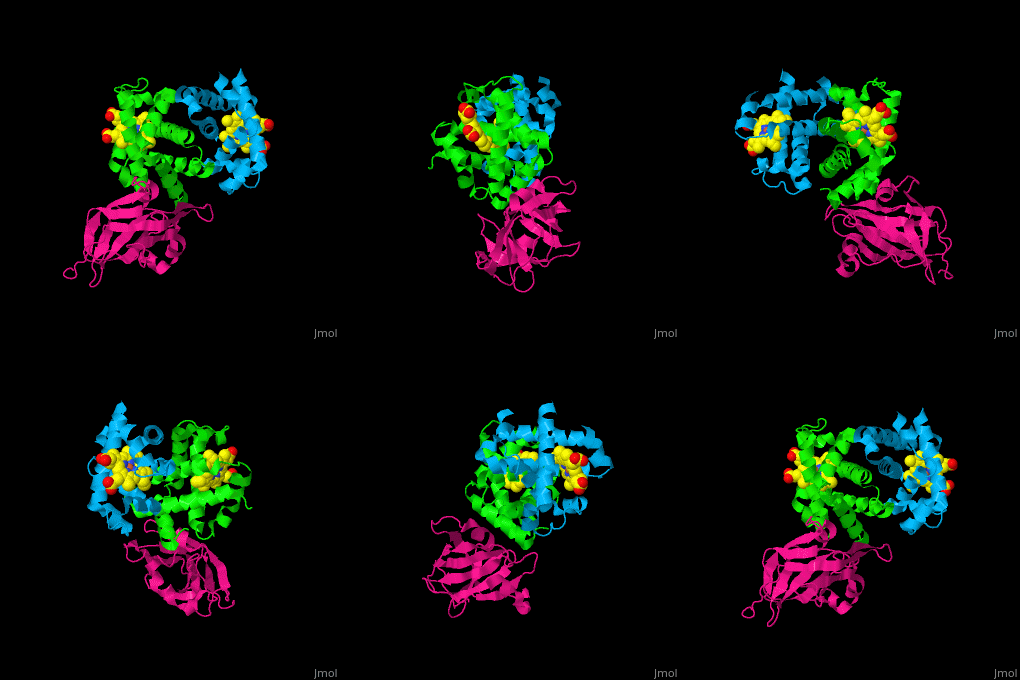
3D Structures of haptoglobin receptor
Updated on 14-May-2019
References
- ↑ Vanhollebeke B, De Muylder G, Nielsen MJ, Pays A, Tebabi P, Dieu M, Raes M, Moestrup SK, Pays E. A haptoglobin-hemoglobin receptor conveys innate immunity to Trypanosoma brucei in humans. Science. 2008 May 2;320(5876):677-81. doi: 10.1126/science.1156296. PMID:18451305 doi:http://dx.doi.org/10.1126/science.1156296
