This old version of Proteopedia is provided for student assignments while the new version is undergoing repairs. Content and edits done in this old version of Proteopedia after March 1, 2026 will eventually be lost when it is retired in about June of 2026.
Apply for new accounts at the new Proteopedia. Your logins will work in both the old and new versions.
Purine nucleoside phosphorylase
From Proteopedia
(Difference between revisions)
| Line 8: | Line 8: | ||
== Structural highlights == | == Structural highlights == | ||
| - | <scene name='57/573714/Cv/ | + | <scene name='57/573714/Cv/5'>Residues 241-265 of PNP act as a gate that opens upon substrate binding</scene>. The ribose binding site is composed of mostly hydrophobic side chains<ref>PMID:14680831</ref>. <scene name='57/573714/Cv/6'>Active site</scene>. |
</StructureSection> | </StructureSection> | ||
Revision as of 13:35, 20 August 2019
| |||||||||||
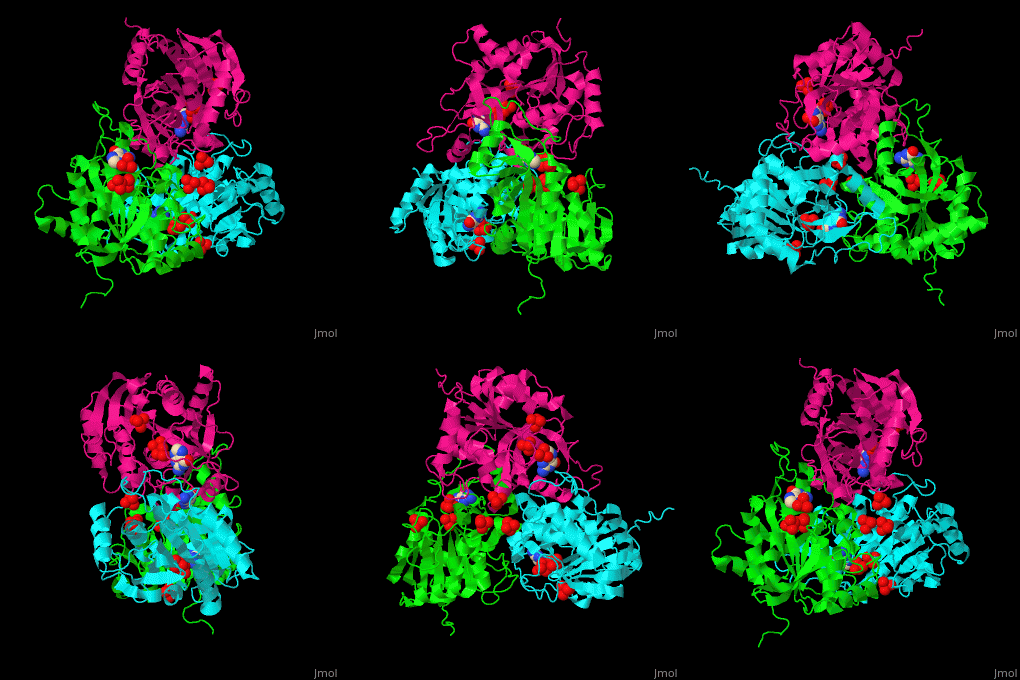
3D structures of purine nucleoside phosphorylase
Updated on 20-August-2019
References
- ↑ Bzowska A, Kulikowska E, Shugar D. Purine nucleoside phosphorylases: properties, functions, and clinical aspects. Pharmacol Ther. 2000 Dec;88(3):349-425. PMID:11337031
- ↑ Markert ML. Purine nucleoside phosphorylase deficiency. Immunodefic Rev. 1991;3(1):45-81. PMID:1931007
- ↑ de Azevedo WF Jr, Canduri F, dos Santos DM, Pereira JH, Bertacine Dias MV, Silva RG, Mendes MA, Basso LA, Palma MS, Santos DS. Crystal structure of human PNP complexed with guanine. Biochem Biophys Res Commun. 2003 Dec 19;312(3):767-72. PMID:14680831 doi:10.1016/j.bbrc.2003.10.190
