This old version of Proteopedia is provided for student assignments while the new version is undergoing repairs. Content and edits done in this old version of Proteopedia after March 1, 2026 will eventually be lost when it is retired in about June of 2026.
Apply for new accounts at the new Proteopedia. Your logins will work in both the old and new versions.
B-DNA tour
From Proteopedia
(Difference between revisions)
m |
|||
| Line 19: | Line 19: | ||
Now change the display to make it show the <scene name='72/725442/Space_filling_bbone/2'>sugar-phosphate backbone as pseudo-bonds</scene> connecting the phosphate atoms. Now the bases are easier to see. Notice how they are stacked upon each other and are nearly perpendicular to the axis of the double helix. Note also that the backbone forms a smooth, continuous curve. | Now change the display to make it show the <scene name='72/725442/Space_filling_bbone/2'>sugar-phosphate backbone as pseudo-bonds</scene> connecting the phosphate atoms. Now the bases are easier to see. Notice how they are stacked upon each other and are nearly perpendicular to the axis of the double helix. Note also that the backbone forms a smooth, continuous curve. | ||
| - | You can <scene name='72/725442/Zoom_pairs/1'>look at just four of the base pairs.</scene>.You are looking into the major groove and the colors of the base pairs alternate. You can also <scene name='72/725442/Zoom_pairs_only/1'> | + | You can <scene name='72/725442/Zoom_pairs/1'>look at just four of the base pairs.</scene>.You are looking into the major groove and the colors of the base pairs alternate. You can also <scene name='72/725442/Zoom_pairs_only/1'>look at just the bases</scene>. |
Each base pair stacks on the next similarly, as shown from <scene name='72/725442/Zoom_pairs_top/1'>this top view</scene>. This is the <scene name='72/725442/Zoom_pairs_only_top/1'>same top view of just the bases</scene>. A-form DNA also stacks in this way, but compare this with Z-DNA, which behaves much differently. | Each base pair stacks on the next similarly, as shown from <scene name='72/725442/Zoom_pairs_top/1'>this top view</scene>. This is the <scene name='72/725442/Zoom_pairs_only_top/1'>same top view of just the bases</scene>. A-form DNA also stacks in this way, but compare this with Z-DNA, which behaves much differently. | ||
Current revision
B-form DNA
| |||||||||||
See Also
- Z-DNA model tour and Z-DNA
- A-RNA tour
- A more general overview will be found at DNA.
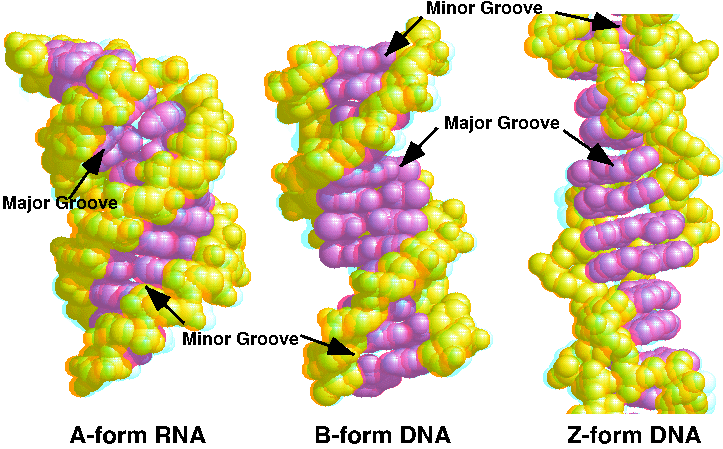
- Forms of DNA shows a side-by-side comparison of A, B, and Z forms of DNA.
- An interactive tutorial on DNA Structure, disponible también en español and eight other languages.
References
JSmol in Proteopedia [2] or to the article describing Jmol [3] to the rescue.
- ↑ Dickerson RE, Drew HR, Conner BN, Wing RM, Fratini AV, Kopka ML. The anatomy of A-, B-, and Z-DNA. Science. 1982 Apr 30;216(4545):475-85. PMID:7071593
- ↑ Hanson, R. M., Prilusky, J., Renjian, Z., Nakane, T. and Sussman, J. L. (2013), JSmol and the Next-Generation Web-Based Representation of 3D Molecular Structure as Applied to Proteopedia. Isr. J. Chem., 53:207-216. doi:http://dx.doi.org/10.1002/ijch.201300024
- ↑ Herraez A. Biomolecules in the computer: Jmol to the rescue. Biochem Mol Biol Educ. 2006 Jul;34(4):255-61. doi: 10.1002/bmb.2006.494034042644. PMID:21638687 doi:10.1002/bmb.2006.494034042644