This old version of Proteopedia is provided for student assignments while the new version is undergoing repairs. Content and edits done in this old version of Proteopedia after March 1, 2026 will eventually be lost when it is retired in about June of 2026.
Apply for new accounts at the new Proteopedia. Your logins will work in both the old and new versions.
1qki
From Proteopedia
(Difference between revisions)
| Line 3: | Line 3: | ||
<StructureSection load='1qki' size='340' side='right'caption='[[1qki]], [[Resolution|resolution]] 3.00Å' scene=''> | <StructureSection load='1qki' size='340' side='right'caption='[[1qki]], [[Resolution|resolution]] 3.00Å' scene=''> | ||
== Structural highlights == | == Structural highlights == | ||
| - | <table><tr><td colspan='2'>[[1qki]] is a 8 chain structure with sequence from [ | + | <table><tr><td colspan='2'>[[1qki]] is a 8 chain structure with sequence from [https://en.wikipedia.org/wiki/Human Human]. Full crystallographic information is available from [http://oca.weizmann.ac.il/oca-bin/ocashort?id=1QKI OCA]. For a <b>guided tour on the structure components</b> use [https://proteopedia.org/fgij/fg.htm?mol=1QKI FirstGlance]. <br> |
| - | </td></tr><tr id='ligand'><td class="sblockLbl"><b>[[Ligand|Ligands:]]</b></td><td class="sblockDat"><scene name='pdbligand=GOA:GLYCOLIC+ACID'>GOA</scene>, <scene name='pdbligand=GOL:GLYCEROL'>GOL</scene>, <scene name='pdbligand=NAP:NADP+NICOTINAMIDE-ADENINE-DINUCLEOTIDE+PHOSPHATE'>NAP</scene></td></tr> | + | </td></tr><tr id='ligand'><td class="sblockLbl"><b>[[Ligand|Ligands:]]</b></td><td class="sblockDat" id="ligandDat"><scene name='pdbligand=GOA:GLYCOLIC+ACID'>GOA</scene>, <scene name='pdbligand=GOL:GLYCEROL'>GOL</scene>, <scene name='pdbligand=NAP:NADP+NICOTINAMIDE-ADENINE-DINUCLEOTIDE+PHOSPHATE'>NAP</scene></td></tr> |
| - | <tr id='related'><td class="sblockLbl"><b>[[Related_structure|Related:]]</b></td><td class="sblockDat">[[1dpg|1dpg]], [[2dpg|2dpg]]</td></tr> | + | <tr id='related'><td class="sblockLbl"><b>[[Related_structure|Related:]]</b></td><td class="sblockDat"><div style='overflow: auto; max-height: 3em;'>[[1dpg|1dpg]], [[2dpg|2dpg]]</div></td></tr> |
| - | <tr id='gene'><td class="sblockLbl"><b>[[Gene|Gene:]]</b></td><td class="sblockDat">G6PD ([ | + | <tr id='gene'><td class="sblockLbl"><b>[[Gene|Gene:]]</b></td><td class="sblockDat">G6PD ([https://www.ncbi.nlm.nih.gov/Taxonomy/Browser/wwwtax.cgi?mode=Info&srchmode=5&id=9606 HUMAN])</td></tr> |
| - | <tr id='activity'><td class="sblockLbl"><b>Activity:</b></td><td class="sblockDat"><span class='plainlinks'>[ | + | <tr id='activity'><td class="sblockLbl"><b>Activity:</b></td><td class="sblockDat"><span class='plainlinks'>[https://en.wikipedia.org/wiki/Glucose-6-phosphate_dehydrogenase Glucose-6-phosphate dehydrogenase], with EC number [https://www.brenda-enzymes.info/php/result_flat.php4?ecno=1.1.1.49 1.1.1.49] </span></td></tr> |
| - | <tr id='resources'><td class="sblockLbl"><b>Resources:</b></td><td class="sblockDat"><span class='plainlinks'>[ | + | <tr id='resources'><td class="sblockLbl"><b>Resources:</b></td><td class="sblockDat"><span class='plainlinks'>[https://proteopedia.org/fgij/fg.htm?mol=1qki FirstGlance], [http://oca.weizmann.ac.il/oca-bin/ocaids?id=1qki OCA], [https://pdbe.org/1qki PDBe], [https://www.rcsb.org/pdb/explore.do?structureId=1qki RCSB], [https://www.ebi.ac.uk/pdbsum/1qki PDBsum], [https://prosat.h-its.org/prosat/prosatexe?pdbcode=1qki ProSAT]</span></td></tr> |
</table> | </table> | ||
== Disease == | == Disease == | ||
| - | [[ | + | [[https://www.uniprot.org/uniprot/G6PD_HUMAN G6PD_HUMAN]] Defects in G6PD are the cause of chronic non-spherocytic hemolytic anemia (CNSHA) [MIM:[https://omim.org/entry/305900 305900]]. Deficiency of G6PD is associated with hemolytic anemia in two different situations. First, in areas in which malaria has been endemic, G6PD-deficiency alleles have reached high frequencies (1% to 50%) and deficient individuals, though essentially asymptomatic in the steady state, have a high risk of acute hemolytic attacks. Secondly, sporadic cases of G6PD deficiency occur at a very low frequencies, and they usually present a more severe phenotype. Several types of CNSHA are recognized. Class-I variants are associated with severe NSHA; class-II have an activity <10% of normal; class-III have an activity of 10% to 60% of normal; class-IV have near normal activity.<ref>PMID:1611091</ref> |
== Function == | == Function == | ||
| - | [[ | + | [[https://www.uniprot.org/uniprot/G6PD_HUMAN G6PD_HUMAN]] Produces pentose sugars for nucleic acid synthesis and main producer of NADPH reducing power. |
== Evolutionary Conservation == | == Evolutionary Conservation == | ||
[[Image:Consurf_key_small.gif|200px|right]] | [[Image:Consurf_key_small.gif|200px|right]] | ||
| Line 35: | Line 35: | ||
==See Also== | ==See Also== | ||
| - | *[[G6PD (Hebrew)|G6PD (Hebrew)]] | ||
*[[Glucose 6-phosphate dehydrogenase|Glucose 6-phosphate dehydrogenase]] | *[[Glucose 6-phosphate dehydrogenase|Glucose 6-phosphate dehydrogenase]] | ||
== References == | == References == | ||
Revision as of 07:07, 24 February 2021
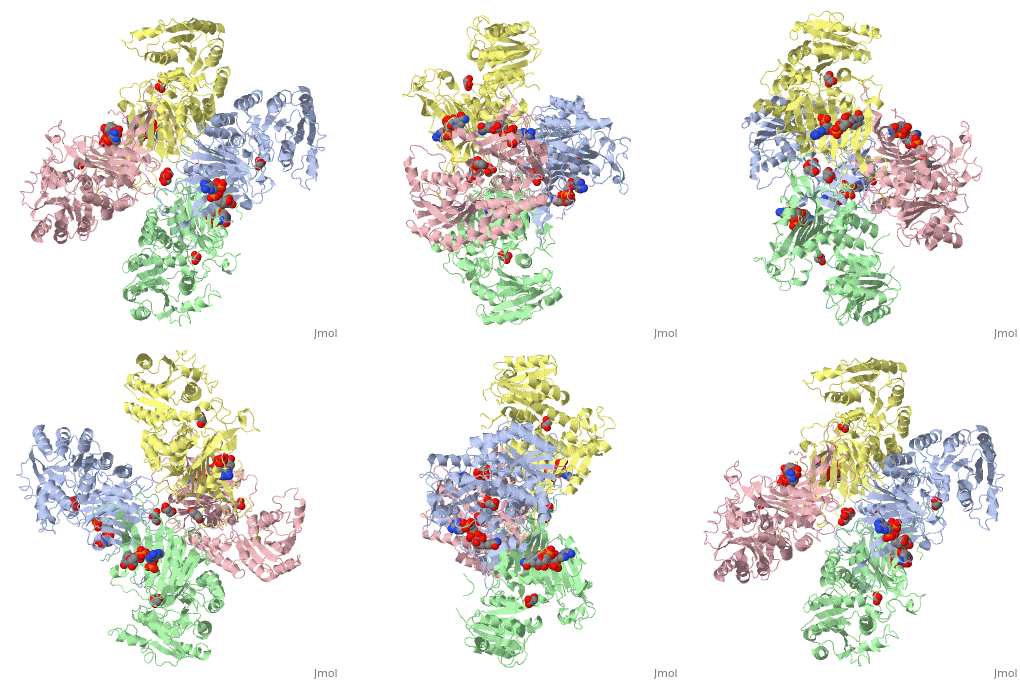
X-RAY STRUCTURE OF HUMAN GLUCOSE 6-PHOSPHATE DEHYDROGENASE (VARIANT CANTON R459L) COMPLEXED WITH STRUCTURAL NADP+
| |||||||||||