Introduction
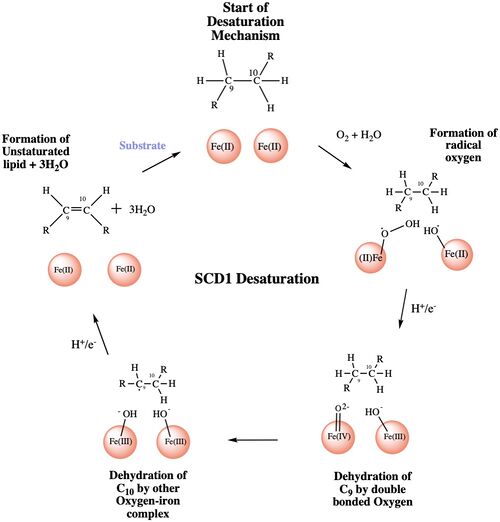
Stearyol CoA Desaturase (SCD1) functions as a lipogenic enzyme which is essential for fatty acid metabolism[1]. SCD1 desaturates the sigma bond, within the 18-carbon acyl-CoA ligand, that attaches carbons 9 and 10 [1]. The desaturated ligand is used in the synthesis of cholesteryl esters and triglycerides[2]. The exact origin of SCD1 is unknown. Current studies have used mouse SCD to determine the structure and function of the enzyme[3]. The metal ions within the structure of SCD1 were determined by X-Ray Flourescense. The structure of the ligand before the reaction takes place and how it interacts with the enzyme was determined by using zinc as the metal ions which inhibits the enzymes activity[1]. The structure of the ligand post reaction was determined by using [hhttps://en.wikipedia.org/wiki/Iron iron] as the metal ions which allowed the enzyme to be active and complete the reaction[3]. SCD1 is a transmembrane protein title with 4 helices within the membrane, and 8 helices in cytoplasm. This protein acquires electrons via an electron transport chain which includes cytochrome B5 reductase and cytochrome B5[3]. The electrons are transferred via a ternary complex and accepted by SCD1 by the iron metal ions[3]. SCD1 has 8 helices that are hydrophobic, 4 helices that are hydrophilic, and 3 helices that are amphipathic[1][3].
Biological Relevance
The primary job of SCD1 in the body is to catalyze the biosynthesis of monounsaturated fatty acids (MUFAs) via saturated Acyl-CoAs with an acyl chain length of 14-19 carbons[2][3]. Variations of the monounsaturated fatty acids function as precursors for the biosynthesis of phospholipids, cholesterol esters, and triglycerides; therefore, SCD1 is a promising candidate for drug targeting1. Absence or a deficit of SCD1 in the body is associated with obesity and insulin resistance which is a main cause of type II diabetes[3]. Cancer sites in the body tend to show a much higher expression rate of SCD13. Focusing on SCD1 as a drug target could lead to advancements in treatment of obesity, diabetes, and other metabolic diseases[1].
The active site is stabilized by three conserved amino acids. These amino acids interact with each other to form hydrogen bonds to induce a kink within the ST9 substrate.
General Structure
Hydrophobicity of helices, type of assembly in biological system (Dimer/monomer/homo/hetero?), ST9 Ligand, MPG Ligand, how substrate enters/leaves
Necessary Structural Elements
The SCD catalytic area is made possible by the coordination of two ions, originally believed to be zinc, but now known to be iron. These molecules are coordinated by 9
Desaturase Enzyme
Disease
Structural highlights