This old version of Proteopedia is provided for student assignments while the new version is undergoing repairs. Content and edits done in this old version of Proteopedia after March 1, 2026 will eventually be lost when it is retired in about June of 2026.
Apply for new accounts at the new Proteopedia. Your logins will work in both the old and new versions.
Autophagy-related protein
From Proteopedia
(Difference between revisions)
| Line 4: | Line 4: | ||
'''Autophagy-related proteins''' (Atg) function in autophagosome formation from the pre-autophagosomal structure (PAS). The phagosomes perform protein degradation under starvation. Autophagy is the process of forming a vacuole around proteins or nucleic acids destined to be broken down. This vacuole is a double membrane enclosure called phagophore. Atgs have non-autophagic functions as well as they are involved in cell survival and apoptosis.<ref>PMID:26382870</ref> So far 34 Atgs have been identified in yeast. <br /> | '''Autophagy-related proteins''' (Atg) function in autophagosome formation from the pre-autophagosomal structure (PAS). The phagosomes perform protein degradation under starvation. Autophagy is the process of forming a vacuole around proteins or nucleic acids destined to be broken down. This vacuole is a double membrane enclosure called phagophore. Atgs have non-autophagic functions as well as they are involved in cell survival and apoptosis.<ref>PMID:26382870</ref> So far 34 Atgs have been identified in yeast. <br /> | ||
*'''Atg1, 6, 14''' are involved in the formation of the phagophore. <br /> | *'''Atg1, 6, 14''' are involved in the formation of the phagophore. <br /> | ||
| - | *'''Atg3''' catalyzes the conjugation of Atg8 and phosphatidylethanolamine. This conjugation is essential for autophagosome formation. <br /> | + | *'''Atg2''' is essential for autophagosome formation<ref>PMID:22219374</ref>. <br /> |
| + | *'''Atg3''' catalyzes the conjugation of Atg8 and phosphatidylethanolamine. This conjugation is essential for autophagosome formation<ref>PMID:25645919</ref>. <br /> | ||
*'''Atg4, 5, 7, 10, 16''' are involved in the maturation of the phagophore.<br /> | *'''Atg4, 5, 7, 10, 16''' are involved in the maturation of the phagophore.<br /> | ||
| - | *'''Atg8''' is structurally similar to ubiquitin. It is a targeting factor in cytoplasm-to-vacuole transport of proteins such as aminopeptidase and a-mannosidase. [[Microtubule-associated protein light chain 3]] '''LC3''' is a mammalian Atg8.<br /> | + | *'''Atg8''' is structurally similar to ubiquitin. It is a targeting factor in cytoplasm-to-vacuole transport of proteins such as aminopeptidase and a-mannosidase. [[Microtubule-associated protein light chain 3]] '''LC3''' is a mammalian Atg8<ref>PMID:31450711</ref>.<br /> |
| + | *'''Atg9''' mediates autophagosomal membrane expansion<ref>PMID:33106658</ref>. <br /> | ||
| + | *'''Atg11''' is essential for selective autophagy<ref>PMID:31238043</ref>. <br /> | ||
*'''Atg12''' is involved in the elongation of the phagophore.<br /> | *'''Atg12''' is involved in the elongation of the phagophore.<br /> | ||
*'''Atg13, 17''' are PAS scaffold proteins. <br /> | *'''Atg13, 17''' are PAS scaffold proteins. <br /> | ||
| + | *'''Atg18''' forms a complex with Atg2 which tethers membranes to the ER for autophagosome formation<ref>PMID:222130254161</ref>. <br /> | ||
*'''Atg101''' is believed to protect Atg13 from proteasomal degradation. | *'''Atg101''' is believed to protect Atg13 from proteasomal degradation. | ||
Revision as of 08:01, 27 April 2021
| |||||||||||
References
- ↑ Shibutani ST, Saitoh T, Nowag H, Munz C, Yoshimori T. Autophagy and autophagy-related proteins in the immune system. Nat Immunol. 2015 Sep 18;16(10):1014-24. doi: 10.1038/ni.3273. PMID:26382870 doi:http://dx.doi.org/10.1038/ni.3273
- ↑ Velikkakath AK, Nishimura T, Oita E, Ishihara N, Mizushima N. Mammalian Atg2 proteins are essential for autophagosome formation and important for regulation of size and distribution of lipid droplets. Mol Biol Cell. 2012 Mar;23(5):896-909. doi: 10.1091/mbc.E11-09-0785. Epub 2012, Jan 4. PMID:22219374 doi:http://dx.doi.org/10.1091/mbc.E11-09-0785
- ↑ Ngu M, Hirata E, Suzuki K. Visualization of Atg3 during autophagosome formation in Saccharomyces cerevisiae. J Biol Chem. 2015 Mar 27;290(13):8146-53. doi: 10.1074/jbc.M114.626952. Epub 2015, Feb 2. PMID:25645919 doi:http://dx.doi.org/10.1074/jbc.M114.626952
- ↑ Lystad AH, Simonsen A. Mechanisms and Pathophysiological Roles of the ATG8 Conjugation Machinery. Cells. 2019 Aug 25;8(9). pii: cells8090973. doi: 10.3390/cells8090973. PMID:31450711 doi:http://dx.doi.org/10.3390/cells8090973
- ↑ Matoba K, Kotani T, Tsutsumi A, Tsuji T, Mori T, Noshiro D, Sugita Y, Nomura N, Iwata S, Ohsumi Y, Fujimoto T, Nakatogawa H, Kikkawa M, Noda NN. Atg9 is a lipid scramblase that mediates autophagosomal membrane expansion. Nat Struct Mol Biol. 2020 Oct 26. pii: 10.1038/s41594-020-00518-w. doi:, 10.1038/s41594-020-00518-w. PMID:33106658 doi:http://dx.doi.org/10.1038/s41594-020-00518-w
- ↑ Zientara-Rytter K, Subramani S. Mechanistic Insights into the Role of Atg11 in Selective Autophagy. J Mol Biol. 2020 Jan 3;432(1):104-122. doi: 10.1016/j.jmb.2019.06.017. Epub 2019 , Jun 22. PMID:31238043 doi:http://dx.doi.org/10.1016/j.jmb.2019.06.017
- ↑ Unknown PubmedID 222130254161
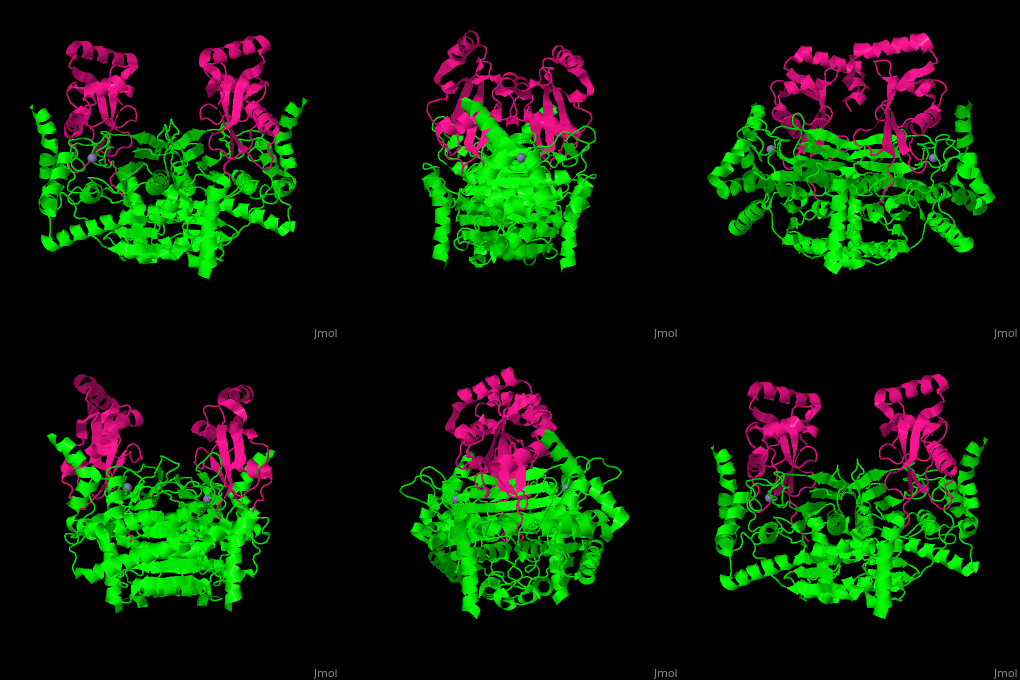
- ↑ Noda NN, Satoo K, Fujioka Y, Kumeta H, Ogura K, Nakatogawa H, Ohsumi Y, Inagaki F. Structural basis of Atg8 activation by a homodimeric E1, Atg7. Mol Cell. 2011 Nov 4;44(3):462-75. PMID:22055191 doi:10.1016/j.molcel.2011.08.035
Proteopedia Page Contributors and Editors (what is this?)
Michal Harel, Alexander Berchansky, Jaime Prilusky, Joel L. Sussman
