This old version of Proteopedia is provided for student assignments while the new version is undergoing repairs. Content and edits done in this old version of Proteopedia after March 1, 2026 will eventually be lost when it is retired in about June of 2026.
Apply for new accounts at the new Proteopedia. Your logins will work in both the old and new versions.
Gluconeogenesis
From Proteopedia
(Difference between revisions)
| Line 2: | Line 2: | ||
'''Under development!''' | '''Under development!''' | ||
| - | Gluconeogenesis is a metabolic pathway that results in the generation of glucose from certain non-carbohydrate carbon substrates. In humans the main gluconeogenic precursors are lactate, <scene name='92/925544/Cv/1'>glycerol</scene> (which is a part of the triglyceride molecule), alanine and glutamine. Other glucogenic amino acids and all [[Citric Acid Cycle]] intermediates (through conversion to oxaloacetate) can also function as substrates for gluconeogenesis. | + | [https://en.wikipedia.org/wiki/Gluconeogenesis|Gluconeogenesis] is a metabolic pathway that results in the generation of glucose from certain non-carbohydrate carbon substrates. In humans the main gluconeogenic precursors are lactate, <scene name='92/925544/Cv/1'>glycerol</scene> (which is a part of the triglyceride molecule), alanine and glutamine. Other glucogenic amino acids and all [[Citric Acid Cycle]] intermediates (through conversion to oxaloacetate) can also function as substrates for gluconeogenesis. |
<scene name='39/392339/Cv1/10'>Lactate</scene> is transported back to the liver where it is converted into <scene name='39/392339/Cv1/11'>pyruvate</scene> by the [[Cori cycle]] using the enzyme [[lactate dehydrogenase]]. <scene name='Lactate_Dehydrogenase/Cv/4'>Interconversion of pyruvate and lactate acid</scene>. Pyruvate, the first designated substrate of the gluconeogenic pathway, can then be used to generate glucose. | <scene name='39/392339/Cv1/10'>Lactate</scene> is transported back to the liver where it is converted into <scene name='39/392339/Cv1/11'>pyruvate</scene> by the [[Cori cycle]] using the enzyme [[lactate dehydrogenase]]. <scene name='Lactate_Dehydrogenase/Cv/4'>Interconversion of pyruvate and lactate acid</scene>. Pyruvate, the first designated substrate of the gluconeogenic pathway, can then be used to generate glucose. | ||
Revision as of 12:51, 5 December 2022
| |||||||||||
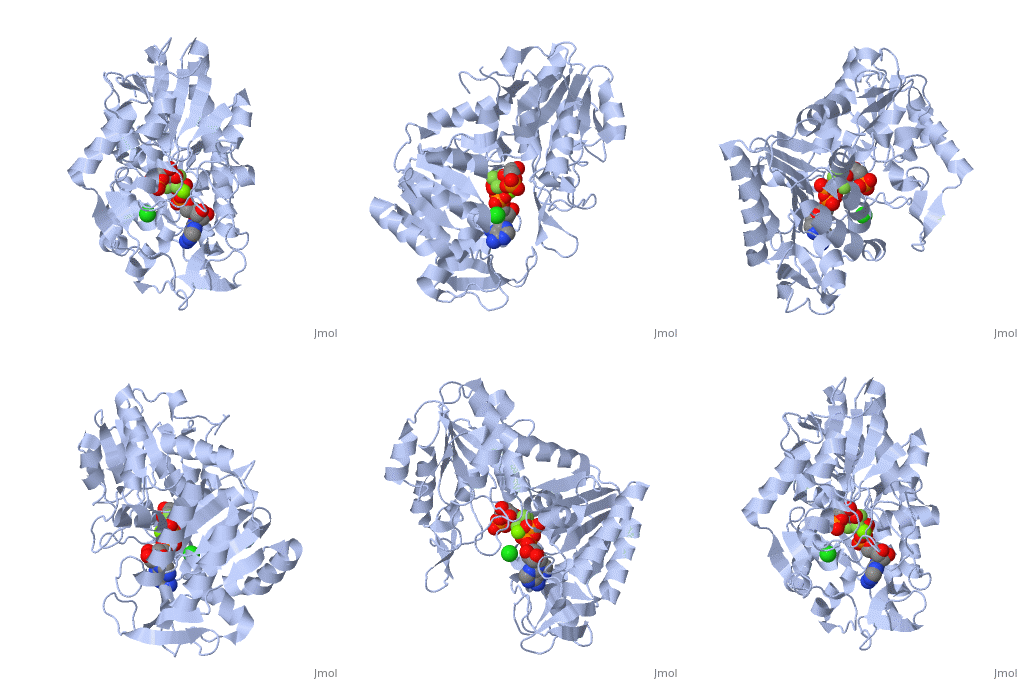
References
- ↑ Dunten P, Belunis C, Crowther R, Hollfelder K, Kammlott U, Levin W, Michel H, Ramsey GB, Swain A, Weber D, Wertheimer SJ. Crystal structure of human cytosolic phosphoenolpyruvate carboxykinase reveals a new GTP-binding site. J Mol Biol. 2002 Feb 15;316(2):257-64. PMID:11851336 doi:http://dx.doi.org/10.1006/jmbi.2001.5364
