Gluconeogenesis
From Proteopedia
(Difference between revisions)
| Line 1: | Line 1: | ||
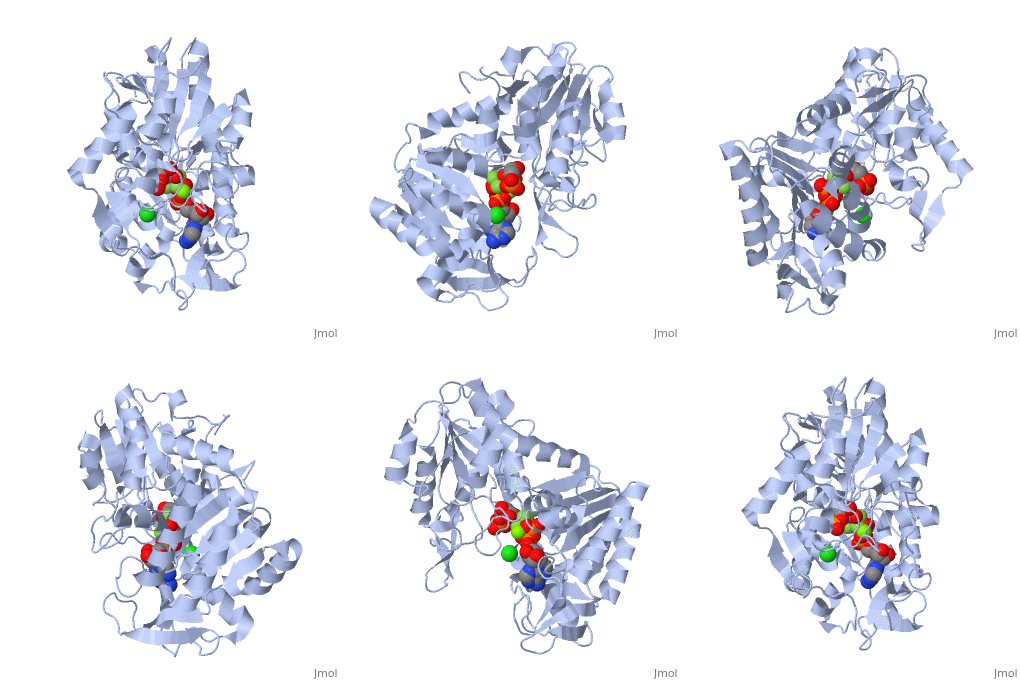
<StructureSection load='2y3i' size='350' side='right' scene='' caption='Human phosphoglycerate kinase complex with phosphoglyceric acid, ADP (stick model) AlF4-, Cl- and Mg+2 ions (green) (PDB code [[2y3i]])'> | <StructureSection load='2y3i' size='350' side='right' scene='' caption='Human phosphoglycerate kinase complex with phosphoglyceric acid, ADP (stick model) AlF4-, Cl- and Mg+2 ions (green) (PDB code [[2y3i]])'> | ||
| - | |||
Gluconeogenesis ([https://en.wikipedia.org/wiki/Gluconeogenesis]) is a metabolic pathway that results in the generation of glucose from certain non-carbohydrate carbon substrates. In humans the main gluconeogenic precursors are lactate, <scene name='92/925544/Cv/1'>glycerol</scene> (which is a part of the triglyceride molecule), alanine and glutamine. Other glucogenic amino acids and all [[Citric Acid Cycle]] intermediates (through conversion to oxaloacetate) can also function as substrates for gluconeogenesis. See also [[Cori cycle]] and [[Glyoxylate cycle]]. | Gluconeogenesis ([https://en.wikipedia.org/wiki/Gluconeogenesis]) is a metabolic pathway that results in the generation of glucose from certain non-carbohydrate carbon substrates. In humans the main gluconeogenic precursors are lactate, <scene name='92/925544/Cv/1'>glycerol</scene> (which is a part of the triglyceride molecule), alanine and glutamine. Other glucogenic amino acids and all [[Citric Acid Cycle]] intermediates (through conversion to oxaloacetate) can also function as substrates for gluconeogenesis. See also [[Cori cycle]] and [[Glyoxylate cycle]]. | ||
Current revision
| |||||||||||
References
- ↑ Dunten P, Belunis C, Crowther R, Hollfelder K, Kammlott U, Levin W, Michel H, Ramsey GB, Swain A, Weber D, Wertheimer SJ. Crystal structure of human cytosolic phosphoenolpyruvate carboxykinase reveals a new GTP-binding site. J Mol Biol. 2002 Feb 15;316(2):257-64. PMID:11851336 doi:http://dx.doi.org/10.1006/jmbi.2001.5364
