Sandbox Home

From Proteopedia

(Difference between revisions)
Jump to: navigation, search
Line 4: Line 4:
<tr>
<tr>
<td colspan="3" style="background:#F5F5FC; border:1px solid #ddd;">
-
<div style="position:relative; top:0.2em; font-size:1.2em; padding:5px 5px 5px 10px; float:right;">
+
<div style="position:relative; top:0.2em; font-size:1.2em; padding:5px 5px 5px 10px; text-align:right; display:block;">
-
<b><i>ISSN 2310-6301</i></b>
+
<b><i>ISSN 2310-6301</i></b>
-
</div>
+
</div>
<span style="display:block; margin:0; padding:0.3em; color:#000; font-style:italic; font-size:1.4em;">

Revision as of 16:13, 30 September 2025

 ISSN 2310-6301
     
       As life is more than 2D, Proteopedia helps to bridge the gap between 3D structure & function of biomacromolecules
     
     
       Proteopedia presents this information in a user-friendly way as a collaborative & free 3D-encyclopedia of proteins & other biomolecules.
     
Selected Research Pages In Journals Education
About this image
The ribosome

by Wayne Decatur
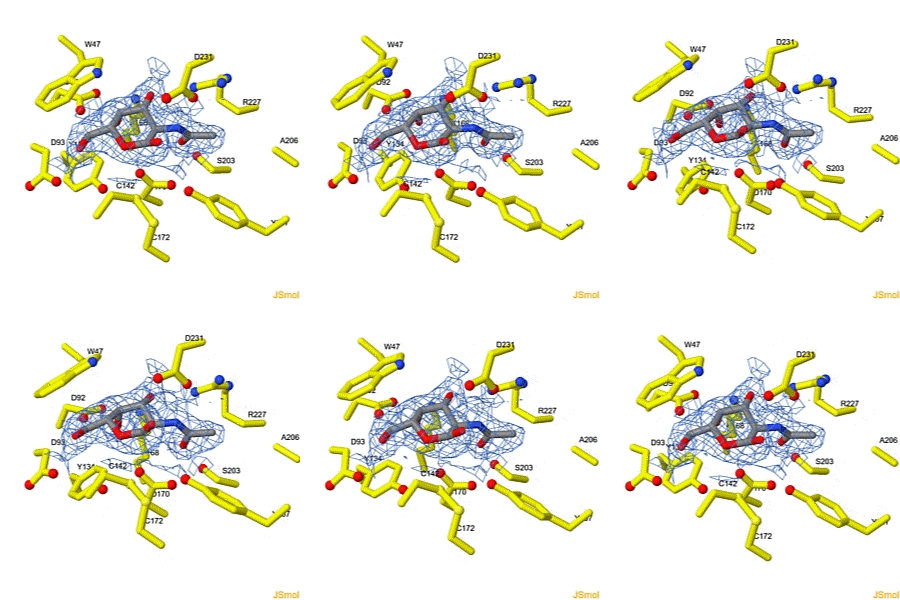
The 2009 Nobel Prize in Chemistry was awarded for studies of the ribosome. The ribosome is the machine in your cells that accurately and efficiently decodes the genetic information stored in your genome and synthesizes the corresponding polypeptide chain one amino acid at a time in the process of translation. These structures are considered landmarks for the fact they showed clearly the major contributions to decoding and peptide bond synthesis come from RNA and not protein, as well as for the sheer size of the structures determined.

>>> Visit this page >>>

About this image
Geobacter nanowire structure surprise.

F Wang, Y Gu, JP O'Brien, SM Yi, SE Yalcin, V Srikanth, C Shen, D Vu, NL Ing, AI Hochbaum, EH Egelman, NS Malvankar. Cell 2019 doi: 10.1016/j.cell.2019.03.029
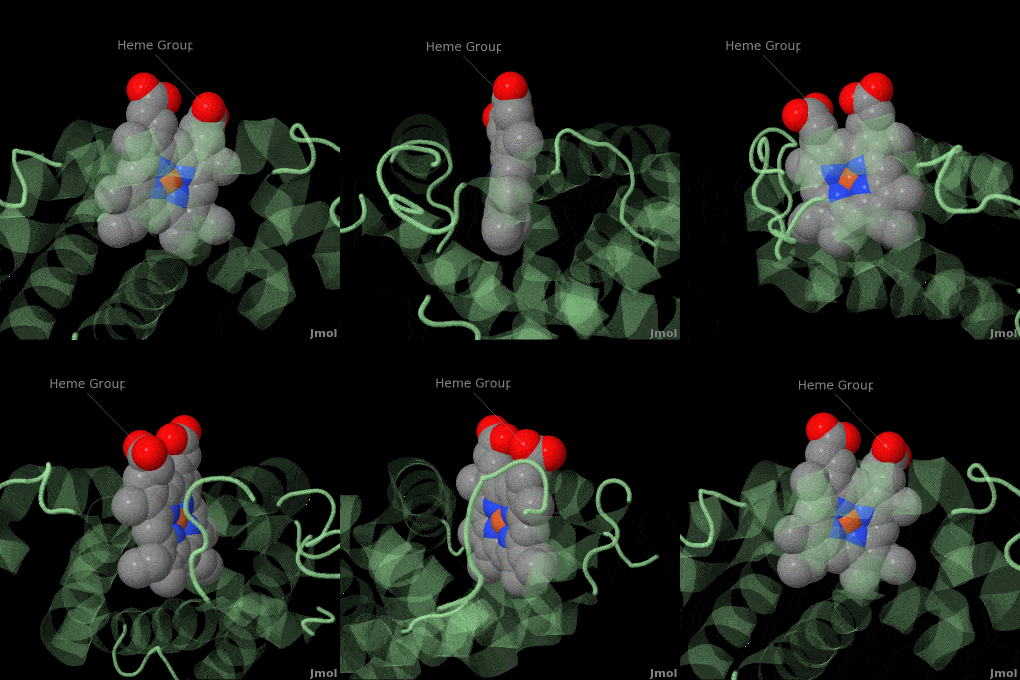
Bacteria living in anaerobic environments (no oxygen) need alternative electron acceptors in order to get energy from their food. An acceptor abundant in the earth's crust is red iron oxide ("rust"), which gets reduced to black iron oxide (magnetite). Many bacteria, such as Geobacter, get their metabolic energy by transferring electrons to acceptors that are multiple cell diameters distant, using protein nanowires. These were long thought to be pili. But when the structure of the nanowires was solved in 2019, to everyone's surprise, they turned out to be unprecedented linear polymers of multi-heme cytochromes. The hemes form an electrically conductive chain in the cores of these nanowires.

>>> Visit I3DC Interactive Visualizations >>>

About this image
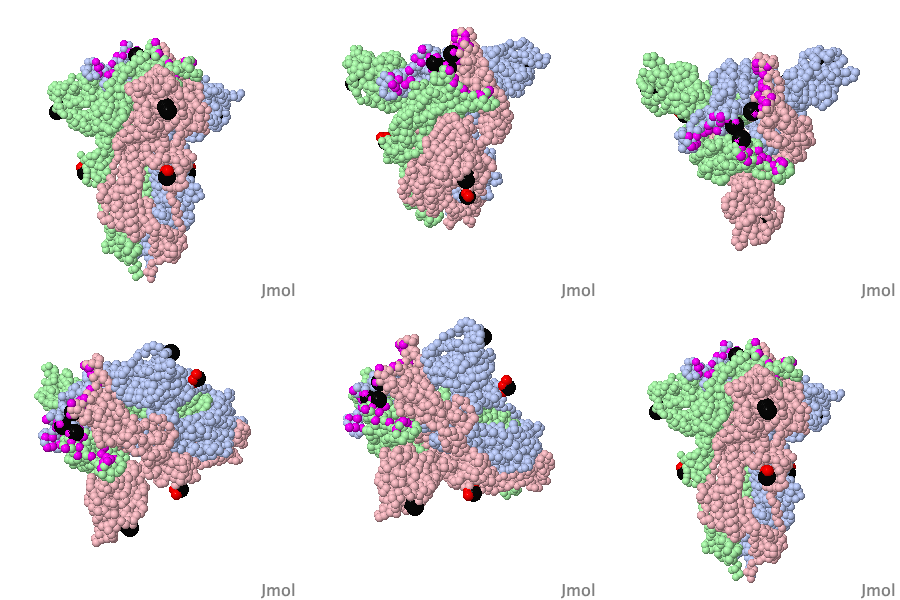
Eastern Equine Encephalitis virus
Although only a few people in the USA get Eastern Equine Encephalitis every year, the fatality rate is 30%, and many survivors have ongoing neurological problems. The virus is transmitted by mosquitoes from animals, especially birds, to humans. This RNA virus has a complicated capsid (a slab of which is shown) composed of protein shells with an enclosed lipid bilayer. The structures of virus capsids can be explored using free FirstGlance in Jmol.

>>> Visit I3DC Interactive Visualizations >>>

About Contact Hot News Table of Contents Structure Index Help
Personal tools