This old version of Proteopedia is provided for student assignments while the new version is undergoing repairs. Content and edits done in this old version of Proteopedia after March 1, 2026 will eventually be lost when it is retired in about June of 2026.
Apply for new accounts at the new Proteopedia. Your logins will work in both the old and new versions.
1s9v
From Proteopedia
| |||||||
| , resolution 2.22Å | |||||||
|---|---|---|---|---|---|---|---|
| Ligands: | |||||||
| Coordinates: | save as pdb, mmCIF, xml | ||||||
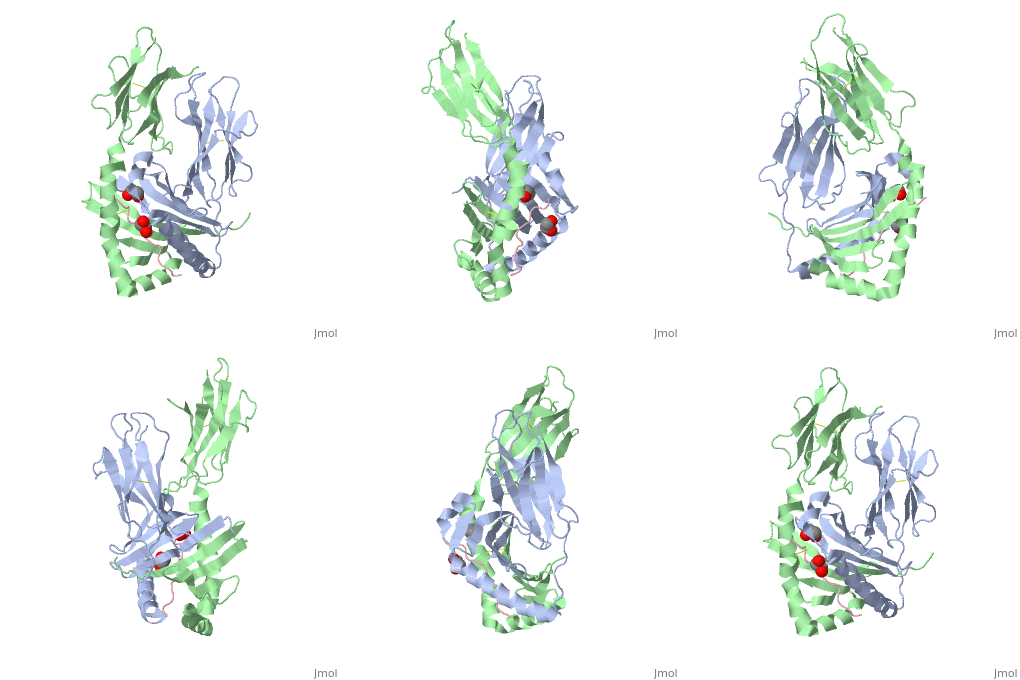
Crystal structure of HLA-DQ2 complexed with deamidated gliadin peptide
Contents |
Overview
Celiac disease, also known as celiac sprue, is a gluten-induced autoimmune-like disorder of the small intestine, which is strongly associated with HLA-DQ2. The structure of DQ2 complexed with an immunogenic epitope from gluten, QLQPFPQPELPY, has been determined to 2.2-A resolution by x-ray crystallography. The glutamate at P6, which is formed by tissue transglutaminase-catalyzed deamidation, is an important anchor residue as it participates in an extensive hydrogen-bonding network involving Lys-beta71 of DQ2. The gluten peptide-DQ2 complex retains critical hydrogen bonds between the MHC and the peptide backbone despite the presence of many proline residues in the peptide that are unable to participate in amide-mediated hydrogen bonds. Positioning of proline residues such that they do not interfere with backbone hydrogen bonding results in a reduction in the number of registers available for gluten peptides to bind to MHC class II molecules and presumably impairs the likelihood of establishing favorable side-chain interactions. The HLA association in celiac disease can be explained by a superior ability of DQ2 to bind the biased repertoire of proline-rich gluten peptides that have survived gastrointestinal digestion and that have been deamidated by tissue transglutaminase. Finally, surface-exposed proline residues in the proteolytically resistant ligand were replaced with functionalized analogs, thereby providing a starting point for the design of orally active agents for blocking gluten-induced toxicity.
Disease
Known diseases associated with this structure: Celiac disease, susceptibility to OMIM:[146880], Celiac disease, susceptibility to OMIM:[604305], Creutzfeldt-Jakob disease, variant, resistance to OMIM:[604305], Multiple sclerosis, susceptibility to OMIM:[604305]
About this Structure
1S9V is a Protein complex structure of sequences from Homo sapiens. Full crystallographic information is available from OCA.
Reference
Structural basis for HLA-DQ2-mediated presentation of gluten epitopes in celiac disease., Kim CY, Quarsten H, Bergseng E, Khosla C, Sollid LM, Proc Natl Acad Sci U S A. 2004 Mar 23;101(12):4175-9. Epub 2004 Mar 12. PMID:15020763
Page seeded by OCA on Thu Mar 20 14:02:17 2008
Categories: Homo sapiens | Protein complex | Bergseng, E. | Khosla, C. | Kim, C Y. | Quarsten, H. | Sollid, L M. | EDO | Hla-dq2 | Immune system

