This old version of Proteopedia is provided for student assignments while the new version is undergoing repairs. Content and edits done in this old version of Proteopedia after March 1, 2026 will eventually be lost when it is retired in about June of 2026.
Apply for new accounts at the new Proteopedia. Your logins will work in both the old and new versions.
2a9i
From Proteopedia
|
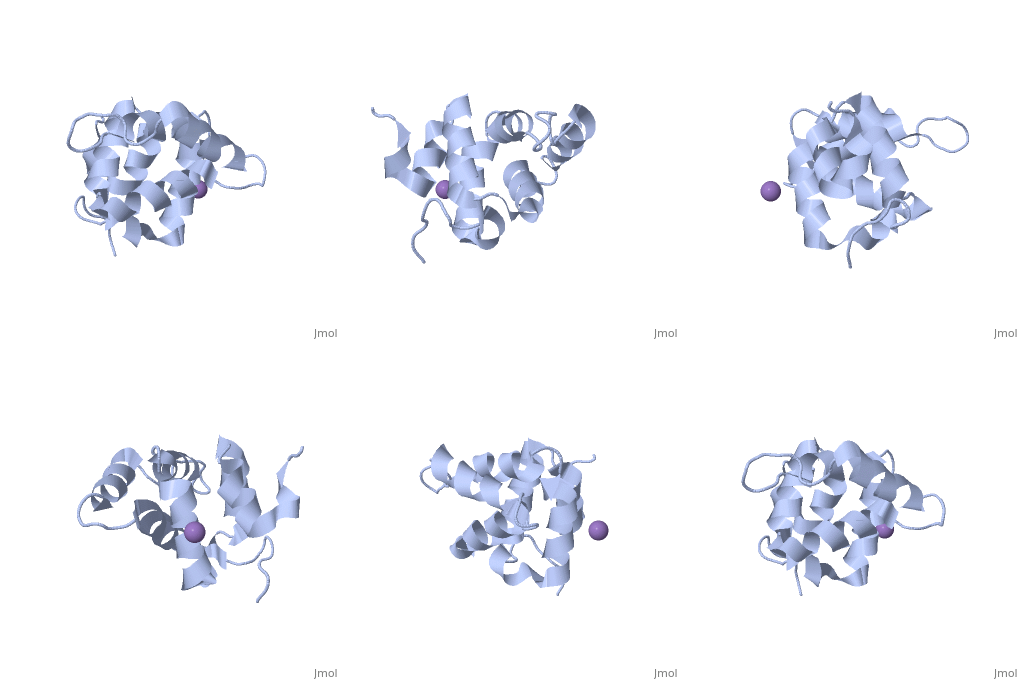
Molecular Structure of the Interleukin-1 Receptor-Associated Kinase-4 Death Domain
Overview
IL-1R-associated kinase (IRAK) 4 is an essential component of innate immunity. IRAK-4 deficiency in mice and humans results in severe impairment of IL-1 and TLR signaling. We have solved the crystal structure for the death domain of Mus musculus IRAK-4 to 1.7 A resolution. This is the first glimpse of the structural details of a mammalian IRAK family member. The crystal structure reveals a six-helical bundle with a prominent loop, which among IRAKs and Pelle, a Drosophila homologue, is unique to IRAK-4. This highly structured loop contained between helices two and three, comprises an 11-aa stretch. Although innate immune domain recognition is thought to be very similar between Drosophila and mammals, this structural component points to a drastic difference. This structure can be used as a framework for future mutation and deletion studies and potential drug design.
About this Structure
2A9I is a Single protein structure of sequence from Mus musculus with as ligand. Active as Non-specific serine/threonine protein kinase, with EC number 2.7.11.1 Full crystallographic information is available from OCA.
Reference
Cutting edge: molecular structure of the IL-1R-associated kinase-4 death domain and its implications for TLR signaling., Lasker MV, Gajjar MM, Nair SK, J Immunol. 2005 Oct 1;175(7):4175-9. PMID:16177054
Page seeded by OCA on Thu Feb 21 16:25:11 2008

