This old version of Proteopedia is provided for student assignments while the new version is undergoing repairs. Content and edits done in this old version of Proteopedia after March 1, 2026 will eventually be lost when it is retired in about June of 2026.
Apply for new accounts at the new Proteopedia. Your logins will work in both the old and new versions.
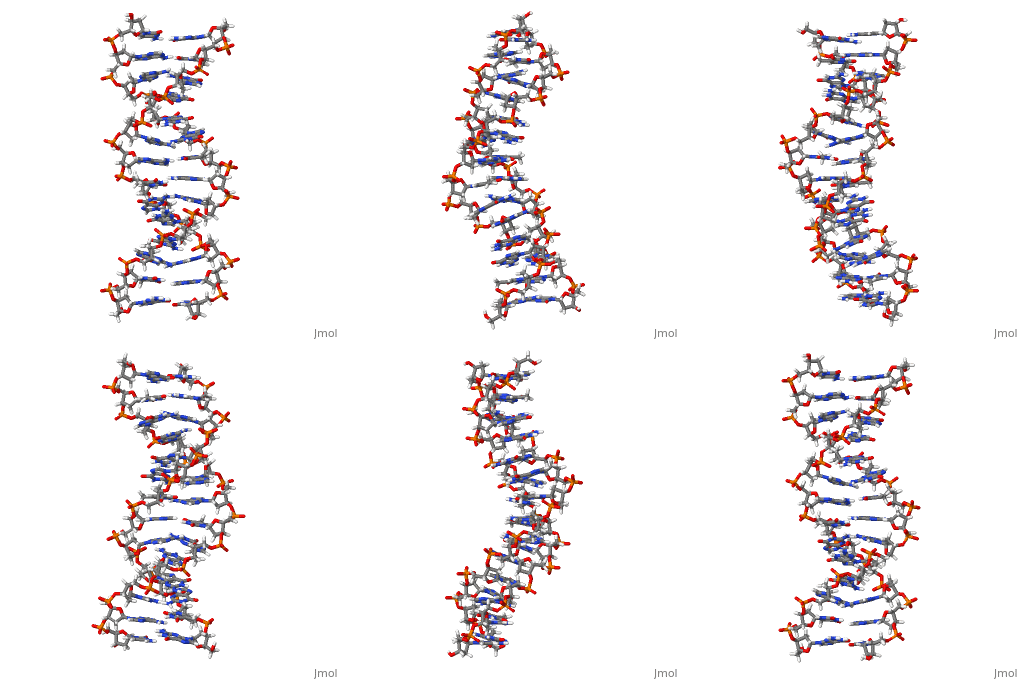
The centromere of human chromosomes contains multiple repeats of the DNA sequence d(TGGAA)n. This sequence has the interesting property of pairing with itself to form stable duplexes. We have determined the solution structure of the unusual DNA duplex 5'-TGGAATGGAA:TGGAATGGAA-3' at atomic resolution. The duplex contains unpaired staggered guanosine residues, which co-stack by intercalation between sheared G.A and A.G base-pairs to form an interesting new structural motif, the GA-bracketed G-stack. The TGGAA repeat unit contains six "steps", four of which are not Watson-Crick base-pairs.
The unusual structure of the human centromere (GGA)2 motif. Unpaired guanosine residues stacked between sheared G.A pairs.,Chou SH, Zhu L, Reid BR J Mol Biol. 1994 Dec 2;244(3):259-68. PMID:7966337[1]
From MEDLINE®/PubMed®, a database of the U.S. National Library of Medicine.
References
↑ Chou SH, Zhu L, Reid BR. The unusual structure of the human centromere (GGA)2 motif. Unpaired guanosine residues stacked between sheared G.A pairs. J Mol Biol. 1994 Dec 2;244(3):259-68. PMID:7966337 doi:http://dx.doi.org/10.1006/jmbi.1994.1727