We apologize for Proteopedia being slow to respond. For the past two years, a new implementation of Proteopedia has been being built. Soon, it will replace this 18-year old system. All existing content will be moved to the new system at a date that will be announced here.
1fj1
From Proteopedia
Revision as of 13:48, 28 September 2014 by OCA (Talk | contribs)
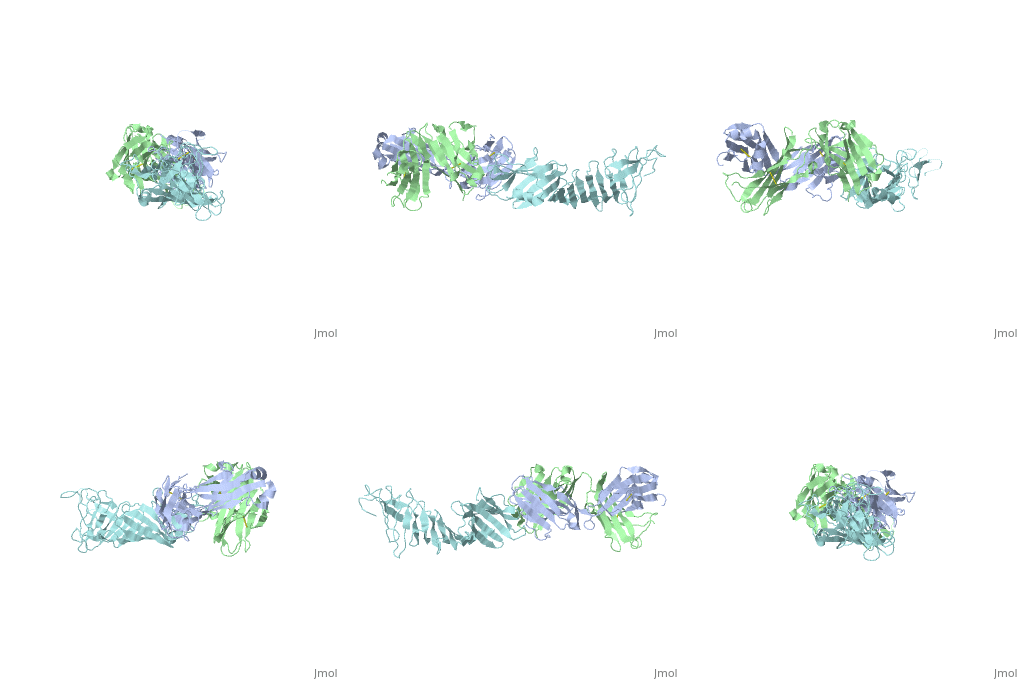
1fj1 is a 6 chain structure with sequence from Borrelia burgdorferi and Mus musculus. This structure supersedes the now removed PDB entry 2osp. Full crystallographic information is available from OCA. For a guided tour on the structure components use FirstGlance.
Check, as determined by ConSurfDB. You may read the explanation of the method and the full data available from ConSurf.
Publication Abstract from PubMed
Outer surface protein A (OspA) is a major lipoprotein of the Borrelia burgdorferi spirochete, the causative agent of Lyme disease. Vaccination with OspA generates an immune response that can prevent bacterial transmission to a mammalian host during the attachment of an infected tick. However, the protective capacity of immune sera cannot be predicted by measuring total anti-OspA antibody. The murine monoclonal antibody LA-2 defines an important protective B-cell epitope of OspA against which protective sera have strong levels of reactivity. We have now mapped the LA-2 epitope of OspA using both NMR chemical-shift perturbation measurements in solution and X-ray crystal structure determination. LA-2 recognizes the three surface-exposed loops of the C-terminal domain of OspA that are on the tip of the elongated molecule most distant from the lipid-modified N terminus. The structure suggests that the natural variation at OspA sequence position 208 in the first loop is a major limiting factor for antibody cross-reactivity between different Lyme disease-causing Borrelia strains. The unusual Fab-dominated lattice of the crystal also permits a rare view of antigen flexibility within an antigen:antibody complex. These results provide a rationale for improvements in OspA-based vaccines and suggest possible designs for more direct tests of antibody protective levels in vaccinated individuals.
Structural identification of a key protective B-cell epitope in Lyme disease antigen OspA.,Ding W, Huang X, Yang X, Dunn JJ, Luft BJ, Koide S, Lawson CL J Mol Biol. 2000 Oct 6;302(5):1153-64. PMID:11183781[1]
From MEDLINE®/PubMed®, a database of the U.S. National Library of Medicine.