This old version of Proteopedia is provided for student assignments while the new version is undergoing repairs. Content and edits done in this old version of Proteopedia after March 1, 2026 will eventually be lost when it is retired in about June of 2026.
Apply for new accounts at the new Proteopedia. Your logins will work in both the old and new versions.
1gzr
From Proteopedia
|
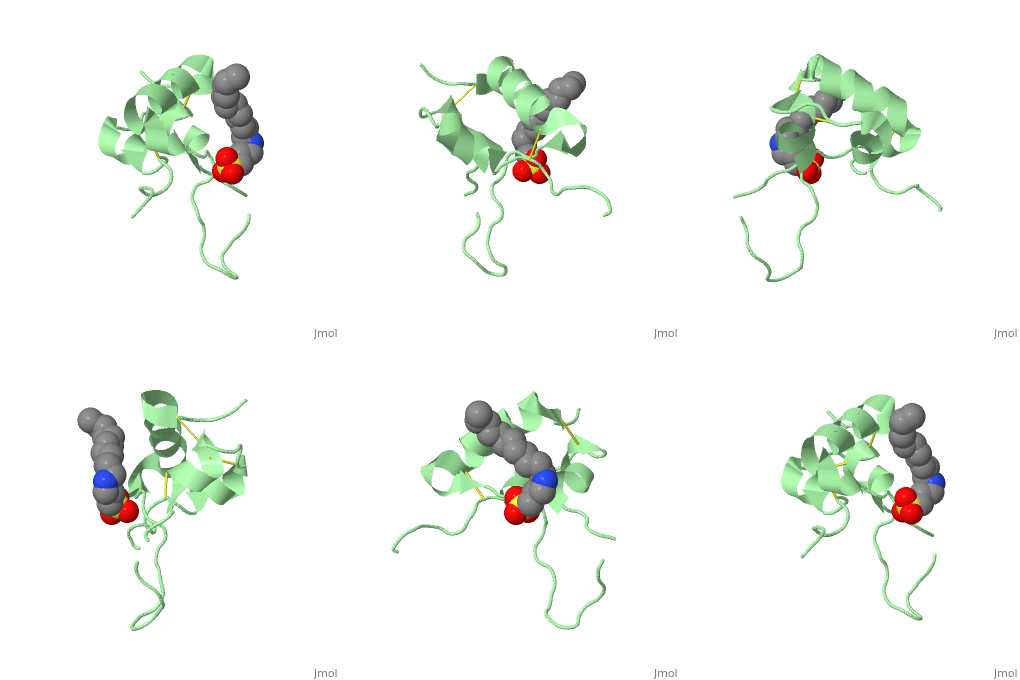
HUMAN INSULIN-LIKE GROWTH FACTOR; ESRF DATA
Overview
Human insulin-like growth factors I and II (hIGF-I, hIGF-II) are potent, stimulators of cell and growth processes. They display high sequence, similarity to both the A and B chains of insulin but contain an additional, connecting C-domain, which reflects their secretion without specific, packaging or precursor conversion. IGFs also have an extension at the, C-terminus known as the D-domain. This paper describes four homologous, hIGF-1 structures, obtained from crystals grown in the presence of the, detergent SB12, which reveal additional detail in the C- and D-domains., Two different detergent binding modes observed in the crystals may reflect, different hIGF-I biological properties such as the interaction with IGF, binding proteins and self-aggregation. While the helical core of hIGF-I is, very similar to that in insulin, there are distinct differences in the, region of hIGF-I corresponding to the insulin B chain C-terminus, residues, B25-B30. In hIGF-I, these residues (24-29) and the following C-domain form, an extensive loop protruding 20 A from the core, which results in a, substantially different conformation for the receptor binding epitope in, hIGF-I compared to insulin. One notable feature of the structures, presented here is demonstration of peptide-bond cleavage between Ser35 and, Arg36 resulting in an apparent gap between residues 35 and 39. The, equivalent region of proinsulin is involved in hormone processing, demanding a reassessment of the structural integrity of hIGF-I in relation, to its biological function.
About this Structure
1GZR is a Single protein structure of sequence from Homo sapiens with C15 as ligand. Structure known Active Site: C15. Full crystallographic information is available from OCA.
Reference
Structural origins of the functional divergence of human insulin-like growth factor-I and insulin., Brzozowski AM, Dodson EJ, Dodson GG, Murshudov GN, Verma C, Turkenburg JP, de Bree FM, Dauter Z, Biochemistry. 2002 Jul 30;41(30):9389-97. PMID:12135360
Page seeded by OCA on Mon Nov 5 12:53:11 2007

