Flagellar motors are locomotive organelles located in bacterial cell envelopes and push the cell in its environment. These motors are composed of a variety of proteins and consist of a rotary motor, a universal joint, and a helical filament [2]. They are driven by the flow of ions down their concentration gradient with respect to the cytoplasmic membrane through a stator, and are regulated by the chemotaxis pathway. The stator complex serves as a channel to couple the proton flow with a torque generation that occurs at the interface between the stator(s) and a rotor. The torque generation and stator assembly around the rotor require highly conserved charged residues to be present [1,3].
Function
Structure
Relevance
Structural highlights
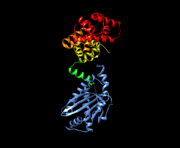
This is an image of the components of FliG and FliM (PDB files 3AJC and 3SOH, respectively)
This is a sample scene created with SAT to by Group, and another to make of the protein. You can make your own scenes on SAT starting from scratch or loading and editing one of these sample scenes.

