This old version of Proteopedia is provided for student assignments while the new version is undergoing repairs. Content and edits done in this old version of Proteopedia after March 1, 2026 will eventually be lost when it is retired in about June of 2026.
Apply for new accounts at the new Proteopedia. Your logins will work in both the old and new versions.
Sandbox1996
From Proteopedia
Diuril (Chlorothiazide)
| |||||||||||
References
- ↑ 7</sub>H8ClN3O4S2 and a molecular weight of 298 Da. This chemical compound consists of an aromatic ring, benzothiadiazine, a sulfonamide group, and a chloride. It has a melting point of 272 degrees Celsius, a flash po int of 302.7 degrees Celsius, a solubility of 60 mg/ml in DMSO and less than 1 mg/ml in water, and appears as a white crystalline powder(reference). The structure was determined by X-Ray diffraction and was measured at a resolution of 2.1 Angstroms (reference). . The enzyme cave of glutamate receptor 2 contained that enabled binding of chlorothiazide. Binding involved hydrogen bonding between the (Figure 2 & 3). Synthesis of chlorothiazide occurs through the reaction between 3-chloroaniline, chlorosulfonic acid, and ammonia; and it is catalyzed by formic acid (Figure 4)(reference).
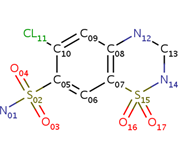 Figure 1. Molecular structure of chlorothiazide.
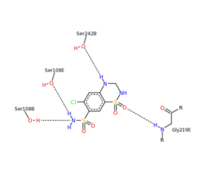 Figure 2. Stabilizing structure between glutamate receptor 2 and chlorothiazide.
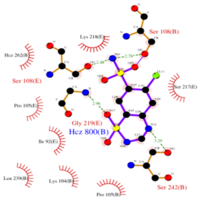 Figure 3. Stabilizing structure between glutamate receptor 2 and chlorothiazide.
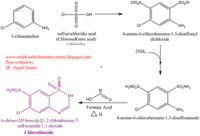 Figure 4. Synthesis of chlorothiazide.
Function and Mechanism
Chlorothiazide has diuretic and anti-hypertensive properties. Chlorothiazide acts as a diuretic, which means that it inhibits the reabsorption of chloride. This occurs at the distal tubules via the sodium-chloride co-transporter. The result of this is an increased excretion of sodium, chlorine, and water. Chlorothiazide also inhibits sodium ion transport across the renal tubular epithelium through binding to the thiazide-sensitive sodium-chloride transporter. The result of this is an increase in the excretion of potassium using the sodium-potassium exchange system. More specifically, chlorothiazide targets which mediates sodium and chloride reabsorption in the nephron segment to enhance renal sodium reabsorption. As for the anti-hypertensive properties of chlorothiazide, the mechanism is not quite as known. It is thought that vasodilation is caused by the activation of calcium-activated potassium channels (KCa) and the inhibition of carbonic anhydrases. <ref> The Metabolomics Innovation Centre. (2016) Chlorothiazide, DrugBank. Retrieved from https://www.drugbank.ca/drugs/DB00880 </li> <li id="cite_note-one-1">[[#cite_ref-one_1-0|↑]] The Metabolomics Innovation Centre. (2016) Chlorothiazide, DrugBank. Retrieved from https://www.drugbank.ca/drugs/DB00880 </li> <li id="cite_note-four-2">[[#cite_ref-four_2-0|↑]] Greene, J.A. (2005) Releasing the flood waters: diuril and the reshaping of hypertension, Bull. Hist. Med. 79, 749-794. </li> <li id="cite_note-five-3">↑ <sup>[[#cite_ref-five_3-0|4.0]]</sup> <sup>[[#cite_ref-five_3-1|4.1]]</sup> Drug.com. (2017) Diuril, Drugs.com. Retrieved from https://www.drugs.com/pro/diuril.html </li> <li id="cite_note-six-4">[[#cite_ref-six_4-0|↑]] RxList Inc. (2017) Medical definition of diuretic, RxList: The Internet Drug Index. Retrieved from http://www.rxlist.com/script/main/art.asp?articlekey=7103 </li> <li id="cite_note-seven-5">[[#cite_ref-seven_5-0|↑]] Crawford, J.D., Kennedy, G.C., and Hill, L.E. (1960) Clinical results of treatment of diabetes insipidus with drugs of the chlorothiazide series, N. Engl. J. Med. 262, 737-743. </li> <li id="cite_note-three-6">↑ <sup>[[#cite_ref-three_6-0|7.0]]</sup> <sup>[[#cite_ref-three_6-1|7.1]]</sup> Simon, H. and Zieve, D. (2012) Kidney stones, University of Maryland Medical Center. Retrieved from http://umm.edu/health/medical/reports/articles/kidney-stones </li> <li id="cite_note-two-7">[[#cite_ref-two_7-0|↑]] AHFS Patient Medication Information. (2017) Chlorothiazide, U.S. National Library of Medicine. Retrieved from https://medlineplus.gov/druginfo/meds/a682341.html </li> <li id="cite_note-eight-8">[[#cite_ref-eight_8-0|↑]] The Mayo Clinic Staff. (2017) Idiopathic thrombocytopenic purpura (ITP), Mayo Clinic. Retrieved from http://www.mayoclinic.org/diseases-conditions/idiopathic-thrombocytopenic-purpura/symptoms-causes/dxc-20201224 </li>
<li id="cite_note-nine-9">[[#cite_ref-nine_9-0|↑]] Jaffe, M.O. and Kierland, R. R. (1958) purpura due to chlorothiazide (Diuril), J. Am. Med. Assoc. 168, 2264-2265. </li></ol></ref>


